The Quarterly SOP Audit: Keep Your Procedures From Going Stale
By Debbie Cuha, November 10, 2026. 5 min read
Audit your SOPs once a quarter, in one 90-minute sitting: inventory what you have, score each one, test the five that touch money or clients, fix or retire what fails, and republish with a date. A procedure starts drifting from the work the day it is published. A quarter is long enough for the drift to matter.
Key takeaways
- One 90-minute audit a quarter keeps a small team's SOPs accurate.
- Every SOP gets two scores from 0 to 3: the owner's and the doer's. When they differ, believe the doer.
- Test the five that touch money or clients on someone who has never done the task.
- Retiring an unused SOP is a good outcome.
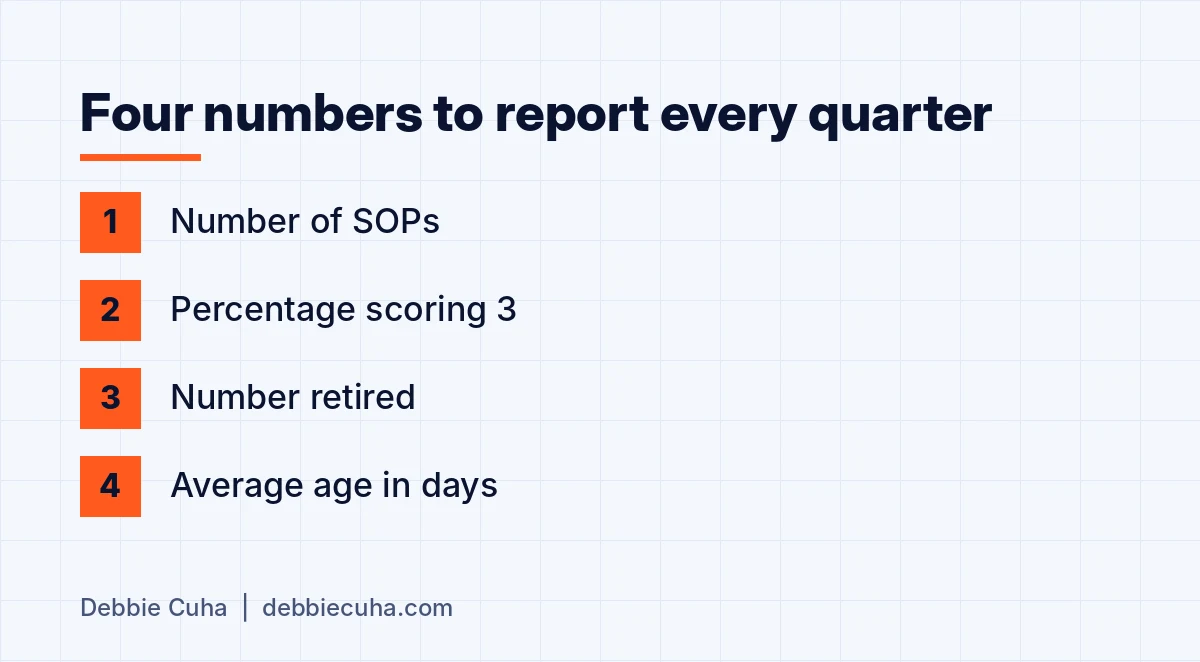
- Report four numbers every quarter: count, percentage scoring 3, number retired, average age.
I wrote the SOPs behind 280 offices at DirectLender.com. A procedure nobody checks is a procedure nobody follows, at any size.
How do you know an SOP is dead?
An SOP is dead when the document and the work no longer match and nobody has noticed. Four signs tell you before a client does.
- The person doing the job cannot tell you where it is.
- It names a tool or a person that is gone.
- The newest team member does the task differently from the document, and their way is better.
- Nobody has opened it since it was written.
How often should you review your SOPs?
Once a quarter for the whole library, in one sitting, plus a same-week edit whenever a trigger hits. Most guides set a different schedule for each type of procedure. On a small team that becomes a calendar nobody keeps. One date, four times a year, gets kept.
What should trigger an update between audits?
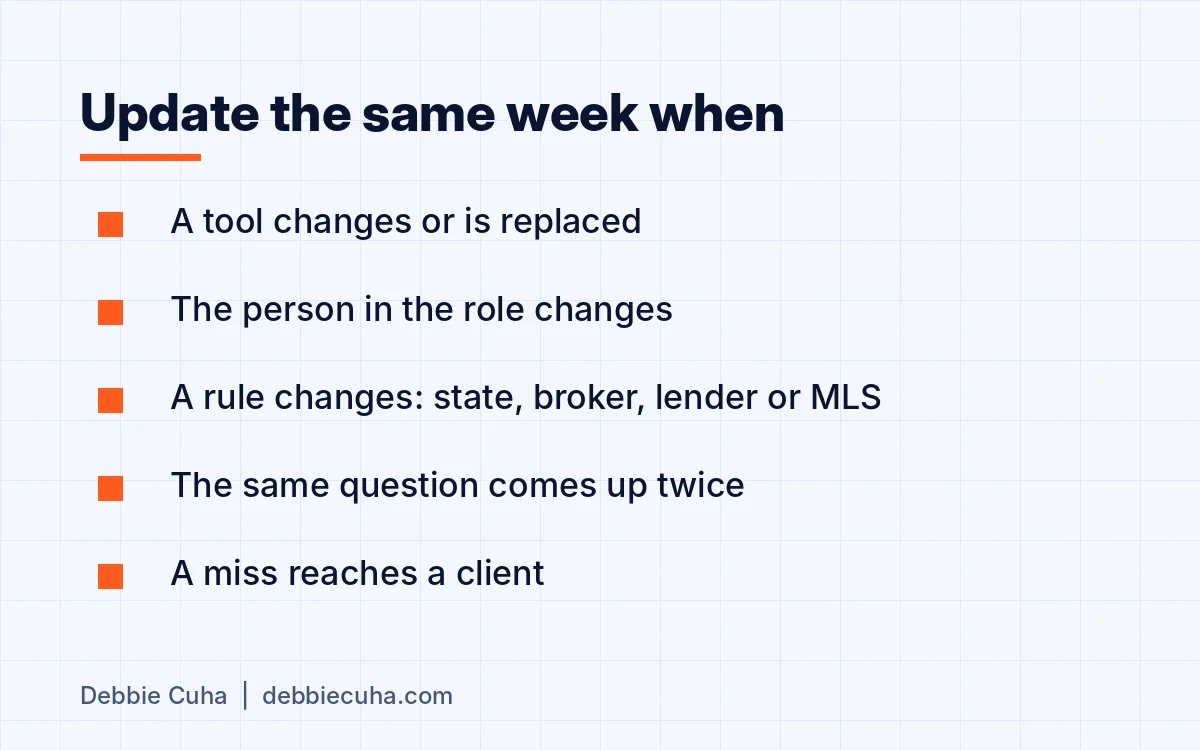
Five events should send the owner back to the page the same week, without waiting for the audit.
- A tool changes or is replaced.
- The person in the role changes.
- A rule changes: state, broker, lender or MLS.
- The same question comes up twice.
- A miss reaches a client.
How do you run the audit in 90 minutes?
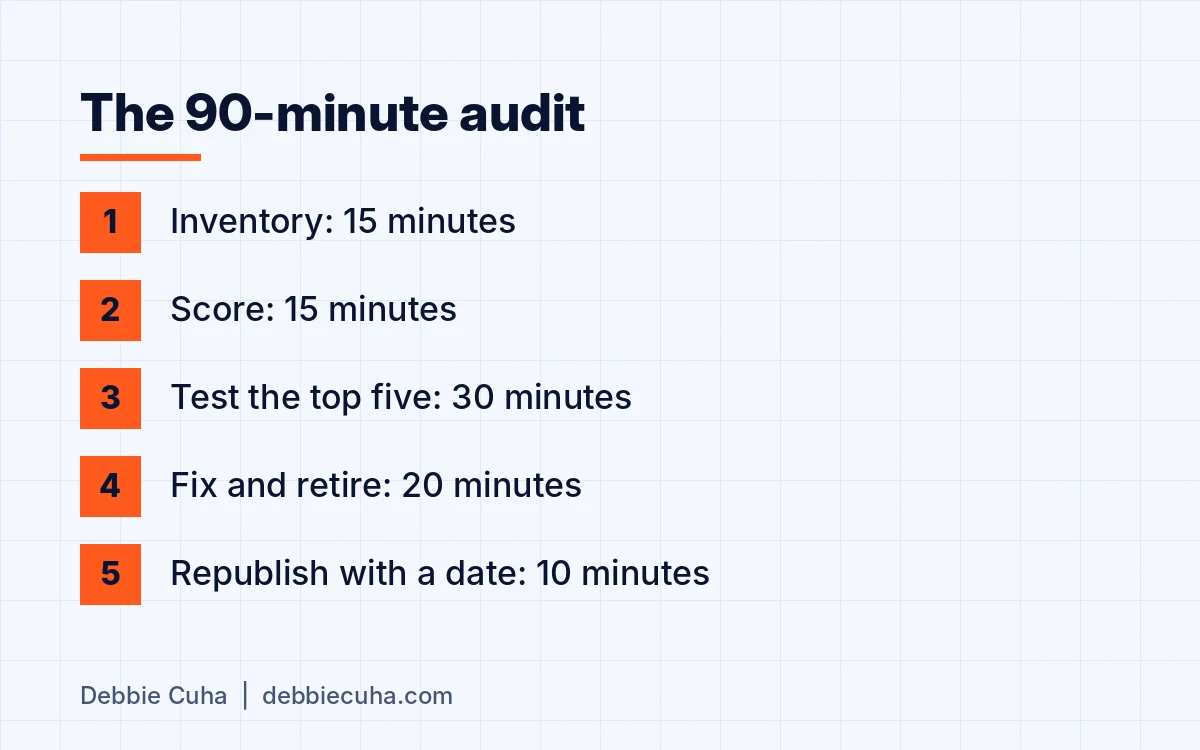
Five steps on a clock: inventory for 15 minutes, score for 15, test the top five for 30, fix and retire for 20, republish for 10. The clock matters. An audit with no end time turns into a rewrite and never gets scheduled again.
Start with the inventory. List every SOP on one sheet. Copy this one.
| SOP name | Owner | Last updated | Where it lives | Owner score | Doer score | Action | Due |
|---|---|---|---|---|---|---|---|
| Listing launch | Name | Date | Link | 0 to 3 | 0 to 3 | Keep, edit, rewrite or retire | Date |
How do you score an SOP?
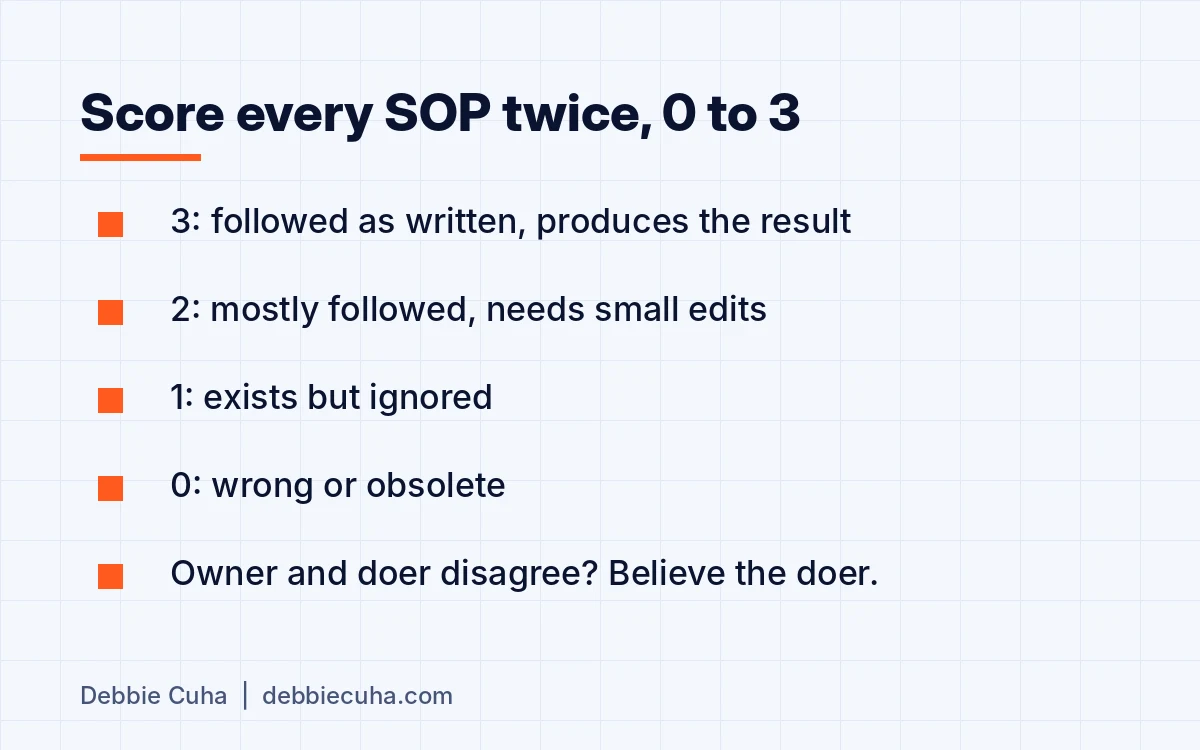
Give each SOP a score from 0 to 3, twice. The owner scores it first. Then the person who does the task scores it without seeing the owner's number. If the two differ, believe the second one.
| Score | Meaning | What happens next |
|---|---|---|
| 3 | Followed as written and produces the result | Keep. New review date. |
| 2 | Mostly followed, needs small edits | Owner edits this week. |
| 1 | Exists but ignored | Find out why before you touch the page. |
| 0 | Wrong or obsolete | Rewrite or retire. |
How do you test an SOP?
Hand it to someone who does not normally do the task and watch them follow it, without helping. Every question they ask is a missing step. Write the questions down. They are the edit list.
Do this for five SOPs, the ones that touch money or clients. Five is what fits in 30 minutes. It is the same test I use in how to write an SOP your newest agent can follow.
What do you do with an SOP that scores 1?
Find out why it is ignored before you rewrite a word. A 1 is rarely a writing problem. The page is too long, or nobody was trained on it, or nobody checks. The usual reasons are in why teams ignore their SOPs.
When should you retire an SOP?
Retire it when the task no longer exists, when another SOP covers it, or when it has scored 0 or 1 two audits in a row and nothing broke.
Move it to an archive folder and take it off the list. A short accurate library beats a long wrong one.
How do you handle versions?
One live version, with the date at the top. If there are two versions, there are zero versions. Pick one and archive the other. No version numbers, no "final v3." The date is the version.
How do you tell the team what changed?
Send one message listing what changed, then spend two minutes on it in the next team meeting. Put a new date at the top of every edited SOP. If the change affects a client or a deadline, say so in the first line of the message.
Who owns the audit?
One person, by name. On a small team that is the team leader or the operations manager. Put all four dates on the calendar for the year now. The owner runs the clock. Each SOP's own owner makes the edits.
What should you measure?
Four numbers, reported once a quarter beside your regular weekly numbers.
- Number of SOPs
- Percentage scoring 3 on the doer's score
- Number retired
- Average age in days since the last update
If the percentage scoring 3 goes up every quarter, operations are getting better whether or not anyone feels it yet.
What if you have no SOPs to audit?
Then you have a short audit, and the first job is to write five procedures down.
Tom Ferry's article on process improvement makes the point that improving a process begins with writing it down, because you cannot see what to fix until it is on paper. Start with the free 12-SOP kit, put your name on five of them, and schedule the first audit 90 days from today. The full list of what a team needs is in the SOPs every real estate team needs.
Next steps
- Get the free 12-SOP kit and put your name on the first five.
- See how SOP consulting works if you want these built for your team.
- Or email me a question at dc@syngp.com. I read every one.