Listing Appointment Prep: The Checklist to Run the Day Before
By Debbie Cuha, November 2, 2026. 7 min read
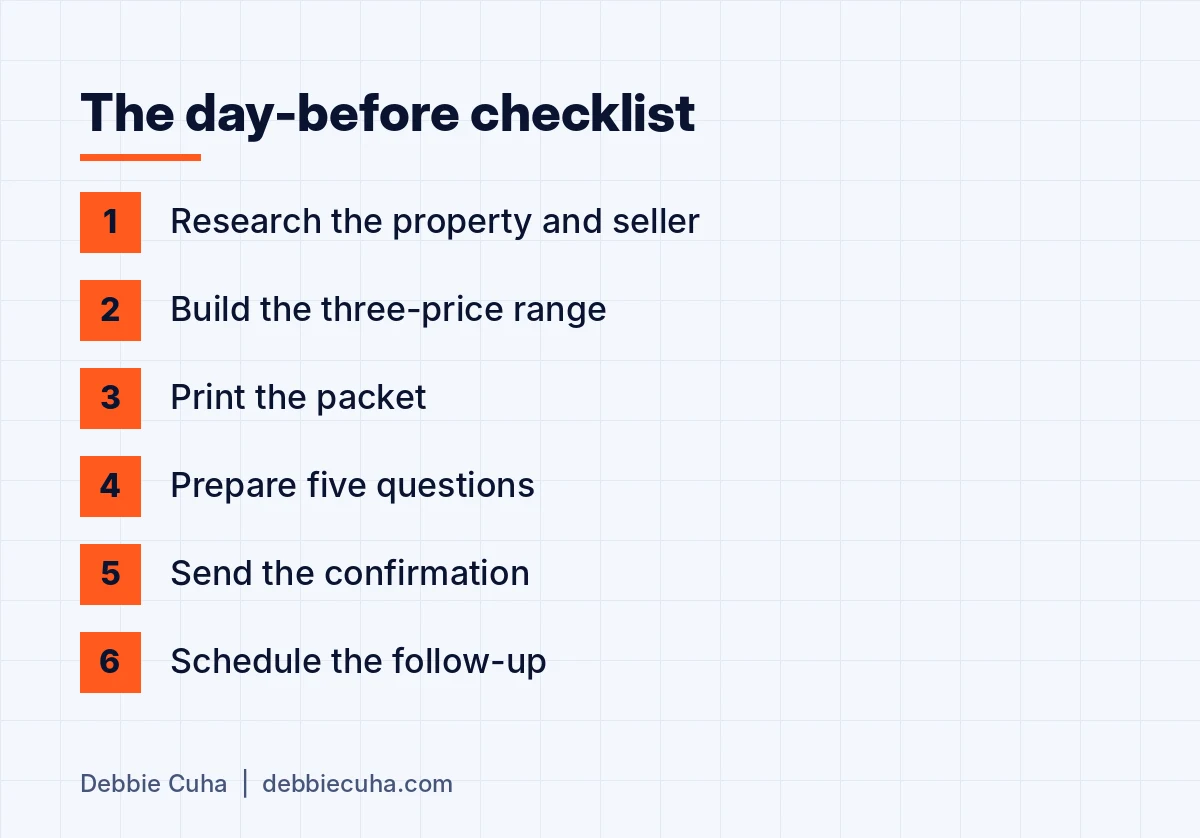
Listing appointments are won the day before. Preparation takes about 90 minutes and covers five things: research on the property and the seller, a price range you can defend, a packet, five questions, and a follow-up that is already on the calendar. Walk in with those and the appointment is a conversation instead of a pitch.
Key takeaways
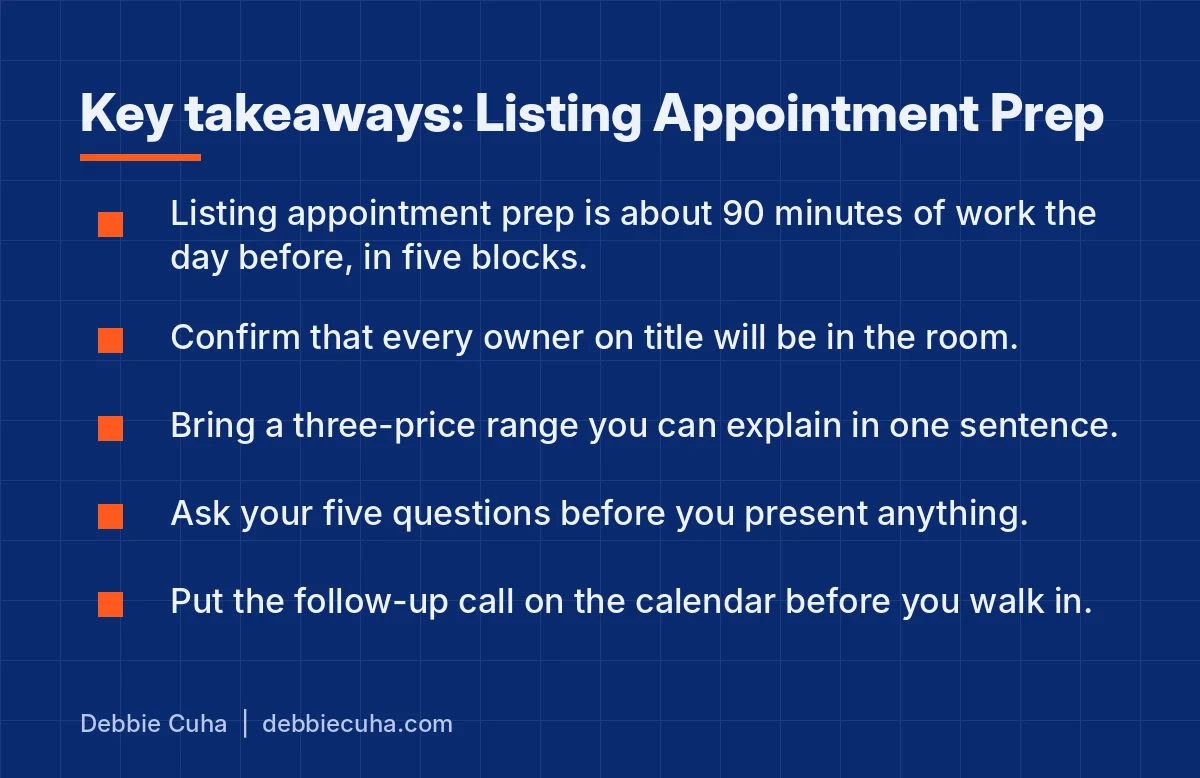
- Listing appointment prep is about 90 minutes of work the day before, in five blocks.
- Confirm that every owner on title will be in the room.
- Bring a three-price range you can explain in one sentence.
- Ask your five questions before you present anything.
- Put the follow-up call on the calendar before you walk in.
I wrote the policies and SOPs for the 280 offices of DirectLender.com. This checklist follows the listing appointment SOP in my free 12-SOP kit, and it is one of the procedures in my guide to real estate SOPs.
How long does listing appointment prep take?
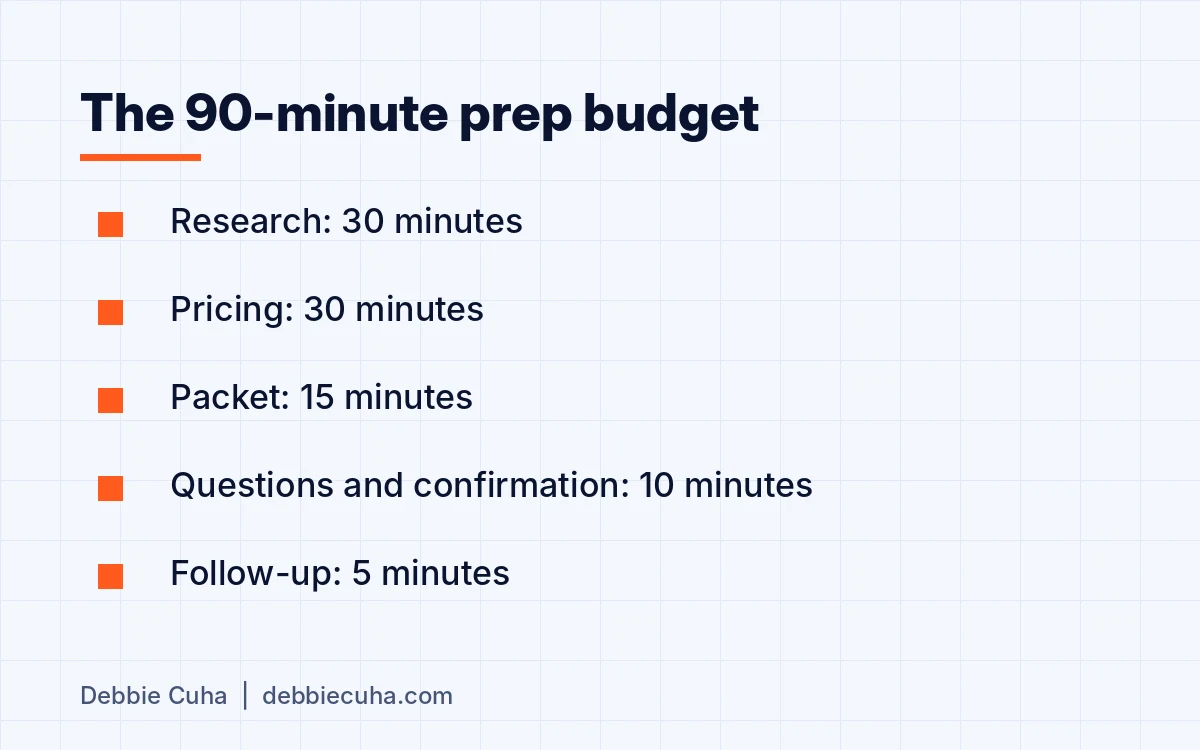
About 90 minutes, split into five blocks. Each block has a test that tells you it is finished, so you stop when the work is done and not when you run out of evening.
| Block | Minutes | Done when |
|---|---|---|
| Research | 30 | You can name the owners, the purchase date and the two closest competing listings |
| Pricing | 30 | Three prices are written down with one sentence that explains them |
| Packet | 15 | Everything is printed or loaded, and the agreement is filled in except price and dates |
| Questions and confirmation | 10 | The five questions are on one page and the confirmation is sent |
| Follow-up | 5 | The thank-you note is written and the follow-up call is on the calendar |
What do you research before a listing appointment?
The property, the seller and the competition. You are looking for anything that would embarrass you if the seller mentioned it first.
- Tax record: owner names, purchase date, purchase price, and loan information if it is public.
- Prior listing history and photos.
- Permits pulled, if your county posts them.
- A drive by the property and the two closest competing listings. Note condition and the street.
- Your CRM, for every past contact with the seller.
How do you build a price range you can defend?
Pull closed, active and pending sales, then write three prices: likely, aggressive and fast-sale. Add one sentence that explains the range. If you cannot explain it in a sentence, you are not ready to present it.
- Three to five closed sales from the last 90 days.
- Every active competitor, because that is who the buyer compares against.
- Pending sales, with a call to each listing agent if possible.
- Expired listings, because they show the price the market refused.
| Price | What it means | When a seller picks it |
|---|---|---|
| Likely | Where the closed sales say it sells | The default |
| Aggressive | The top of what the actives support | Time is not a problem and they accept the risk of a reduction |
| Fast-sale | Under the nearest competitor | The move date matters more than the last dollar |
You will hear advice to leave the comparable sales at home so the seller does not get defensive. I bring them, and I show them after the questions. A range with no evidence behind it is an opinion.
What goes in the listing appointment packet?
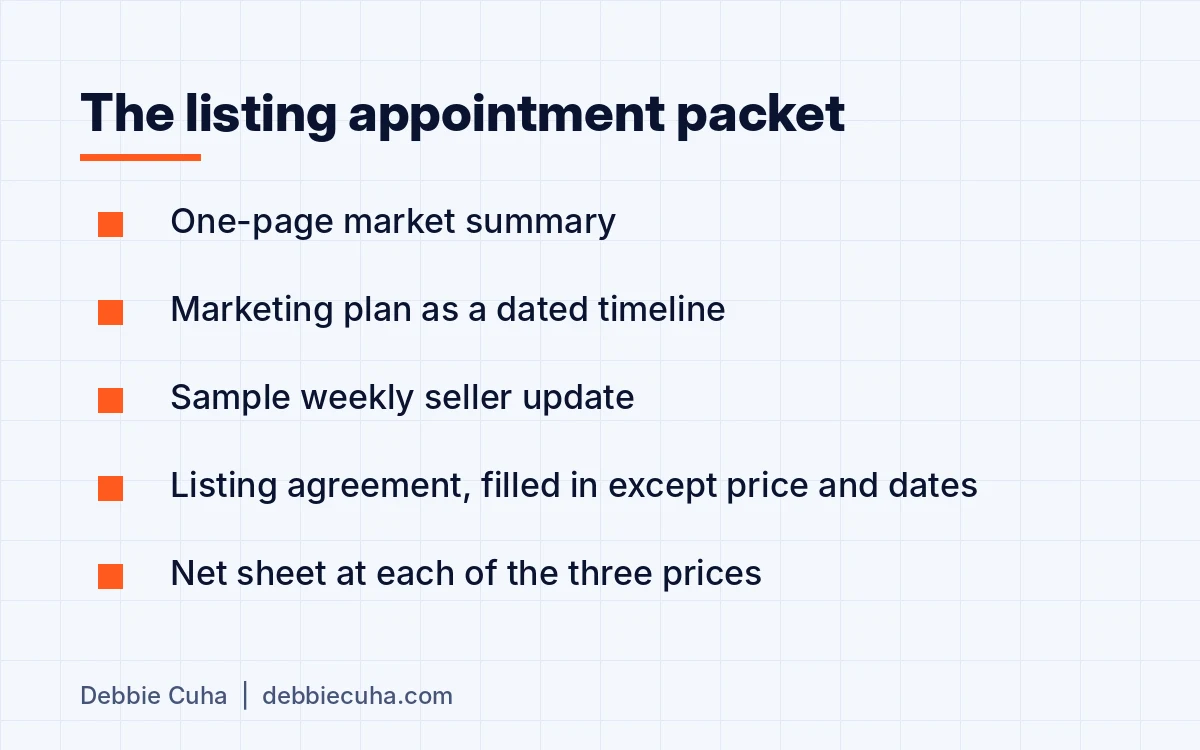
Five things, and nothing that is only about you.
- A one-page market summary.
- Your marketing plan as a dated timeline, which should match the listing launch SOP.
- A sample weekly seller update.
- The listing agreement, filled in except for price and dates, with your broker-approved disclosure forms.
- A net sheet at each of the three prices, so the seller can see the bottom line.
Should you send anything before the appointment?
Yes. Send a short confirmation with what you will cover and two or three things to have ready: the loan payoff, a list of updates, a spare key. My kit's standard is that the pre-listing packet reaches the seller at least 24 hours ahead.
Tom Ferry's listing appointment checklist (August 20, 2026) describes the pre-listing packet as a short document sent before the meeting, with the detailed pricing saved for the appointment itself. I agree with that split. The packet earns the meeting. The range gets explained in person.
Who needs to be at the appointment?
Every owner on title. Confirm it when you book and again in the confirmation. A decision-maker who is missing means the best outcome you can reach is "we will talk about it."
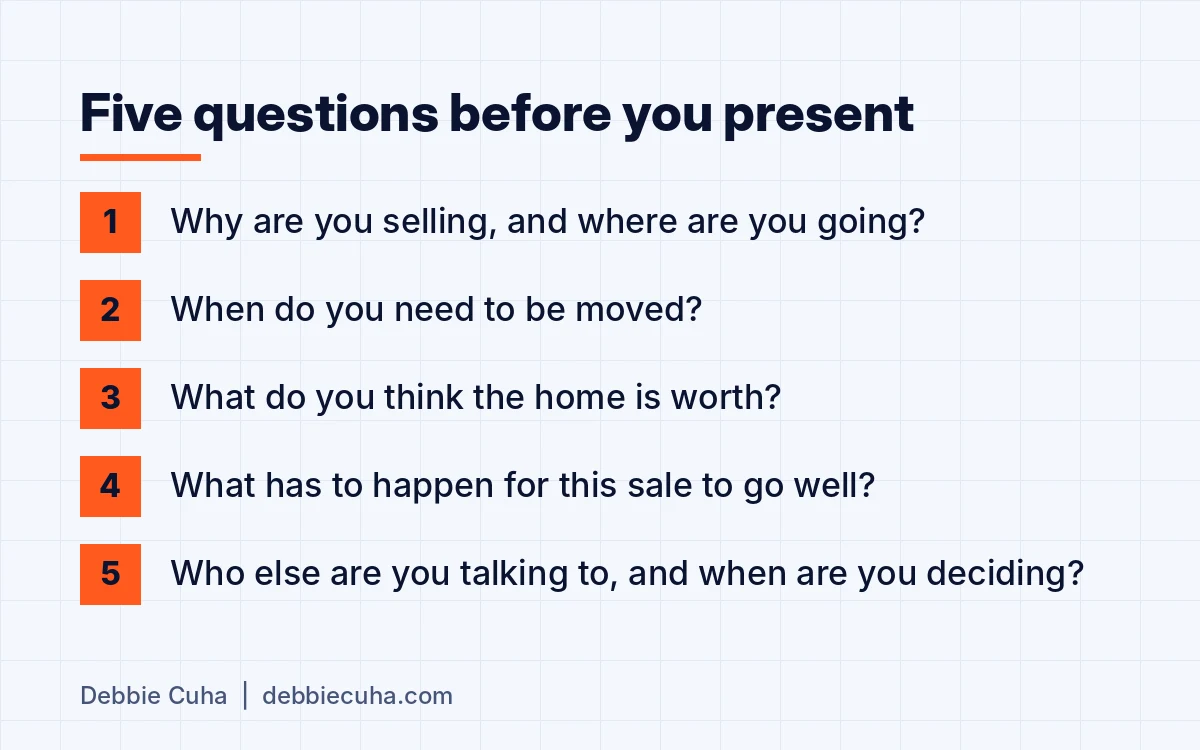
What questions do you ask the seller?
Five, and you ask them before you present anything.
- Why are you selling, and where are you going?
- When do you need to be moved?
- What do you think the home is worth, and how did you get there?
- What has to happen for you to feel this sale went well?
- Who else are you talking to, and when are you deciding?
The answers pick the price out of the range. A seller who must move in 45 days and a seller testing the market need different prices from the same comparable sales.
What do you say about your fee?
Say it plainly, in the order the kit uses: seller goals, pricing data, marketing plan, preparation timeline, then the fee. The fee is negotiable, and you say so. Then you ask for a decision.
What do you do after the appointment?
Most of it is done before you go. The note is written and stamped. The follow-up call is on the calendar for the day they said they would decide, which is why question five matters.
- Within two hours: mail the note, send a thank-you text and update the CRM.
- If signed: the file goes to the listing coordinator the same day, complete, per your team standards.
- If not signed: a specific follow-up date and the reason, written in the CRM.
What numbers tell you the prep is working?
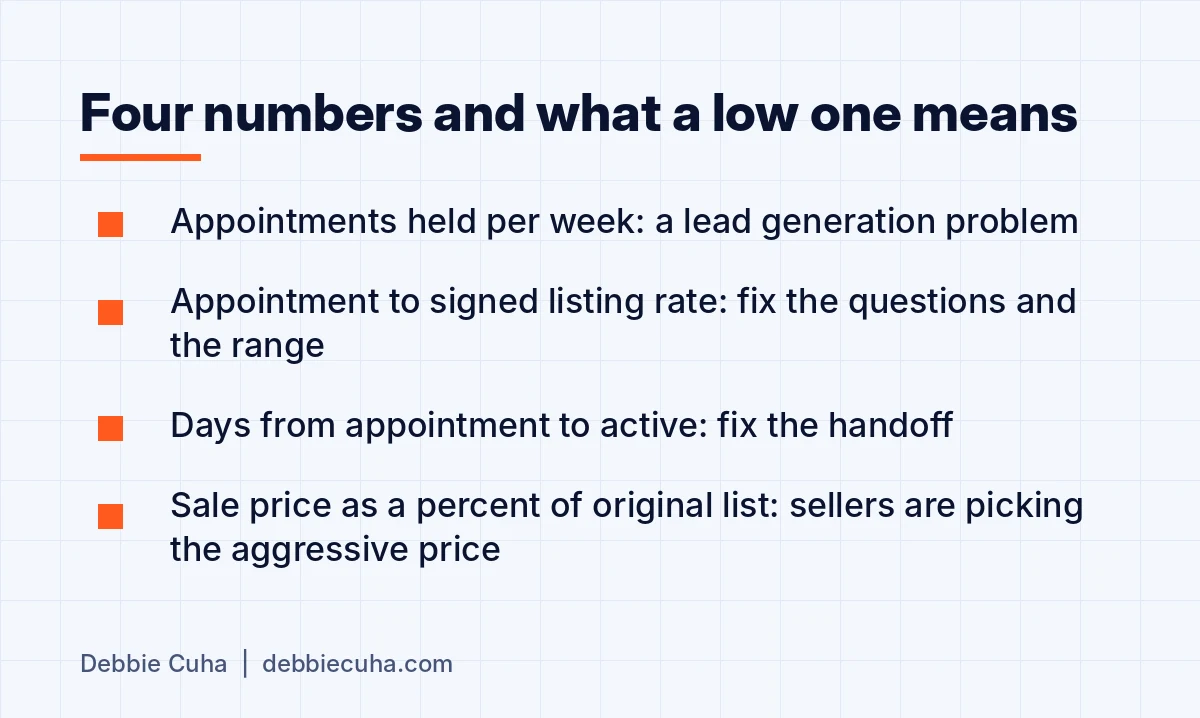
Four, reviewed in your weekly numbers meeting.
| Number | What a low number means |
|---|---|
| Listing appointments held per week | A lead generation problem, not a prep problem |
| Appointment to signed listing rate | Fix the questions and the range |
| Days from appointment to active listing | Fix the handoff to the listing coordinator |
| Final sale price as a percent of original list price | You are letting sellers pick the aggressive price without the evidence |
What are the most common prep mistakes?
Five, and every one is fixed the day before.
- Pricing from an online estimate instead of real comparable sales.
- A decision-maker missing from the appointment.
- No net sheet, so the seller cannot see the bottom line.
- Talking about yourself more than the seller's goals.
- Leaving without a decision or a dated next step.
Does the checklist change with the price of the home?
No. Run it the same way for the $300,000 listing and the $3 million listing. The habit is the point, and the seller of the smaller home deserves the same preparation.
What does the one-page checklist look like?
Copy this and print it.
LISTING APPOINTMENT PREP          Seller: ____________  Date: ______
[ ] Every owner on title confirmed
[ ] Tax record and listing history pulled
[ ] Drive-by done
[ ] Closed, active, pending and expired sales pulled
[ ] Three-price range and a one-sentence reason
[ ] Net sheet at each price
[ ] Packet printed, agreement prepared
[ ] Confirmation sent with what to have ready
[ ] Thank-you note written
[ ] Follow-up call on the calendar
Disclosure rules and listing forms vary by state. Use your broker's forms and ask your broker when a question is legal.
Next steps
- Get the free 12-SOP kit and put your name on the first five.
- See how SOP consulting works if you want these built for your team.
- Or email me a question at dc@syngp.com. I read every one.