Team Standards: The One Document Every Real Estate Team Needs Before SOPs
By Debbie Cuha, October 7, 2026. 7 min read
Team standards are the short list of minimums every person on the team agrees to meet: how fast we respond, how we show up, what we track. SOPs tell people how to do a task. Standards tell them what is not optional. Write the standards first, because an SOP with no standard behind it is a suggestion.
Key takeaways
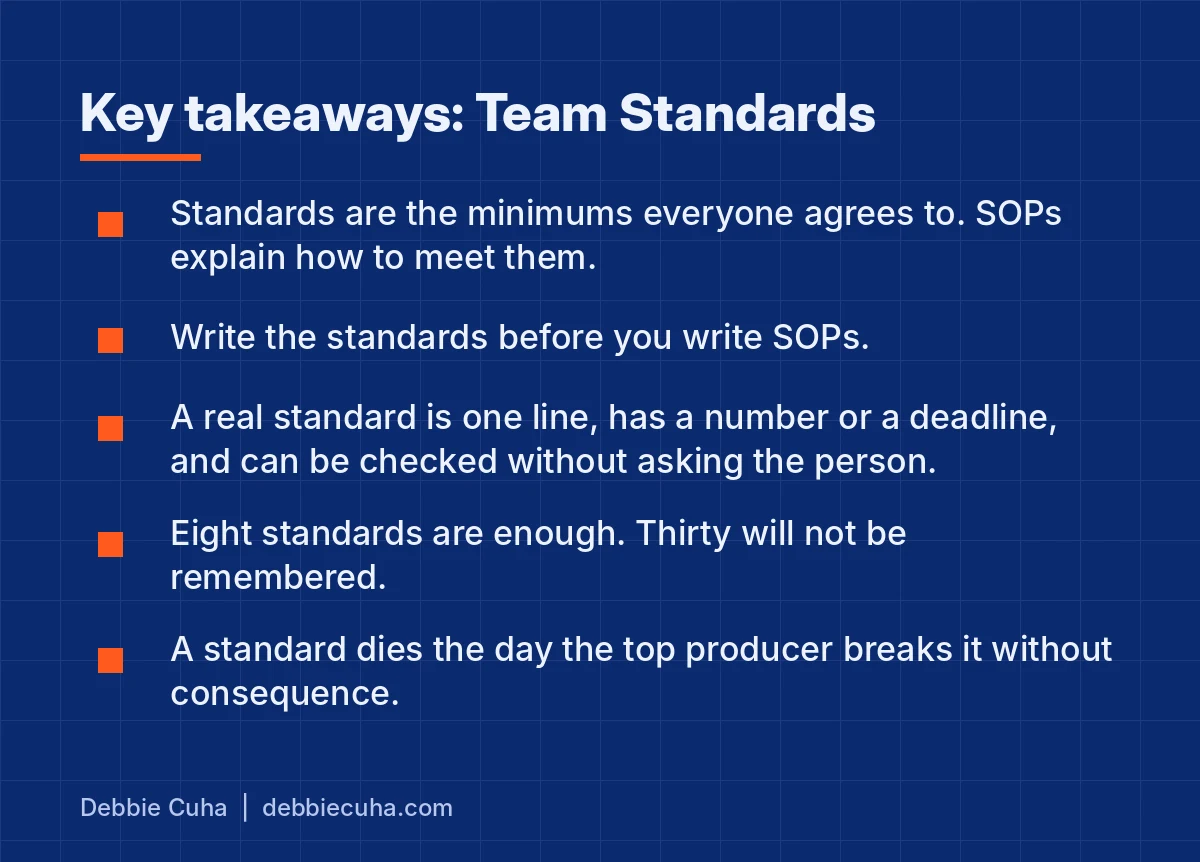
- Standards are the minimums everyone agrees to. SOPs explain how to meet them.
- Write the standards before you write SOPs.
- A real standard is one line, has a number or a deadline, and can be checked without asking the person.
- Eight standards are enough. Thirty will not be remembered.
- A standard dies the day the top producer breaks it without consequence.
I wrote the SOPs behind 280 offices and about 3,000 people at DirectLender.com. At that size the line has to be clear enough to read the same in every office, because the person who wrote it is not in the room.
What is the difference between a standard and an SOP?
A standard is a line. An SOP is the procedure that makes the line reachable. "Every new lead gets a call within five minutes" is a standard.
Who gets the alert, what they say and what happens if they miss it is the SOP. I laid out that exact one in the speed-to-lead SOP.
You can run a small team on standards alone for a while. You cannot run any team on SOPs without standards.
Why write the standards before the SOPs?
Because the standard tells you which SOPs are worth writing. Most guides start with a list of procedures to document. I start one step earlier. If no standard needs a procedure, the procedure is paperwork, and it becomes one of the reasons teams ignore their SOPs.
Each standard below points at the SOP that supports it. That is your writing order.
What standards should a real estate team have?
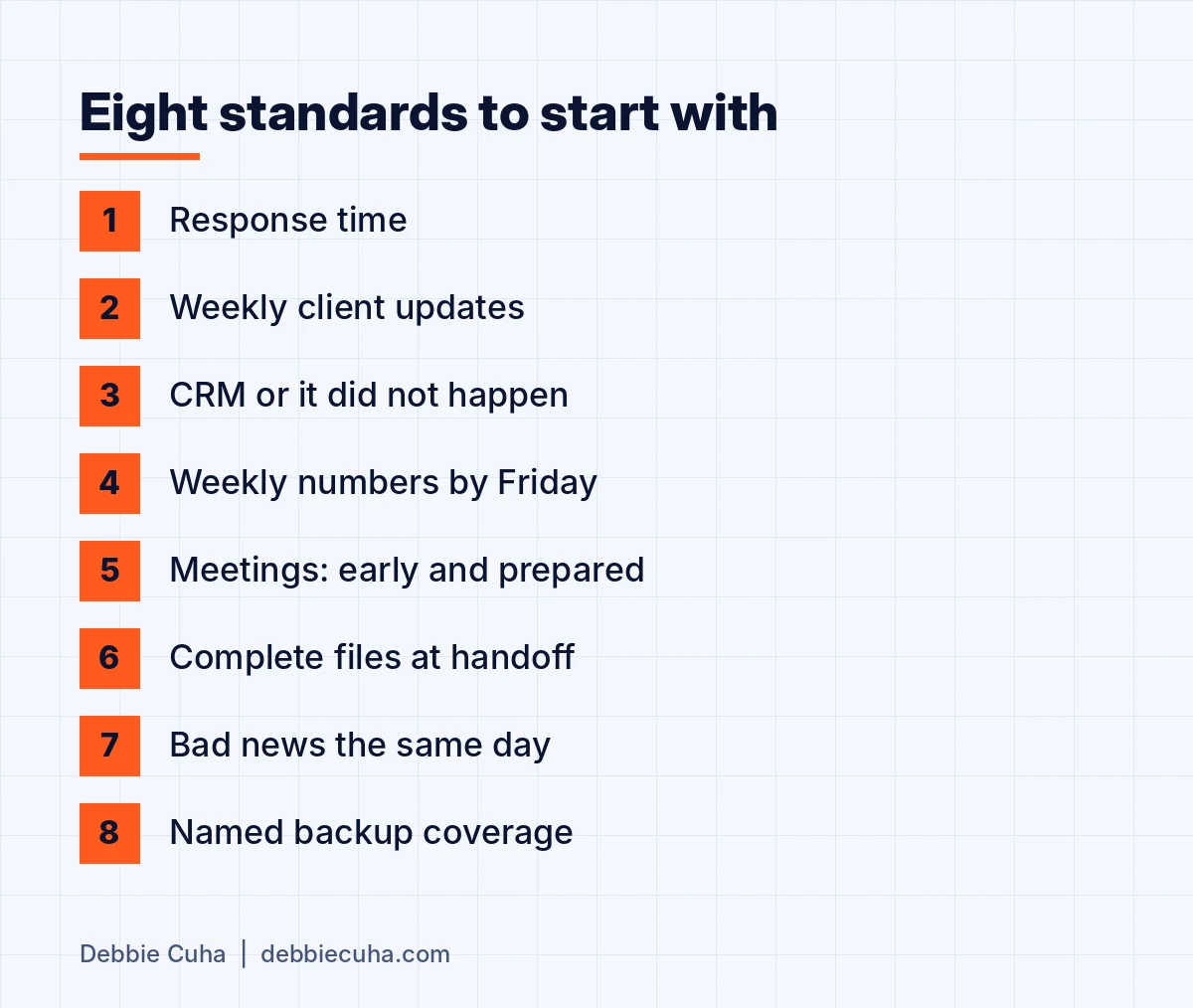
Eight, covering response, communication, records and coverage. These are the ones I start with. Change the numbers to fit your team and keep the checks.
| # | Standard | The line | How it is checked | SOP behind it |
|---|---|---|---|---|
| 1 | Response time | New leads called within five minutes during business hours | CRM timestamp | Speed to lead |
| 2 | Client updates | Every active client hears from us every week, even with no news | Weekly update log | Transaction coordination |
| 3 | CRM | If it is not in the CRM, it did not happen | Spot check of five records a week | Lead intake |
| 4 | Weekly numbers | Entered by Friday 5 pm by the person who owns them | The tracker is full or it is not | Weekly numbers meeting |
| 5 | Meetings | On time means five minutes early, prepared, numbers in hand | Attendance at the start time | Meeting agenda |
| 6 | Files | Complete at handoff. The next person never chases a document | Handoff checklist | Listing launch |
| 7 | Communication | Bad news goes up the same day | Date of the problem against date reported | Escalation |
| 8 | Coverage | Nobody goes dark. Every file has a named backup when you are out | Backup name on the calendar | Time off |
How do you write a standard that can be checked?
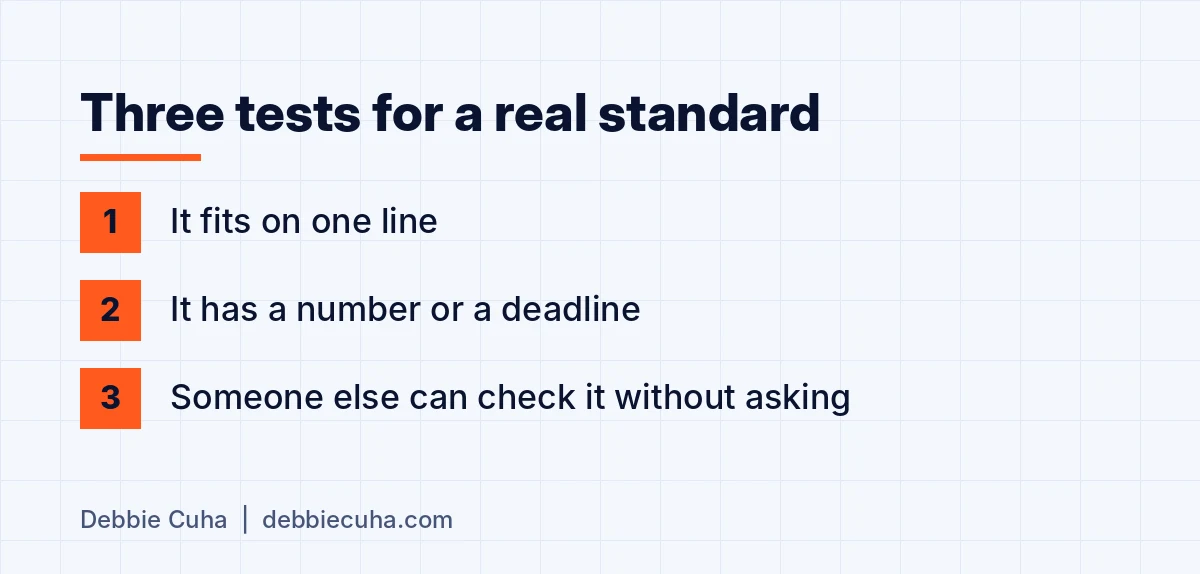
Put it through three tests. If it fails one, rewrite it.
- One line. If it needs a paragraph, it is an SOP.
- A number or a deadline. "Respond quickly" is a wish. "Within five minutes" is a standard.
- Checkable without asking. Someone other than the agent can see whether it was met.
How are standards different from core values?
Values are what you believe. Standards are what you can check. "We put clients first" is a value. "Every active client hears from us every week" is the standard that proves it. A team with values and no standards has a poster.
Should production minimums be on the list?
One line, if you want it, and not first. Most advice on team standards starts with a production minimum. I start with behavior, because every person on the team, staff included, can meet a behavior standard on day one. Nobody controls a closing date.
If you add a production line, measure it over a quarter and write the consequence next to it. The weekly activity side belongs in the accountability agreement.
How many standards should a team have?
Eight is plenty. If your list has 30 items, nobody will remember 22 of them, and the ones they forget will be the ones you care about. When you want to add a ninth, decide which one it replaces.
How do you roll standards out?
Out loud, with the team in the room, and never by email. Standards that arrive in an email are dead by Thursday.
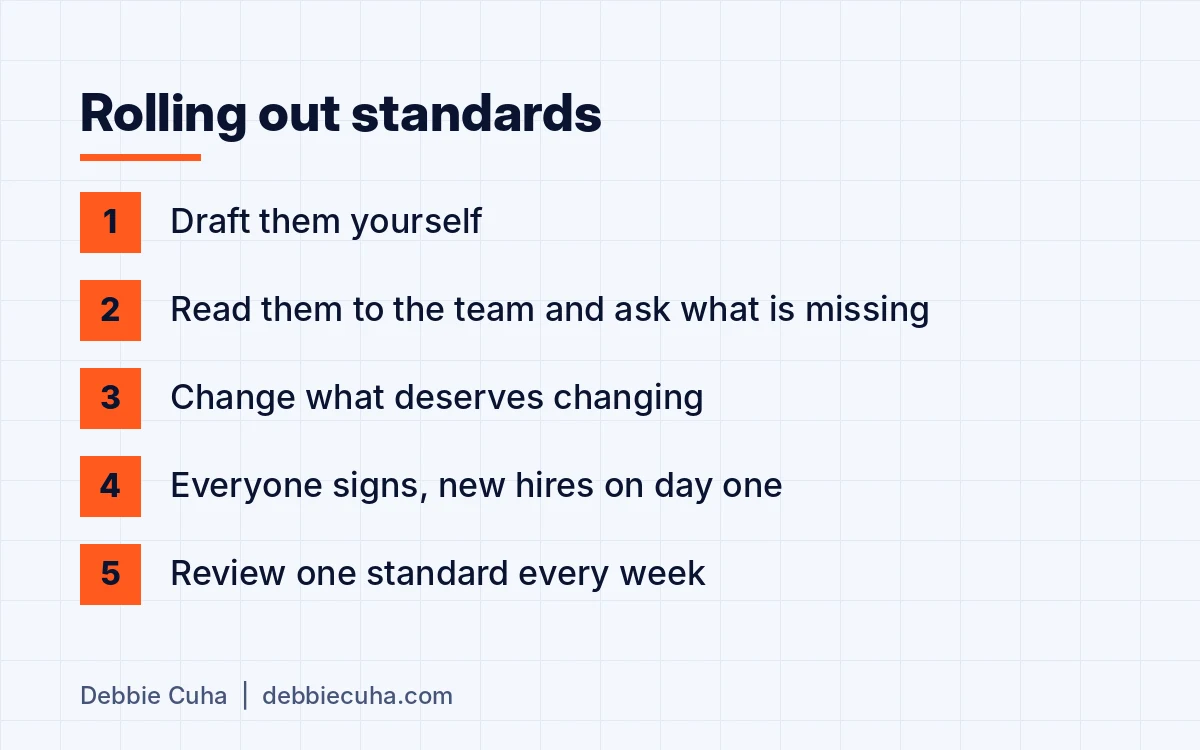
- Draft them yourself, then read them to the team and ask what is missing or unrealistic.
- Change what deserves changing. People keep standards they helped write.
- Everyone signs the page. New hires sign it on day one, as part of onboarding.
- Review one standard at the start of every weekly meeting.
How do you add standards to a team that never had them?
Give it 30 days of notice and start everyone on the same date. Read the draft, take the edits, publish the final page with a start date, and track for two weeks before any consequence applies.
Agents who were there first get the same page as the new hire. A separate deal for veterans is how the page dies.
Do the standards apply to the team leader and the top producer?
Yes, and they are the two people the team watches. Sign the page first. If you walk into the meeting late, say so before anyone else does. The standard holds until the biggest producer ignores it and nothing happens.
From that day on, the team knows the document is decoration.
What happens when someone breaks a standard?
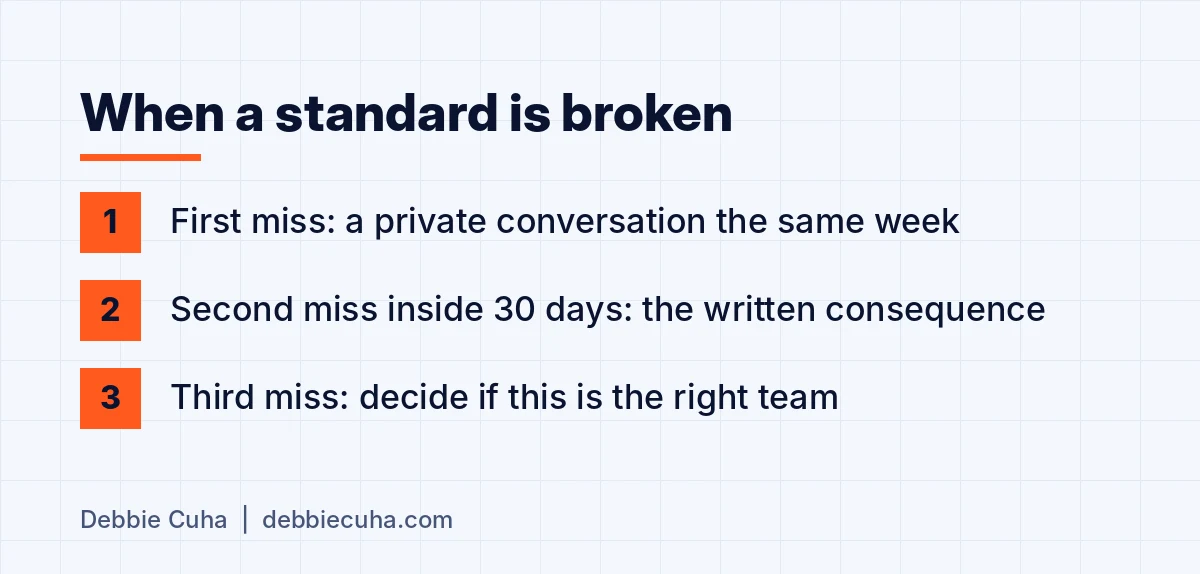
The same thing every time, for everyone. The first time it is a conversation. The second time it is the consequence you wrote down in advance.
| Miss | What happens |
|---|---|
| First | A private conversation the same week. Name the standard and the date. |
| Second, inside 30 days | The written consequence. For example, team-provided leads pause for a week. |
| Third | A decision about whether this is the right team for them. |
How often should the standards change?
Review the page once a quarter and change it rarely. Ask three things: is every standard still being checked, did any get broken without a response, and is one of them now too easy.
Change the page in the open, with a date on it, and have everyone sign again.
What does the one-page standards document look like?
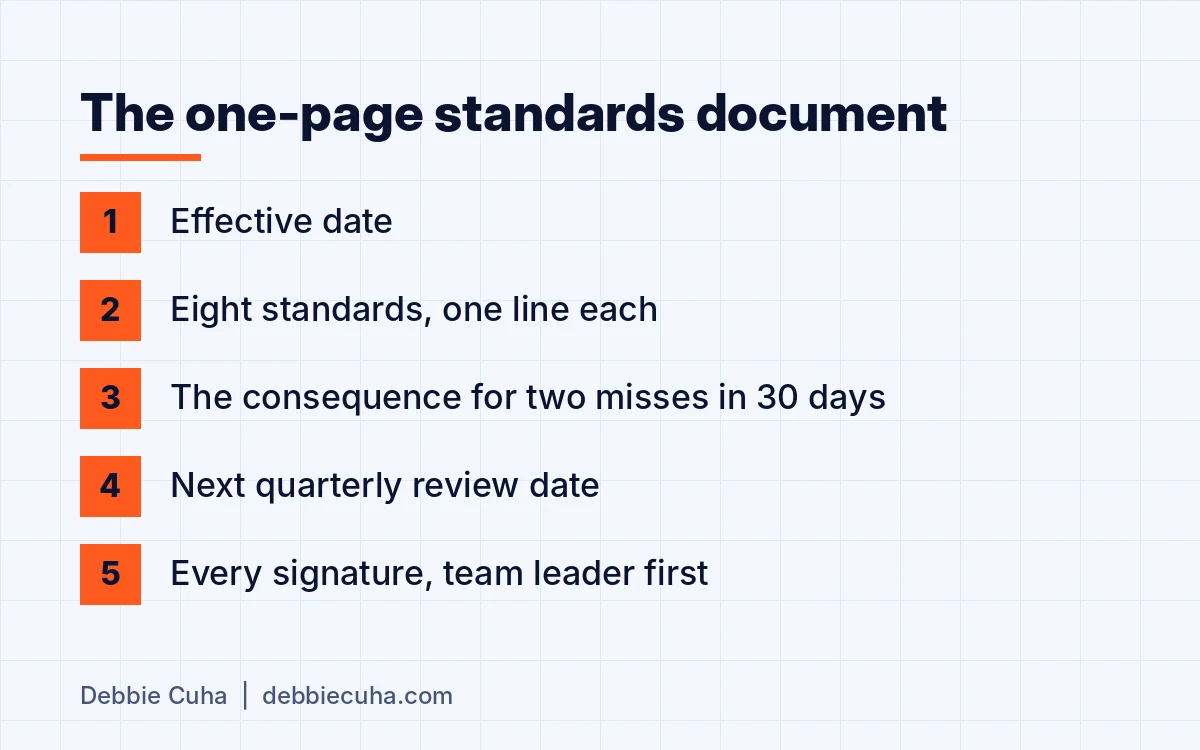
A title, eight lines, a consequence and signatures. Copy this.
- Our team standards, effective: ______
- Standards 1 to 8, one line each
- If a standard is missed twice in 30 days: ______
- Reviewed every quarter. Next review: ______
- Signed by every team member and the team leader, with the date
Structure is what creates culture. The standards page is where that structure starts, and the guide to real estate SOPs is where it goes next.
Next steps
- Get the free 12-SOP kit and put your name on the first five.
- See how SOP consulting works if you want these built for your team.
- Or email me a question at dc@syngp.com. I read every one.