Accountability Without Micromanaging: A System for Real Estate Teams
By Debbie Cuha, October 5, 2026. 7 min read
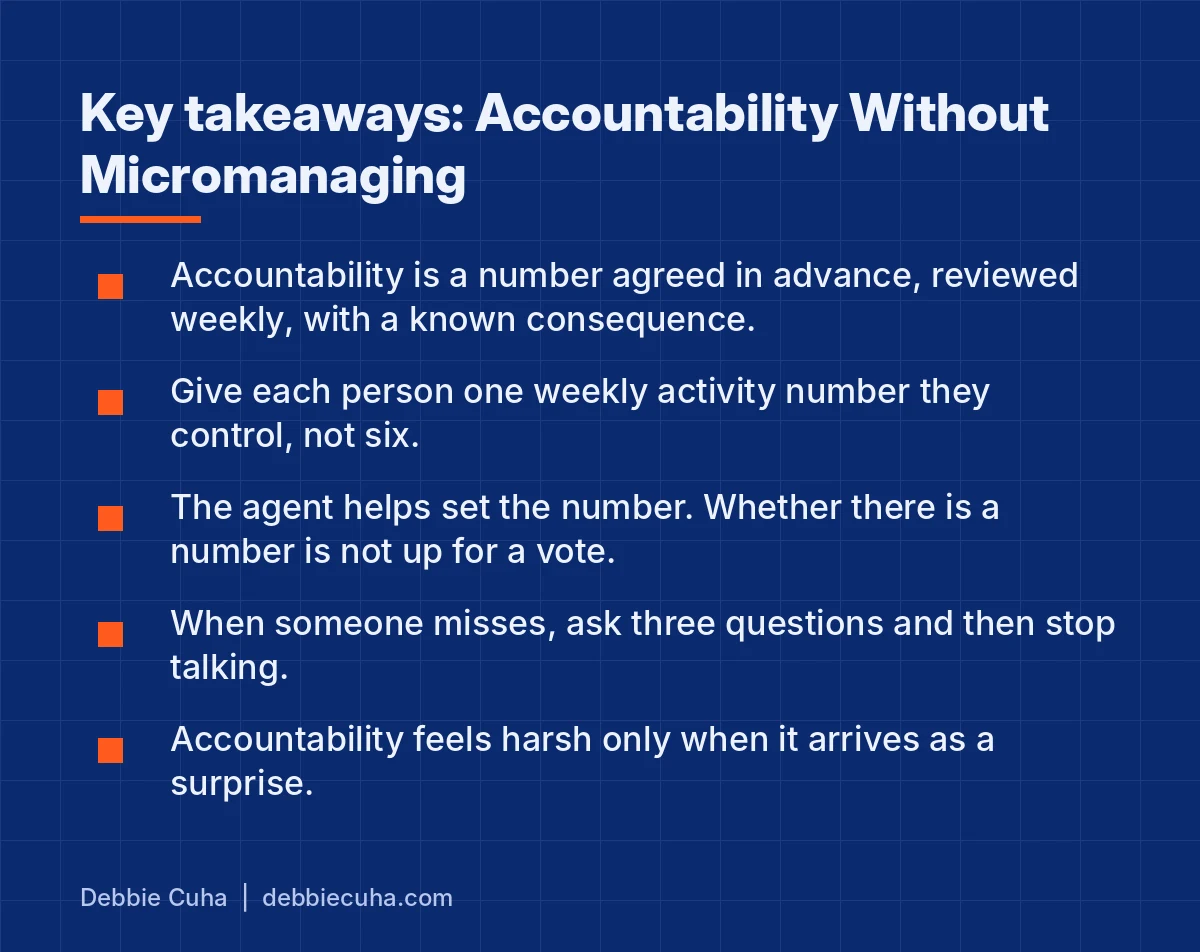
Accountability is not checking up on people. It is a number each person agreed to, reviewed on the same day every week, with a consequence everyone knew about before the week started. If you have those three things you never need to hover. If you are missing one, no amount of hovering will fix it.
Key takeaways
- Accountability is a number agreed in advance, reviewed weekly, with a known consequence.
- Give each person one weekly activity number they control, not six.
- The agent helps set the number. Whether there is a number is not up for a vote.
- When someone misses, ask three questions and then stop talking.
- Accountability feels harsh only when it arrives as a surprise.
I wrote the SOPs for 280 offices and about 3,000 people at DirectLender.com. Nobody can micromanage 3,000 people. The structure had to do the work.
What is the difference between accountability and micromanaging?
Micromanaging is managing how someone does the work, in real time, because you do not trust the result. Accountability is agreeing on the result up front and then looking at it together on a schedule.
Here is the same situation handled both ways.
| Situation | Micromanaging sounds like | Accountability sounds like |
|---|---|---|
| Tuesday, mid-morning | "What are you working on right now?" | Nothing. The review is Monday. |
| The number is behind | "Send me your call list so I can check it." | "You committed to 25 conversations. The tracker says 14. What happened?" |
| A lead went cold | "Copy me on every email from now on." | "Our standard is a call in five minutes. Was it met?" |
| A good week | Silence | "You hit it. That is nine weeks in a row." |
What are the four parts of an accountability system?
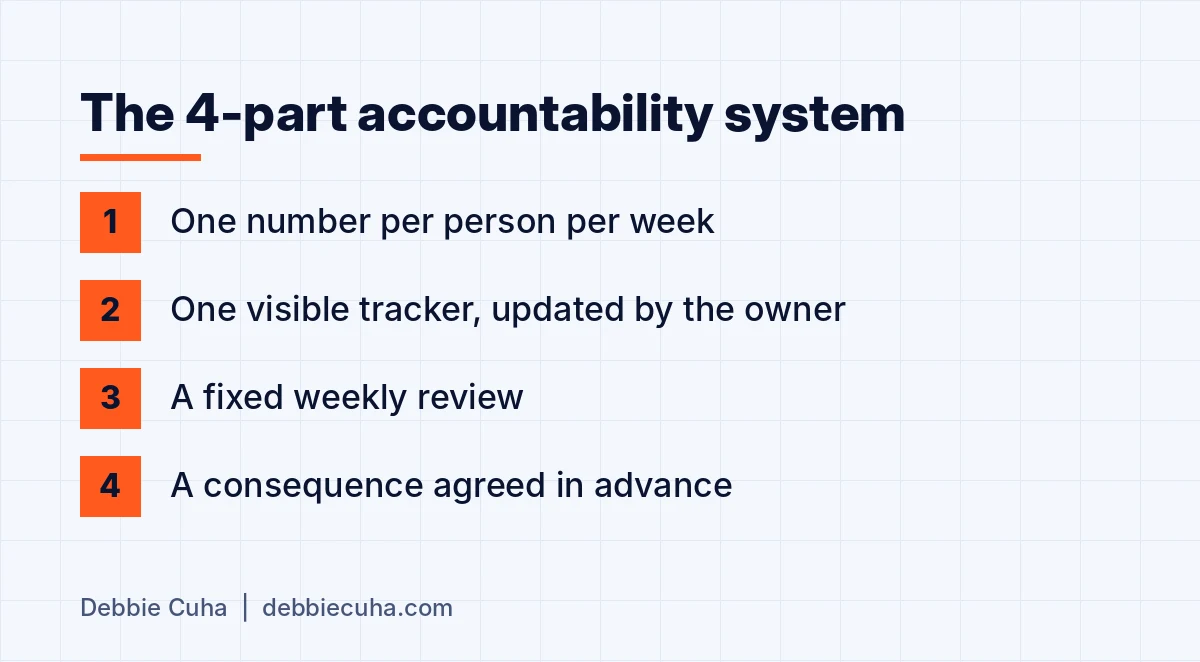
A number, a place the number lives, a fixed review and a consequence agreed in advance. Take one away and the other three stop working.
- One number per person per week. One activity they control.
- One tracker, visible to the team, updated by the person who owns the number.
- A fixed review. Same day, same time, every week. I cover the format in the weekly numbers meeting.
- A consequence agreed in advance, in both directions.
Aaron Cuha's piece on accountability systems lists close to the same bones: someone who challenges your excuses, regular check-ins, a visible scorecard and stakes. His line is that consequences should sting and rewards should pull. I agree with both halves.
Which number should each person be held to?
An activity number the person fully controls: conversations, appointments set, or files submitted. Not closings. A closing is the result of work done weeks ago, and nobody can decide on Monday to have one by Friday.
Results still get tracked. They sit on the agent scorecard next to the activity that produced them. The commitment, the thing a person signs, is the activity.
Why one number and not a full dashboard?
Because a person can keep one promise a week. Common advice is to track a dozen things per agent. Track them in your CRM if you like. But a commitment with twelve parts gets missed in some part every week, and then a miss means nothing.
One number makes the conversation short. Either it was hit or it was not.
How often should you review the numbers?
Weekly, on a fixed day, for a few minutes per person. Monthly is too late to fix anything, and daily turns into hovering. The agent updates the tracker before the review, so the meeting starts with facts instead of a search for them.
What do you say when someone misses?
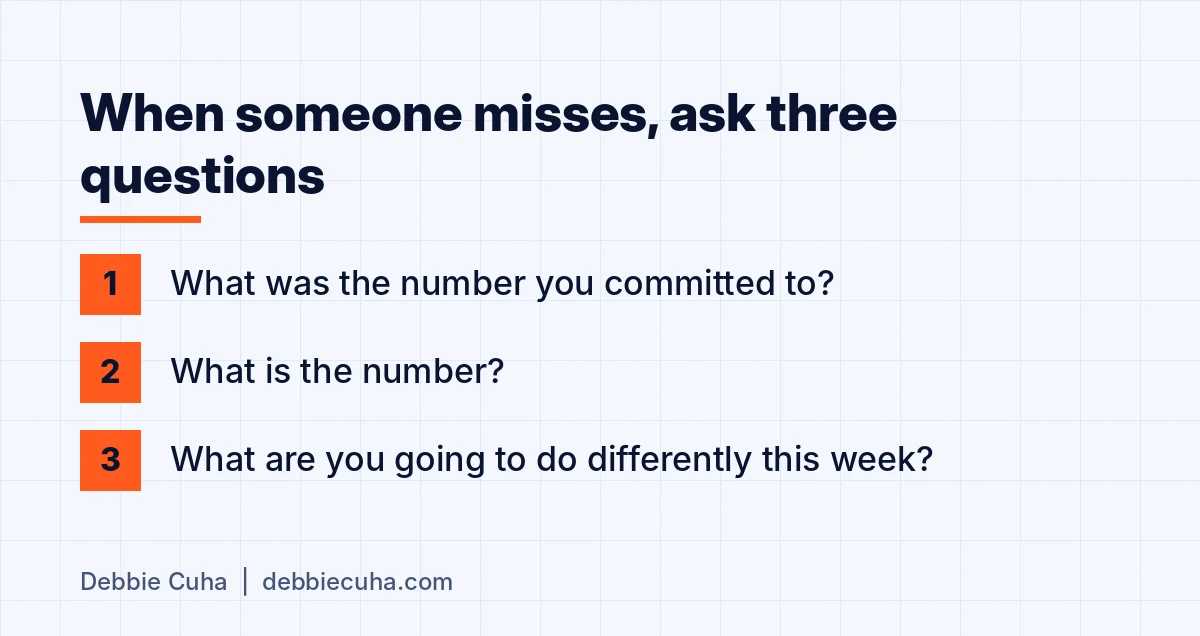
Three questions, in this order, and then stop talking.
- What was the number you committed to?
- What is the number?
- What are you going to do differently this week?
No lecture. The tracker already delivered the message. Your job is to get a new commitment and write it down.
What consequences are fair, and who decides them?
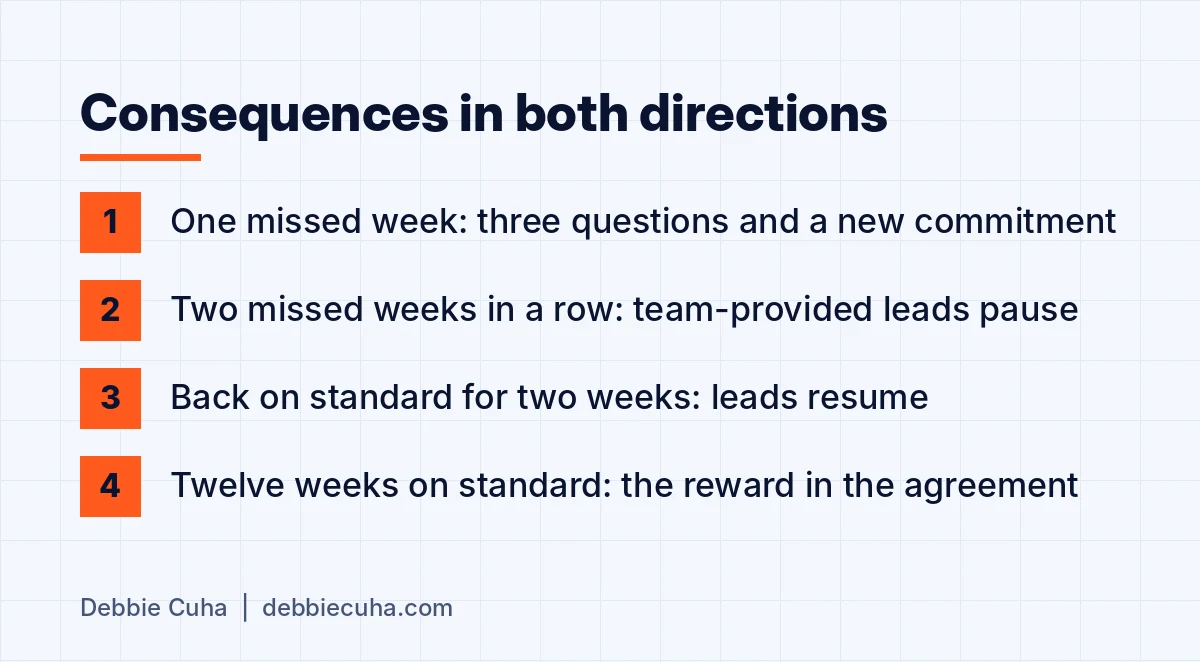
A fair consequence is written before anyone has missed, is the same for everyone, and is tied to something the team provides. You propose it. The team hears it before they sign. Nobody votes on it after a bad month.
| Trigger | What happens | Who acts |
|---|---|---|
| One missed week | The three questions. A new commitment in writing. | Team leader |
| Two missed weeks in a row | Team-provided leads pause until the number is back on standard | Team leader, same day |
| Back on standard for two weeks | Leads resume. No speech. | Team leader |
| Twelve weeks on standard | The reward named in the agreement | Team leader, in front of the team |
Rewards belong on the page too. At DirectLender.com month-end was a war of 17-hour days, and the winners were flown to Cabo the first week of every month. A reward on a fixed calendar is a consequence agreed in advance. It just points the other way. How to design one is in match rewards to effort.
Should accountability be voluntary?
No. Some leaders say it only works when agents opt in. My position is different: the agent has a real say in what the number is, and no say in whether there is one.
If the team is handing out leads, staff time and its name, a weekly number is the price of admission.
How do you hold a top producer accountable?
The same way as everyone else, with a number that fits them. A top producer's number might be listing appointments instead of conversations. What cannot change is the review and the consequence.
The week your best agent is exempt, the agreement becomes decoration. I wrote about that failure in why teams ignore their SOPs.
Can you hold independent contractors accountable?
Yes, to a result they agreed to. What you may require of an independent contractor beyond that is a question for your broker and your attorney, not for me.
As an operator I can tell you what this system does: it tracks an agreed result and ties it to access to things the team provides. It does not dictate hours or methods.
Why does accountability feel harsh on most teams?
Because it shows up as a surprise. The leader ignores the numbers for two months, gets frustrated, and then unloads in a team meeting. That is not accountability. That is a mood.
When the standard is written, the review is weekly and the consequence was agreed on day one, there is nothing personal about it. People who want to perform like it, because they finally know where they stand.
How do you start if your team has never had it?
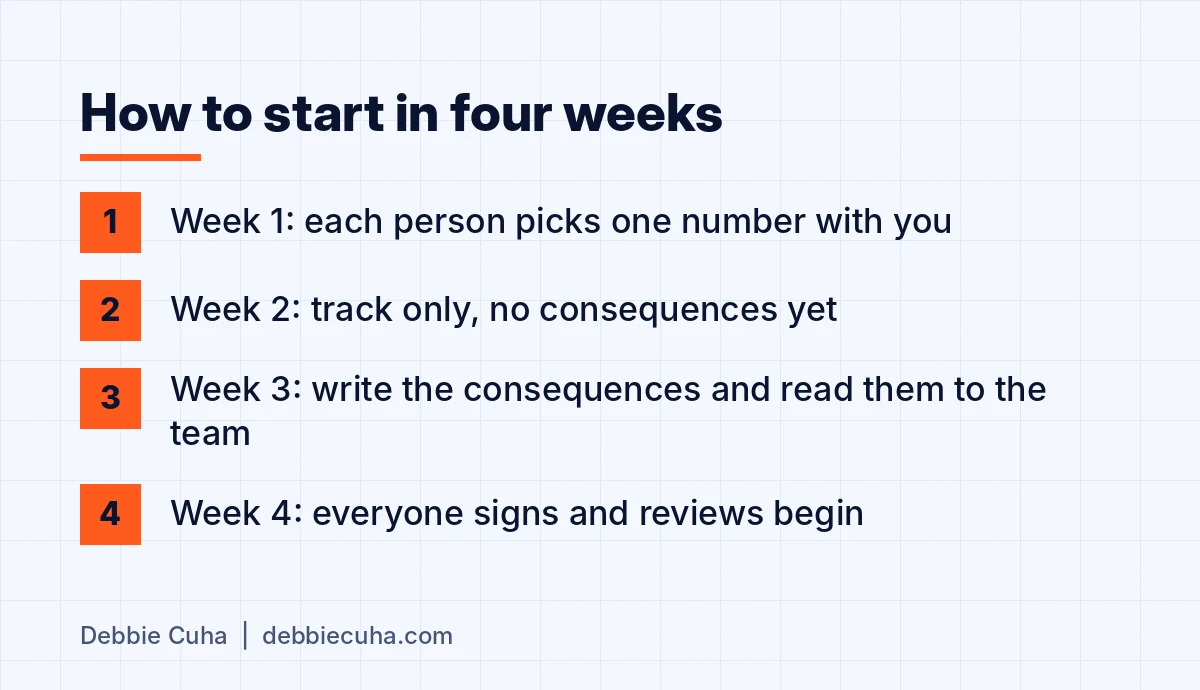
Take four weeks, and do not attach a consequence to anything in the first two.
- Week 1. Each person picks one number with you.
- Week 2. Track only. Find out what normal looks like.
- Week 3. Write the consequences in both directions and read them to the team.
- Week 4. Everyone signs, including you. Reviews begin.
Your own number goes on the same tracker. A leader who skips the review has cancelled it for everyone.
What does the one-page accountability agreement look like?
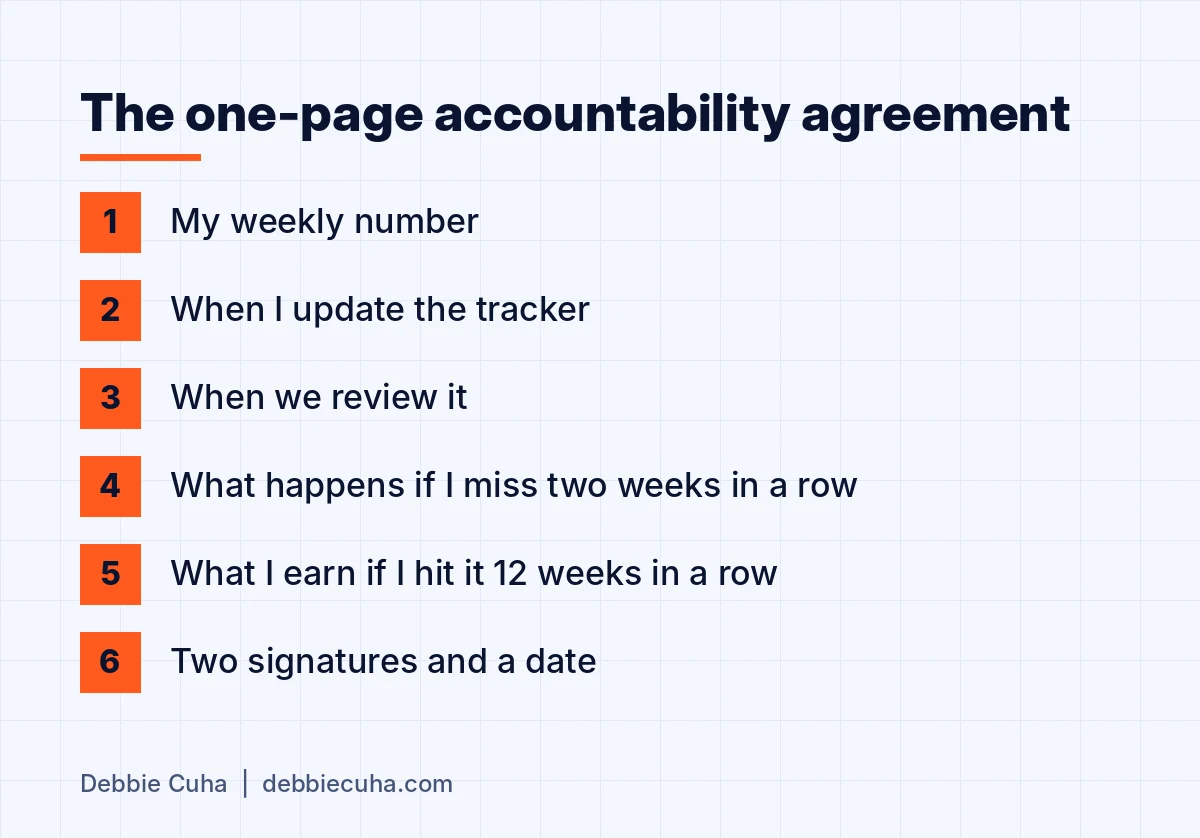
It is five blanks and two signatures. Copy this and have every agent sign it.
- My weekly number is: ______
- I update the tracker by: Friday 5 pm
- We review it: Monday 9 am
- If I miss two weeks in a row: ______
- If I hit it 12 weeks in a row: ______
- Signed by me: ______ Date: ______
- Signed by my team leader: ______ Date: ______
If you have not written the standards behind those numbers yet, start with the team standards document. The procedures that make the standards reachable are in my guide to real estate SOPs.
Next steps
- Get the free 12-SOP kit and put your name on the first five.
- See how SOP consulting works if you want these built for your team.
- Or email me a question at dc@syngp.com. I read every one.