The Agent Scorecard: A One-Page Template for Real Estate Teams
By Debbie Cuha, October 6, 2026. 6 min read
An agent scorecard is one page per agent with five numbers on it: three activities they control and two results those activities produce. You review it weekly in ten minutes. If your scorecard needs a login, a training video and a dashboard, your agents will not use it.
Key takeaways
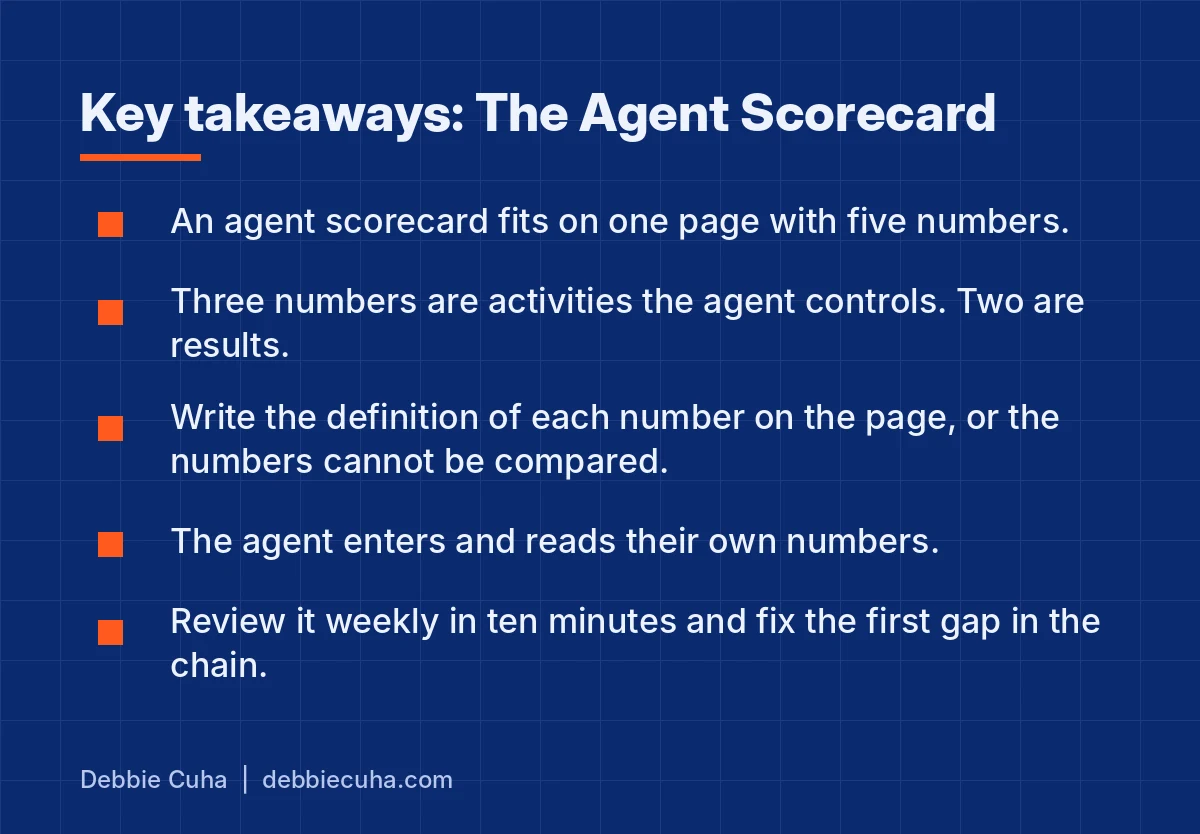
- An agent scorecard fits on one page with five numbers.
- Three numbers are activities the agent controls. Two are results.
- Write the definition of each number on the page, or the numbers cannot be compared.
- The agent enters and reads their own numbers.
- Review it weekly in ten minutes and fix the first gap in the chain.
What goes on an agent scorecard?
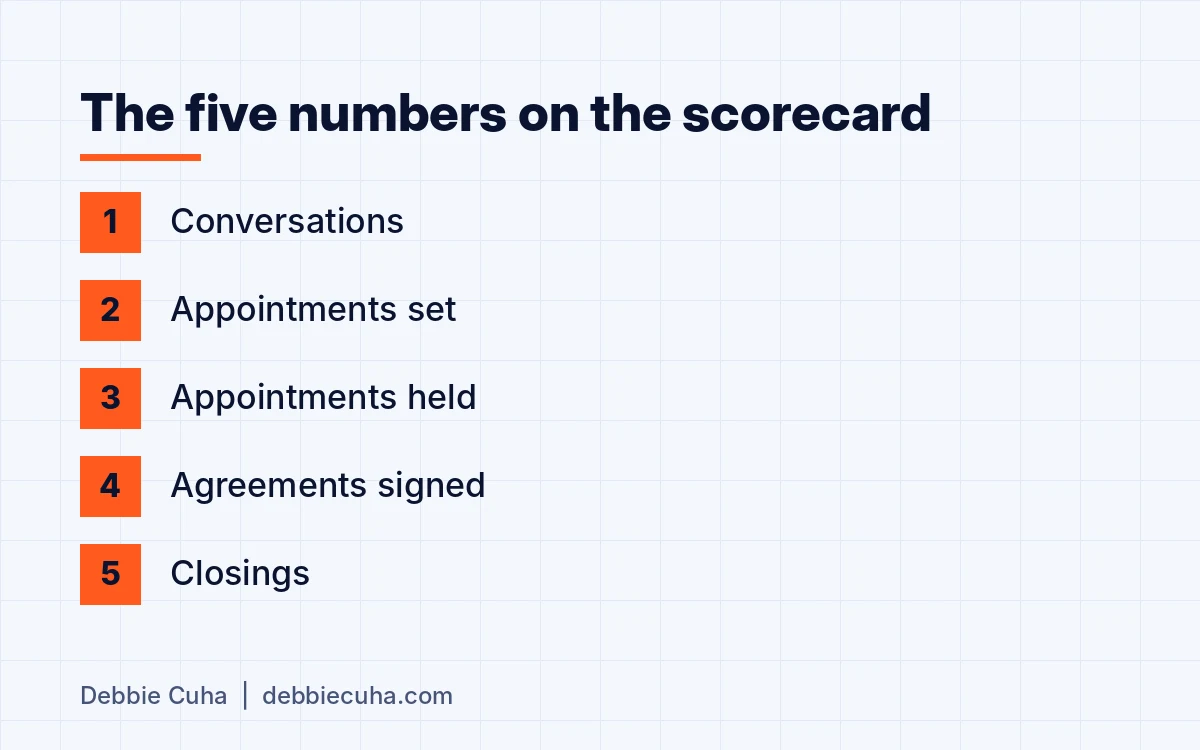
Five numbers and one standard for each. Three leading numbers, which the agent controls completely:
- Conversations about real estate
- Appointments set
- Appointments held
Two lagging numbers, which the activities produce:
- Agreements signed
- Closings
That is the whole document.
What does the one-page template look like?
It is a five-row table with a standard, an actual and a gap. Copy this one. The numbers in the Standard column are placeholders, not benchmarks.
| Week of: ______ | Standard | Actual | Gap |
|---|---|---|---|
| Conversations | 50 | ||
| Appointments set | 5 | ||
| Appointments held | 4 | ||
| Agreements signed | 1 | ||
| Closings (month to date) | 2 | ||
| One fix for this week: |
Under the table, print the definitions. They are part of the scorecard.
| Number | Counts | Does not count |
|---|---|---|
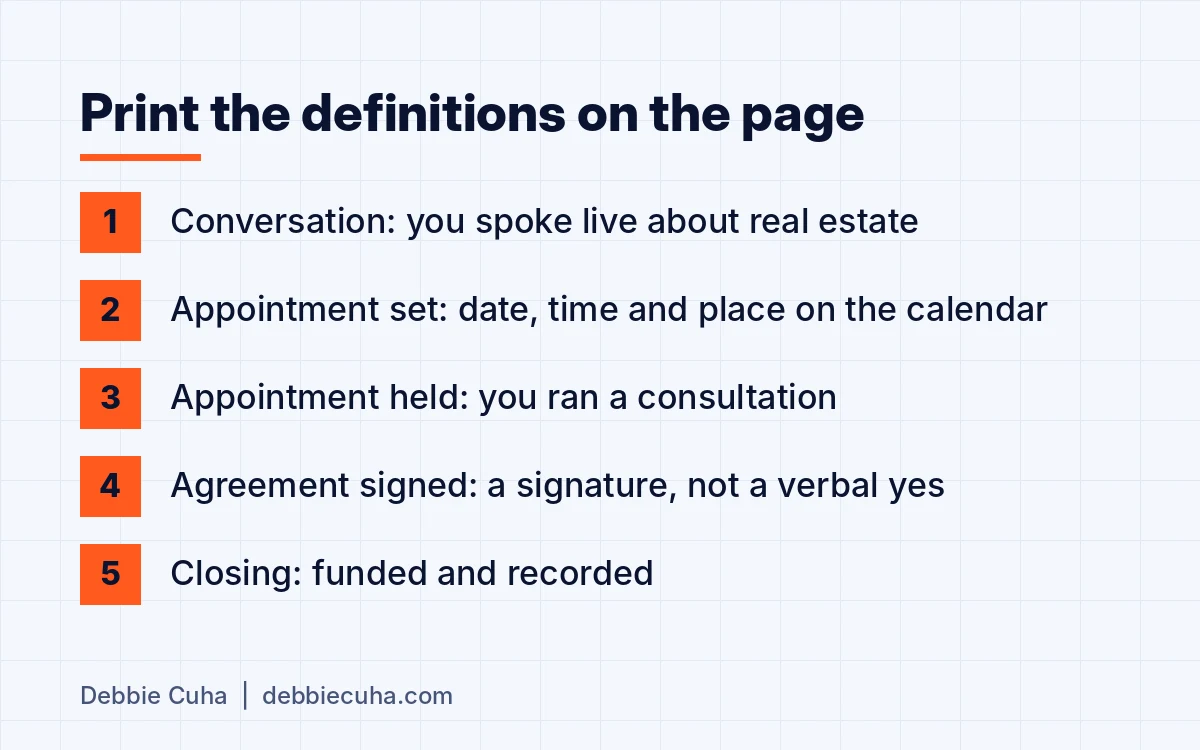
| Conversation | You spoke with a person, live, about buying, selling or a referral | Voicemails, texts, emails, social comments |
| Appointment set | A date, a time and a place are on the calendar | "Let's get together sometime" |
| Appointment held | You sat down, in person or on video, and ran a consultation | A showing with no consultation |
| Agreement signed | A signed buyer or listing agreement | A verbal yes |
| Closing | Funded and recorded | Under contract |
Why only five numbers when the usual advice is to track everything?
Because a person can act on five numbers and cannot act on fifteen. Tom Ferry makes the case for scoreboarding your metrics and keeping the results where you can see them every day. I agree with visible.
Where I draw the line is the page an agent reads out loud each week.
I was CFO of a company closing more than 1,000 loans a month. My position as the numbers person: let the CRM hold everything, and put five on the page. A short page gets read. A 40-line report gets closed.
How do you set the standard for each number?
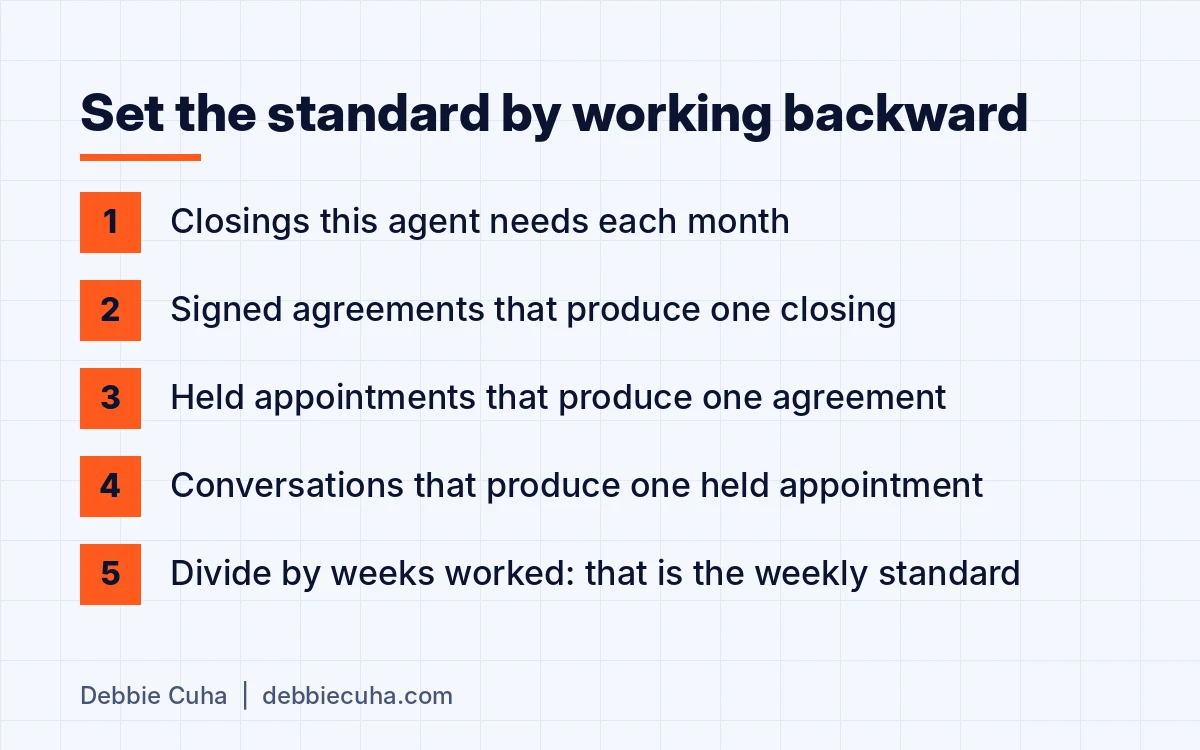
Work backward from the agent's own conversion history, one step at a time. Start with the closings they need, then ask how many agreements produce one closing, how many appointments produce one agreement, and how many conversations produce one appointment.
| Step | Question | Where the answer comes from |
|---|---|---|
| 1 | How many closings a month does this agent need? | Their income goal and your average commission |
| 2 | How many signed agreements produce one closing? | Their last 12 months, or the team's |
| 3 | How many held appointments produce one agreement? | Same |
| 4 | How many conversations produce one held appointment? | Same |
| 5 | Divide the monthly conversation number by the weeks worked | That is the weekly standard |
Use your numbers, not mine and not another team's.
What if a new agent has no history yet?
Run the scorecard for eight weeks with the team's standards and the Gap column switched off. You are collecting a baseline, not grading. After eight weeks the agent has their own ratios and the standards become theirs. The rest of that ramp is in the agent onboarding SOP.
Who fills in the scorecard?
The agent does, every time, before the review. If the leader or an assistant fills it in, the agent does not believe the numbers and does not feel them. Entering your own 14 next to a standard of 50 does more than any talk from me.
Should it be paper, a spreadsheet or the CRM?
Whichever one the agent will open without being reminded. A printed page or a single spreadsheet tab is enough. If your CRM already reports these five numbers accurately, pull them from there, but still put them on one page.
What is the difference between a scorecard and a scoreboard?
A scorecard is one agent's page, reviewed one on one. A scoreboard is the team's numbers on a wall or a screen, reviewed together in the weekly numbers meeting. You need both. The scoreboard shows where the team stands. The scorecard shows one person what to fix.
How do you review a scorecard?
Ten minutes, one on one, same time every week. It sits inside the 20-minute one-on-one.
- The agent reads their own numbers out loud. They own them.
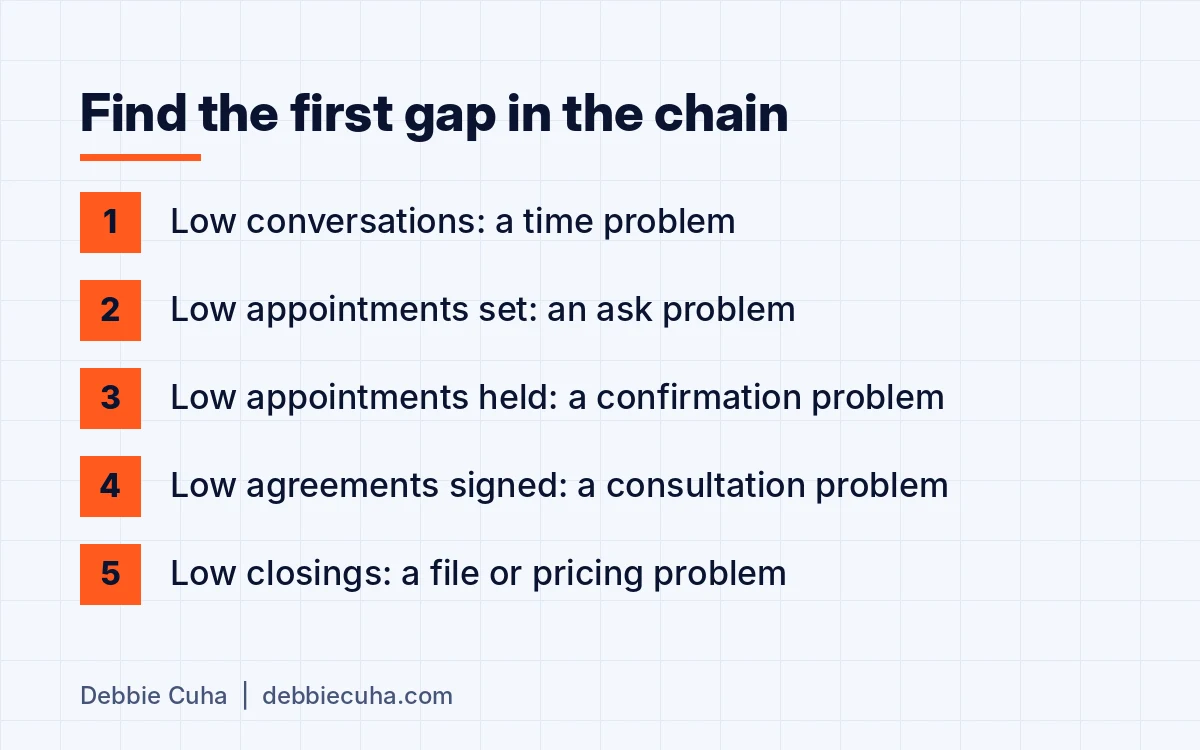
- Find the first gap in the chain, top to bottom. Fix that one only.
- Agree on one fix for the week. Write it on the scorecard.
| First gap shows up at | Usually means | The fix for this week |
|---|---|---|
| Conversations | A time problem. The prospecting block is not happening. | Protect the block. Count days completed. |
| Appointments set | An ask problem. Talking, but not asking for the meeting. | Role-play the close for the appointment. |
| Appointments held | A confirmation problem. Set, then no-show. | Confirm the day before, by phone. |
| Agreements signed | A consultation problem. | Run the written consultation, start to finish. |
| Closings | A file or a pricing problem. | Review the open files line by line. |
Should agents see each other's scorecards?
Activity numbers, yes. Put the three leading numbers on the team scoreboard so everyone reports in front of everyone. Keep the one-on-one notes and the fix for the week private. Public numbers create standards. Public coaching creates resentment.
What mistakes ruin a scorecard?
Four, and all of them are the leader's.
- The leader fills it in.
- It only tracks results. Closings tell you about work done weeks ago. Conversations tell you about the weeks ahead.
- The definitions are missing, so one agent counts voicemails and another does not.
- Nobody looks at it. A scorecard that is not reviewed weekly is a form.
Pair the scorecard with a written accountability agreement and the conversation about performance gets very short. Both sit on top of the procedures in my guide to real estate SOPs.
Next steps
- Get the free 12-SOP kit and put your name on the first five.
- See how SOP consulting works if you want these built for your team.
- Or email me a question at dc@syngp.com. I read every one.