The 20-Minute One-on-One: An Agenda for Team Leaders
By Debbie Cuha, October 26, 2026. 6 min read

A weekly one-on-one with an agent should take 20 minutes and follow the same five steps every time: their numbers, their wins, the gap, one commitment, and what they need from you. When the format never changes, the agent walks in prepared and the meeting stops drifting into small talk and your own to-do list.
Key takeaways
- A weekly one-on-one takes 20 minutes and follows the same five steps every time.
- The agent fills in their scorecard before the meeting and reads it out loud.
- Dig into one gap only and leave with one written commitment.
- Open last week's notes first, every time.
- Reschedule inside the week. Never cancel.
I wrote the SOPs behind 280 offices and about 3,000 people at DirectLender.com. The rule I hold from that work applies here: a meeting that changes shape with the leader's mood is not a system.
What is the agenda for a 20-minute one-on-one?
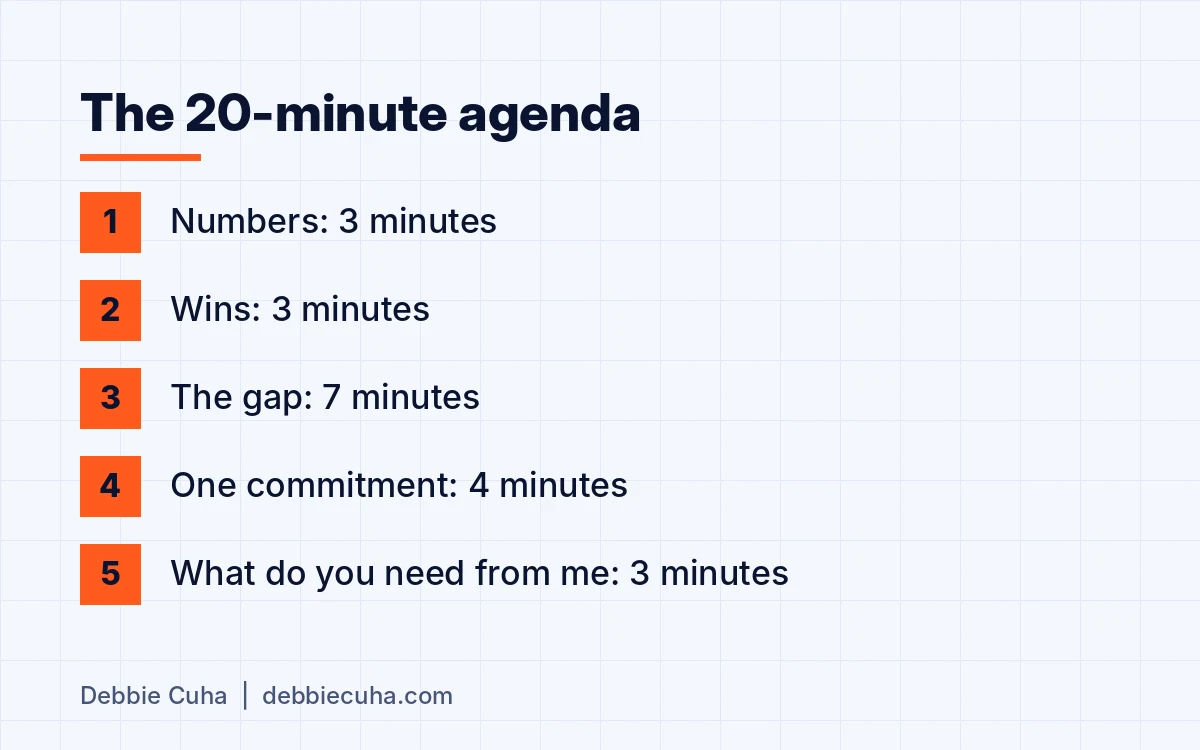
Five steps with fixed minutes, in the same order every week. Copy this table onto one page.
| Step | Minutes | Who talks | What gets written |
|---|---|---|---|
| 1. Numbers | 3 | The agent reads their scorecard out loud | Nothing. The scorecard is already filled in |
| 2. Wins | 3 | The agent | One thing that worked this week and why |
| 3. The gap | 7 | The agent, then you | The first number in the chain that is off standard |
| 4. One commitment | 4 | The agent says it. You write it | What they will do differently by next week |
| 5. What do you need from me | 3 | The agent | What you owe them and by when |
After step 5 you do what you said, or you say when you will.
Why 20 minutes when most advice says 30?
Because the agent arrives with the numbers already written. Thirty minutes is the usual length. Aaron Cuha's four-part one-on-one runs 30, with the first ten on the other person's agenda. His structure is built for any direct report.
Mine is built for one kind: a commissioned agent with a scorecard. The numbers are the agenda, so the first ten minutes are done before they sit down.
If your one-on-ones keep running long, look at step 3. You are working two gaps, or you are solving a deal.
How often should you meet: weekly, every other week or monthly?
Weekly, for every agent who is on a scorecard. A commitment made for one week can be checked while it still matters. A monthly meeting finds the problem after four weeks of missed conversations.
Every other week is acceptable for a steady producer who has hit standard for a full quarter. New agents stay weekly through their first 90 days.
What should the agent bring?
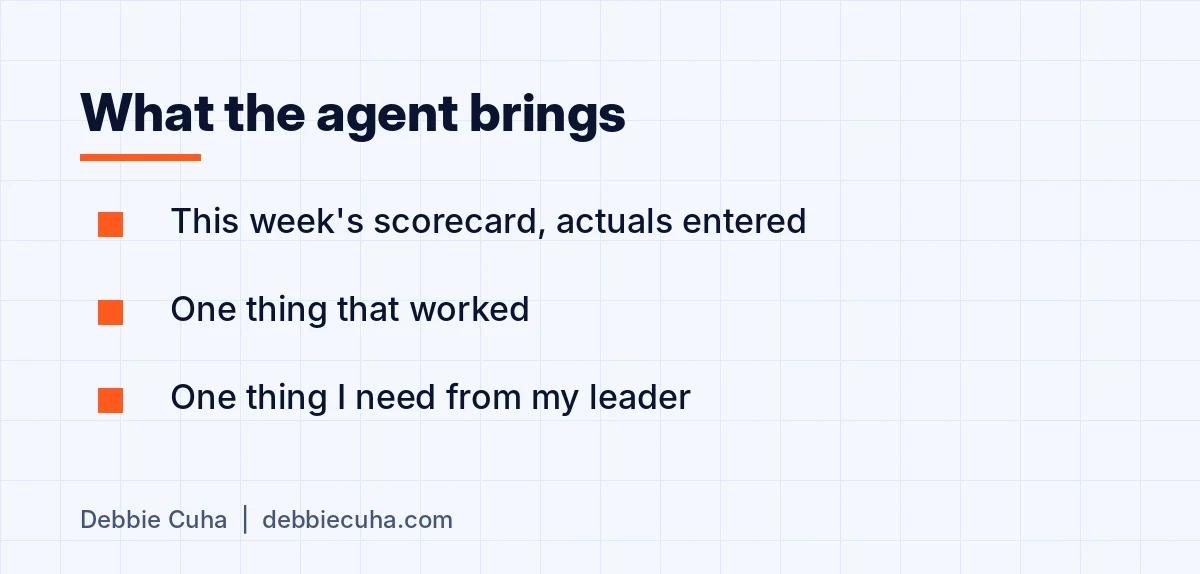
Three things, prepared before they walk in: the scorecard filled in, one win and one request.
- This week's scorecard, actuals entered
- One thing that worked
- One thing I need from my leader
If the scorecard is blank, reschedule for later the same day. Do not fill it in together. Entering the numbers is the agent's job, and doing it for them teaches them the meeting starts without it.
What questions should a team leader ask?
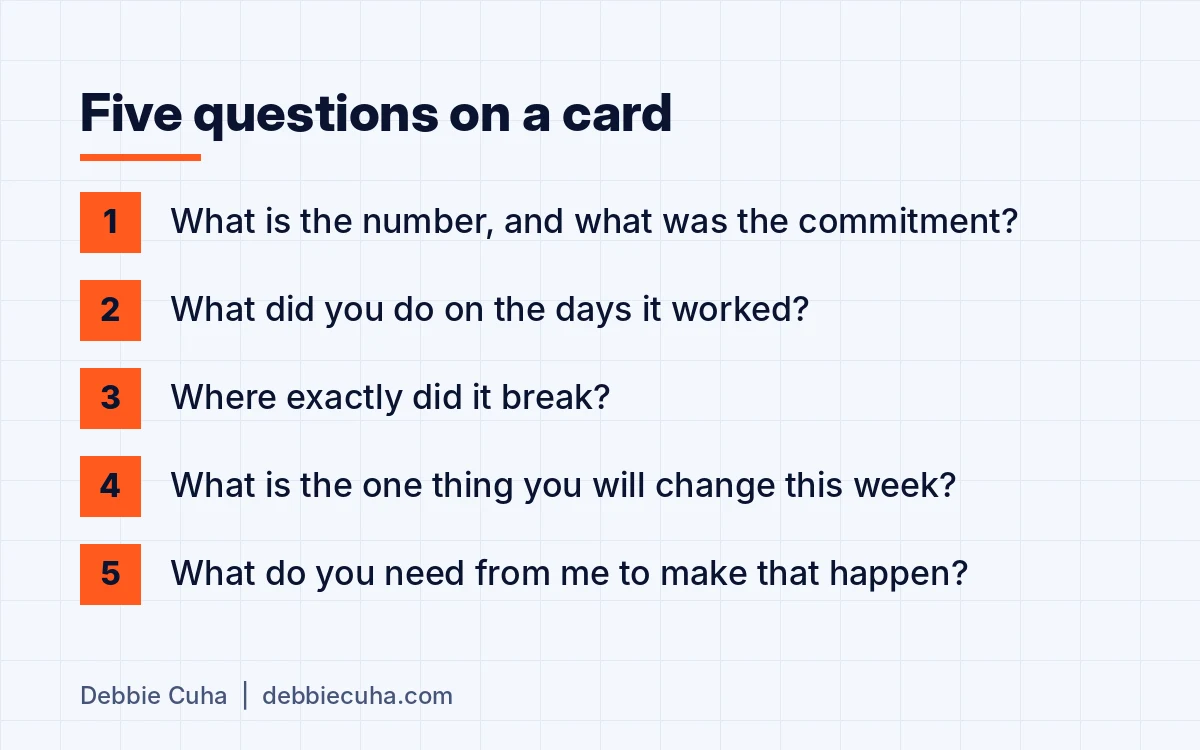
Five, kept on a card, one for each step. Ask the question, then be quiet. Do not answer your own questions.
- What is the number, and what was the commitment?
- What did you do on the days it worked?
- Where exactly did it break: the list, the dial, the ask or the follow-up?
- What is the one thing you will change this week?
- What do you need from me to make that happen?
If you want a longer list, Aaron's article above has a bank of questions sorted by purpose.
What do you do when an agent misses the commitment?
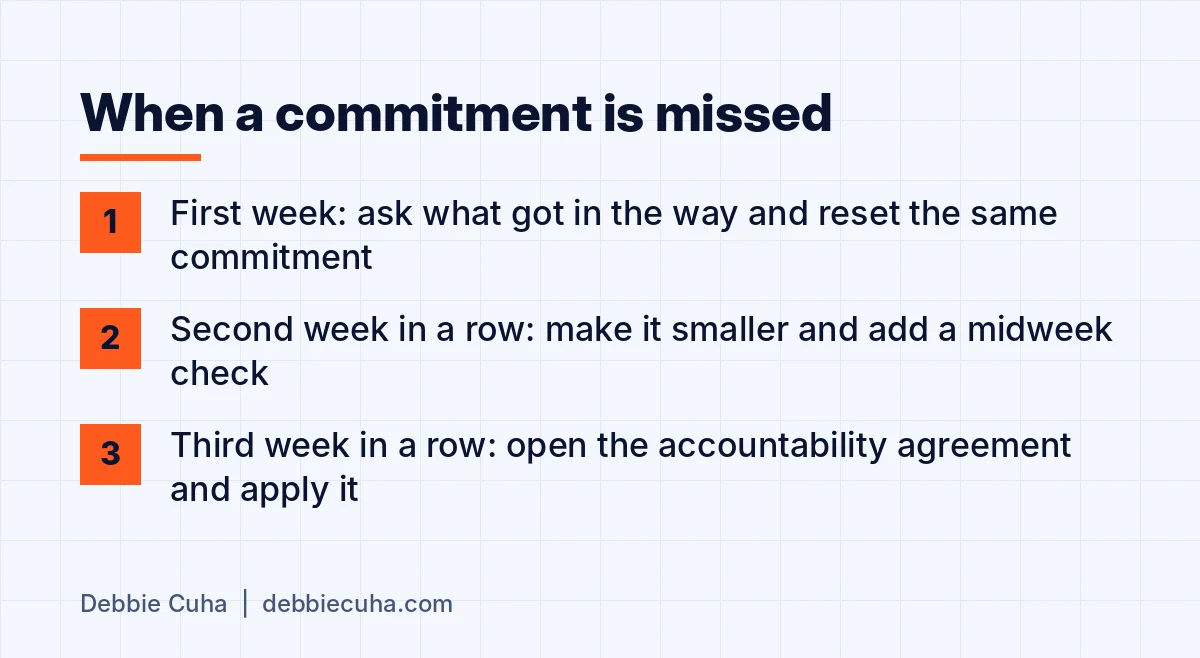
Follow the same ladder for everyone, and tell the team the ladder before anyone needs it. One miss is information. Three in a row is a decision.
| Miss | What you do | What you write |
|---|---|---|
| First week | Ask what got in the way. Reset the same commitment | The obstacle, in their words |
| Second week in a row | Make the commitment smaller and add a midweek check | The smaller commitment and the check date |
| Third week in a row | Open the accountability agreement and apply what it says | The date and what you both agreed |
What does not belong in a one-on-one?
Three things: deal problem solving, team announcements and surprises.
- Deal problem solving. Put active file issues in a separate deal clinic or handle them in the moment.
- Team announcements. Those go in the team meeting. Aaron Cuha has a 60-minute weekly team meeting agenda, and it says plainly that individual performance is handled one on one, not in front of the team. Tom Ferry's site publishes a 45-minute sample agenda for the group meeting.
- Surprises. If a number has been off for three weeks, the agent should have heard about it three weeks ago.
Is a one-on-one for accountability or for coaching?
Accountability first. The 20 minutes find the gap and set the commitment. If the gap is a skill, such as asking for the appointment, book a separate role-play session that week. Teaching a script inside step 3 is how 20 minutes becomes 50.
Do top producers still need a one-on-one?
Yes. Same day, same five steps. With a top producer, step 3 can be short and step 5 carries the value: what is slowing them down that you can remove. Skipping your best people tells everyone else the meeting is a punishment.
How many one-on-ones can one leader run?
Do the arithmetic before you promise it. Ten agents at 20 minutes is 200 minutes a week, plus the minutes between. If you cannot hold that many every week without cancelling, name a second person to run some of them from the same page.
How do you keep it from getting cancelled?
Put it in both calendars as a recurring meeting and treat a move as a reschedule, never a cancellation.
- Same day and time every week.
- If you must move it, reschedule inside the same week. Cancelling tells the agent their numbers do not matter this week.
- Short beats long. A 20-minute meeting that happens 50 weeks a year beats a 60-minute meeting that happens 12 times.
What do you do with the notes?
Keep one running document per agent and open last week's entry before you say anything else. The first question of every meeting is "last week you committed to this, how did it go?"
| Date | Numbers against standard | Win | First gap | Commitment | What I owe them |
|---|---|---|---|---|---|
That single habit is most of what people mean when they say accountability. The rest is in accountability without micromanaging, and the written procedures underneath both are in my guide to real estate SOPs.
Next steps
- Get the free 12-SOP kit and put your name on the first five.
- See how SOP consulting works if you want these built for your team.
- Or email me a question at dc@syngp.com. I read every one.