Structure Creates Culture: Why Your Team's Culture Problem Is a Systems Problem
By Debbie Cuha, November 6, 2026. 6 min read
Culture is what your people do when you are not in the room, and what they do is decided by structure: what is written, what is measured, what is rewarded and what is tolerated. If your team's culture is not what you want, do not start with a retreat or a values poster. Start with the systems.
Key takeaways
- Culture is what people do when the leader is not in the room.
- What is written, measured, rewarded and tolerated decides culture.
- Five structures do most of the work.
- High standards and care belong together.
- The team copies the leader's own compliance.
What is team culture?
It is the set of things your people do without being asked or watched. Not the values on the wall. The behavior on a Tuesday afternoon when you are at an appointment and a client update is due.
Why is culture a systems problem?
Because people respond to what the business actually does, not to what it says.
- If the values say "client first" and nobody tracks client updates, the culture is "client when convenient."
- If the leader says "we are a team" and the lead rules are a mystery, the culture is suspicion.
- If the standard is in the handbook and the top producer ignores it, the culture is "rules are for other people."
At DirectLender.com we had 280 offices and about 3,000 people. You cannot give a speech to 280 offices every morning. What reached every office was what was written down, and the policies and SOPs for all 280 were mine to write.
Which structures build culture?
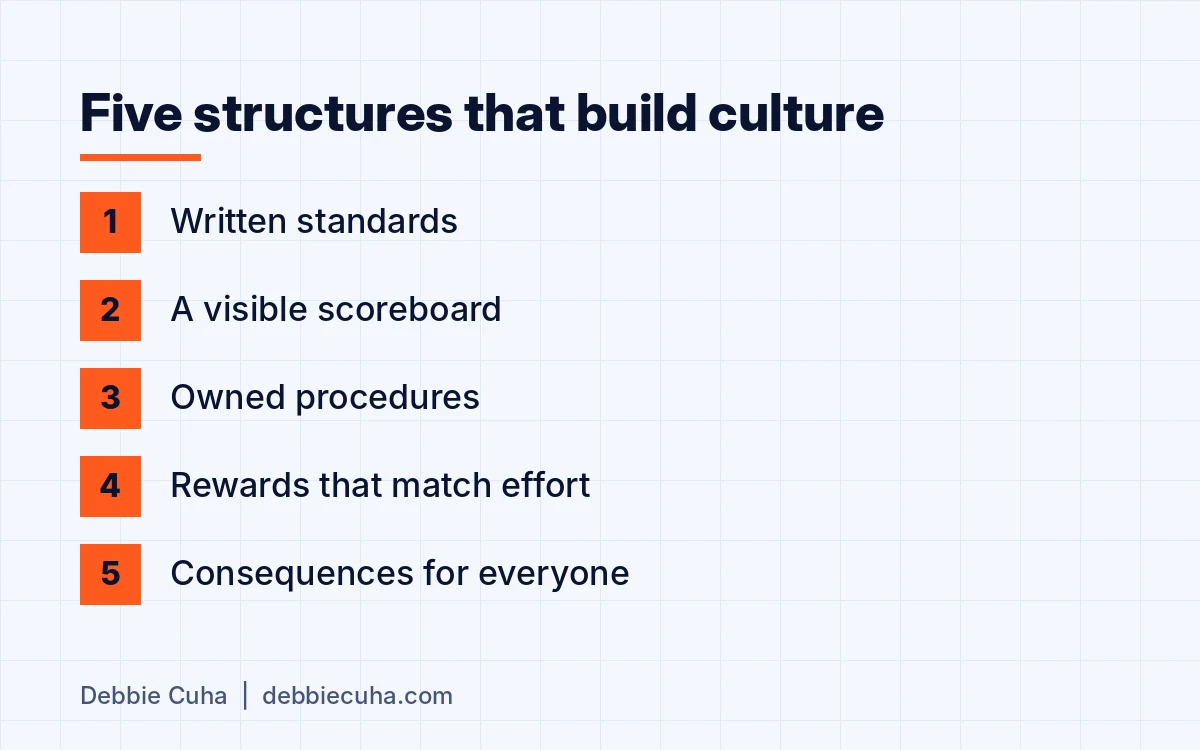
Five. Each one tells the team something that a speech cannot.
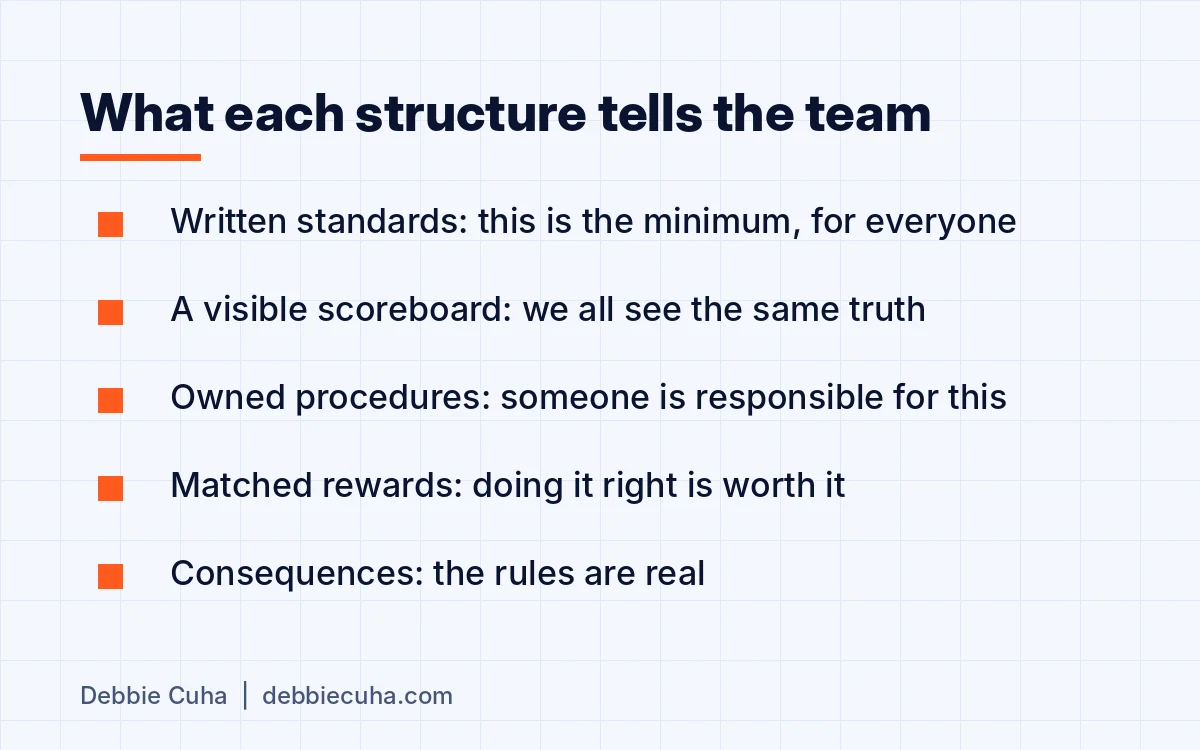
| Structure | What it tells the team | First step |
|---|---|---|
| Written standards | "This is the minimum, for everyone" | One page everyone signs. See team standards |
| A visible scoreboard | "We all see the same truth" | The same numbers, the same day every week, in the weekly numbers meeting |
| Owned procedures | "Someone is responsible for this" | One named owner on every SOP |
| Rewards that match effort | "Doing it right is worth it" | A written reward plan. See what month-end and Cabo taught me |
| Consequences for everyone | "The rules are real" | Agree the consequence before anyone misses |
Does culture come from values or from structure?
Values say what you intend. Structure decides whether it happens. Write the values if you like, then ask of each one: where is it written as a standard, who measures it and what happens when it is missed?
Tom Ferry's site makes the point in its list of team-building pitfalls (March 3, 2022): culture is shaped by what a leader allows, and the fix it gives is clear standards enforced consistently. Software teams have a name for the same idea. A Scrum.org article, Culture Follows Structure (July 26, 2026), cites Larman's laws of organizational behavior for it.
Where does warmth fit?
Right in the middle. High standards without care is a grind. Care without standards is a social club, and your strongest people are the first to notice.
The structure is the caring part. A new agent who gets a written plan, a weekly one-on-one and an honest scoreboard is being looked after far better than one who gets a hug and a login.
What do you do when the top producer ignores the standard?
Apply the consequence you agreed, privately and the same week. The team is watching this one case more closely than any other.
If you are not willing to enforce a standard on your top producer, take it off the page. A rule you will not enforce teaches the team that every rule is a suggestion. A shorter page that is real beats a longer one that is not.
Do retreats and team events build culture?
They celebrate a culture. They do not create one. An event works when it is the reward at the end of a system the team already ran, which is the whole point of matching rewards to effort. Held first, it is a nice day out.
How do you audit your culture?
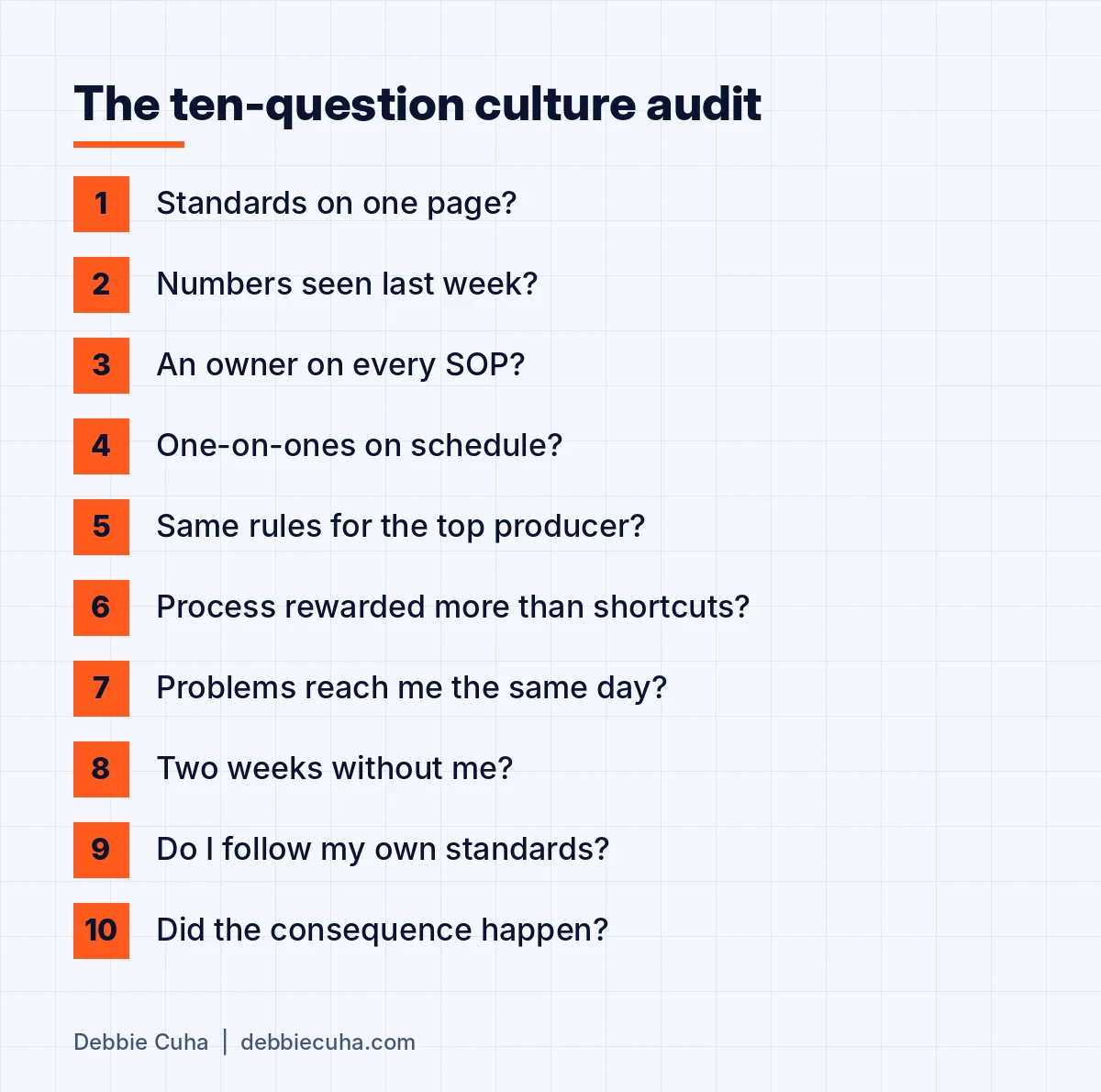
Answer ten questions yes or no. Each one tests a structure, so every no tells you what to build.
| # | Question | Tests |
|---|---|---|
| 1 | Could a new hire read our standards on one page today? | Standards |
| 2 | Did every team member see their numbers last week? | Scoreboard |
| 3 | Does every SOP have a named owner? | Procedures |
| 4 | Did I hold my last five one-on-ones on schedule? | Standards |
| 5 | Does our top producer follow the same rules as everyone else? | Consequences |
| 6 | Is following the process rewarded more than skipping it? | Rewards |
| 7 | Do problems reach me the same day? | Procedures |
| 8 | Could the team run for two weeks without me? | Procedures |
| 9 | Do I follow the standards I wrote? | Consequences |
| 10 | When someone missed a standard last month, did the agreed consequence happen? | Consequences |
How do you score the audit?
Count the yes answers.
| Yes answers | What it means | What to do |
|---|---|---|
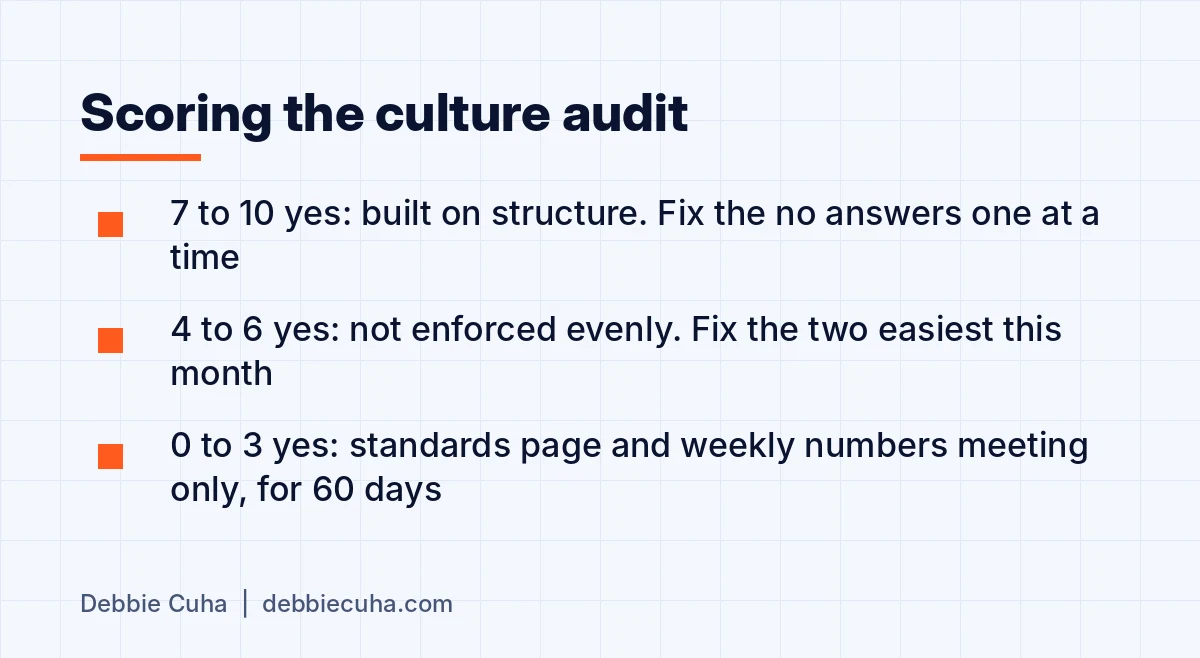
| 7 to 10 | The culture is built on structure | Fix the no answers one at a time |
| 4 to 6 | Structure exists but is not enforced evenly | Pick the two easiest no answers and fix them this month |
| 0 to 3 | The culture is whatever each person brings | Standards page and weekly numbers meeting only, for 60 days |
How long does it take to change a culture?
Plan in 60-day blocks, with one or two structures in each. I will not promise a date. Culture moves when the team sees the same thing happen twice: the same meeting, the same number, the same consequence.
Can a small team do this?
Yes. A team of three needs one page of standards, one weekly meeting and one named owner per procedure. It is less work than at 30 people, and it is the best time to start, because nobody has to unlearn anything.
Where do you start?
With question 9. Teams copy what the leader does, not what the leader says. If you enter your numbers late, expect late numbers.
Every structure here is a written procedure, and the full set is in my guide to real estate SOPs. If you want a second set of eyes on your structure, email me at dc@syngp.com.
Next steps
- Get the free 12-SOP kit and put your name on the first five.
- See how SOP consulting works if you want these built for your team.
- Or email me a question at dc@syngp.com. I read every one.