The Past Client Follow-Up SOP: What Happens After Closing
By Debbie Cuha, October 28, 2026. 6 min read
Past client follow-up works when it is a calendar, not an intention. The procedure is six touches in the first 12 months, each with an owner and a date that the CRM creates automatically on closing day. If the plan depends on someone remembering, it stops the first busy month.
Key takeaways
- Past client follow-up works when the CRM creates the tasks on closing day.
- Six touches in the first 12 months, each with an owner.
- Applying the plan is the last line of the closing checklist.
- Ask for referrals at day 90 and the anniversary, after you have been useful twice.
- Track one number: touches completed versus touches due.
I was CFO of Synergy Real Estate, which closed 500 to 750 transactions a year. At that volume, six touches per client is 3,000 to 4,500 tasks a year. Nobody remembers that many. A system creates them.
Why do teams lose their past clients?
Because closing day feels like the finish line, and nothing in the system says anyone owes that client another call. The file is done, the commission is paid, and attention moves to the next contract.
The clients are not the problem. In the National Association of REALTORS 2026 Profile of Home Buyers and Sellers, released November 5, 2026, 88% of buyers said they would use their agent again or recommend them, and sellers had owned their homes for a median of 12 years. Twelve years is a long time to be remembered on goodwill alone.
So build the system that says someone owes the call.
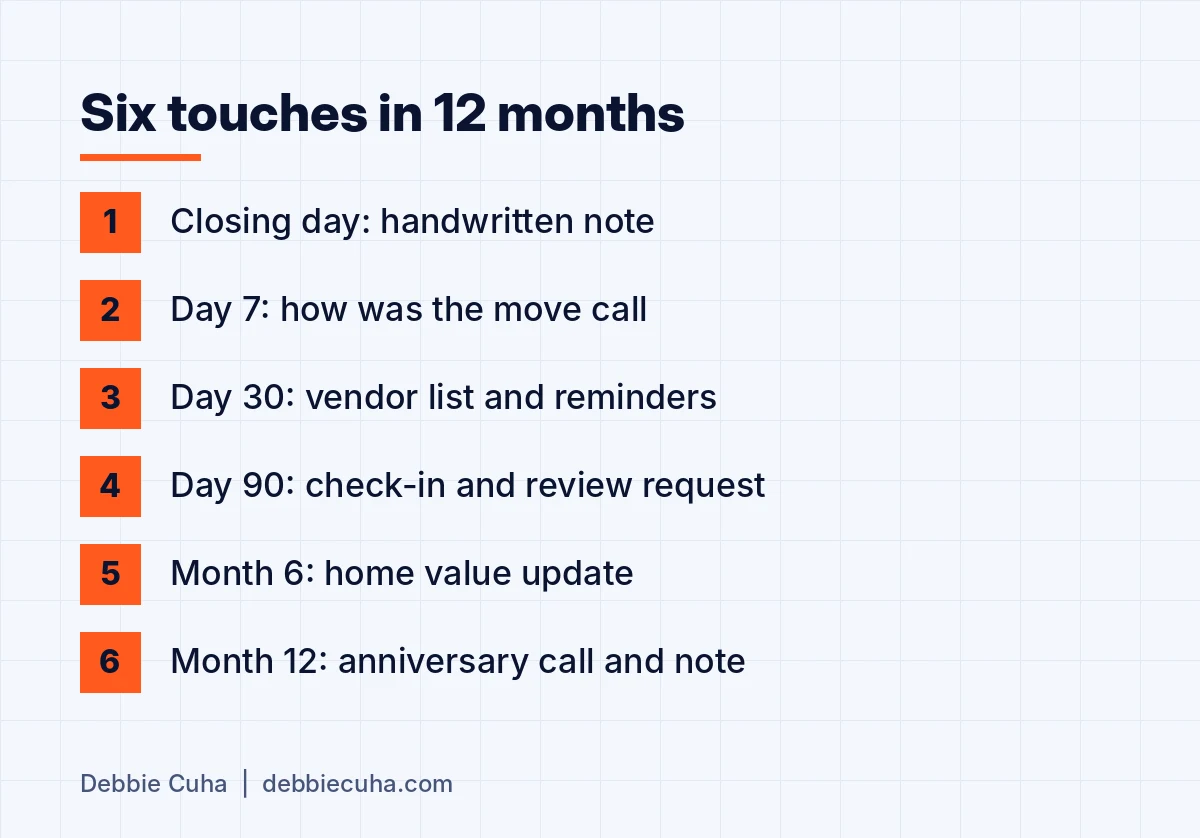
What does the 12-month schedule look like?
Six touches, each with a date counted from closing day and one named owner. Copy the table into your CRM as one action plan.
| When | Touch | Owner |
|---|---|---|
| Closing day | Handwritten thank-you note, mailed | Agent |
| Day 7 | Call: how was the move, what is broken, who do you need | Agent |
| Day 30 | Email with vendor list, utility and tax reminders | Admin |
| Day 90 | Call: any questions on the house, ask for a review | Agent |
| Month 6 | Market update on their home's value | Admin, signed by agent |
| Month 12 | Home anniversary call and note | Agent |
This is the minimum. The Past-Client Touch Plan in the free 12-SOP kit is the longer version, with a monthly email added.
What happens after month 12?
They move to the standing plan: one personal call and one mailed item every quarter, and the home anniversary every year. It does not end. With a median of 12 years between buying and selling, the repeat sale or the referral may come in year nine.
Tom Ferry argues that agents should stop saying "past clients" at all, because the label treats the relationship as finished. I keep the term because it is the tag in the CRM. The standing plan is how you act as if the relationship is not finished.
How do you make it automatic?
Build the plan once and let the closing checklist start it. Nobody decides, client by client, whether to follow up.
- Build the six tasks as one action plan in your CRM.
- The transaction coordinator applies the plan as the last step of the closing checklist. I describe that handoff in the transaction coordinator SOP.
- Tasks land on the owner's daily list with the due date.
- The weekly meeting reports one number: past client touches completed versus due.
Who owns each touch, the agent or the admin?
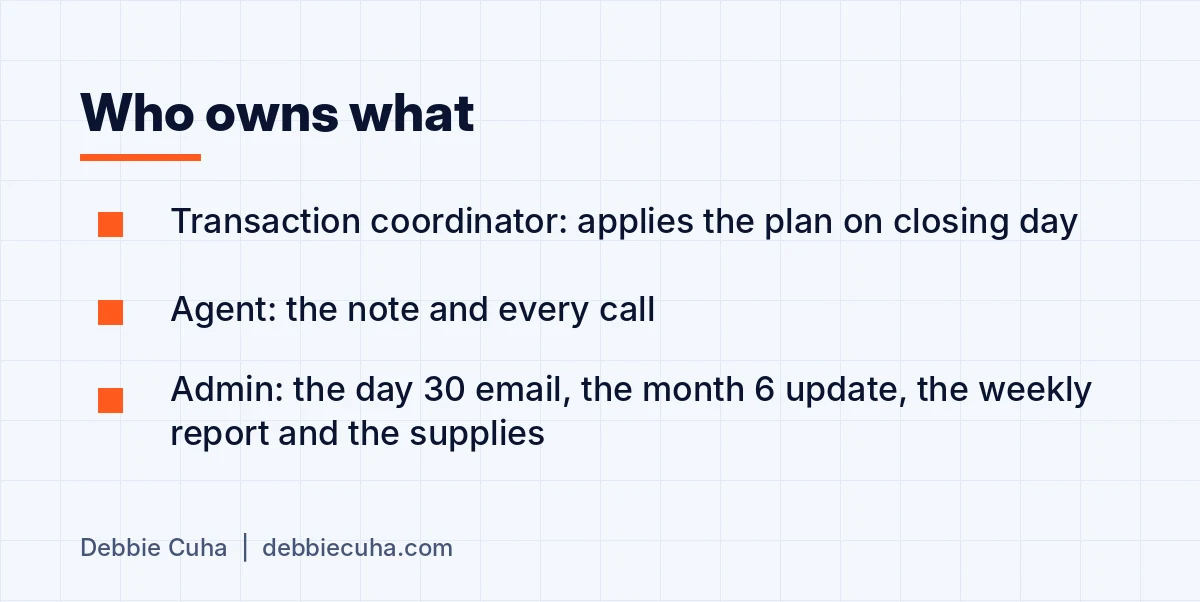
The agent owns every touch where the client hears a voice or sees handwriting. The admin owns everything that can be prepared ahead. The transaction coordinator owns the trigger.
| Role | Owns |
|---|---|
| Transaction coordinator | Applying the plan on closing day |
| Agent | The note, the day 7 call, the day 90 call, the anniversary call |
| Admin | The day 30 email, the month 6 update, the weekly report, note cards and stamps |
What do you say on the day 7 call?
Keep it about them and the house. Three questions are enough.
- "How did the move go?"
- "What has surprised you about the house?"
- "Is there anyone you need, a plumber, a painter, a handyman? I will send you our list."
Do not ask for a referral on this call. You are proving that you still pick up the phone after you have been paid.
When do you ask for a review?
On the day 90 call, after two useful contacts and enough time in the house to mean what they write. Ask once and text the link while you are still on the phone.
If your closing checklist already sends a review request, this call is the personal follow-up for anyone who has not left one.
When do you ask for referrals?
At day 90 and at the anniversary, after you have been useful twice. One sentence: "Who do you know who is thinking about a move this year that I should be taking care of?"
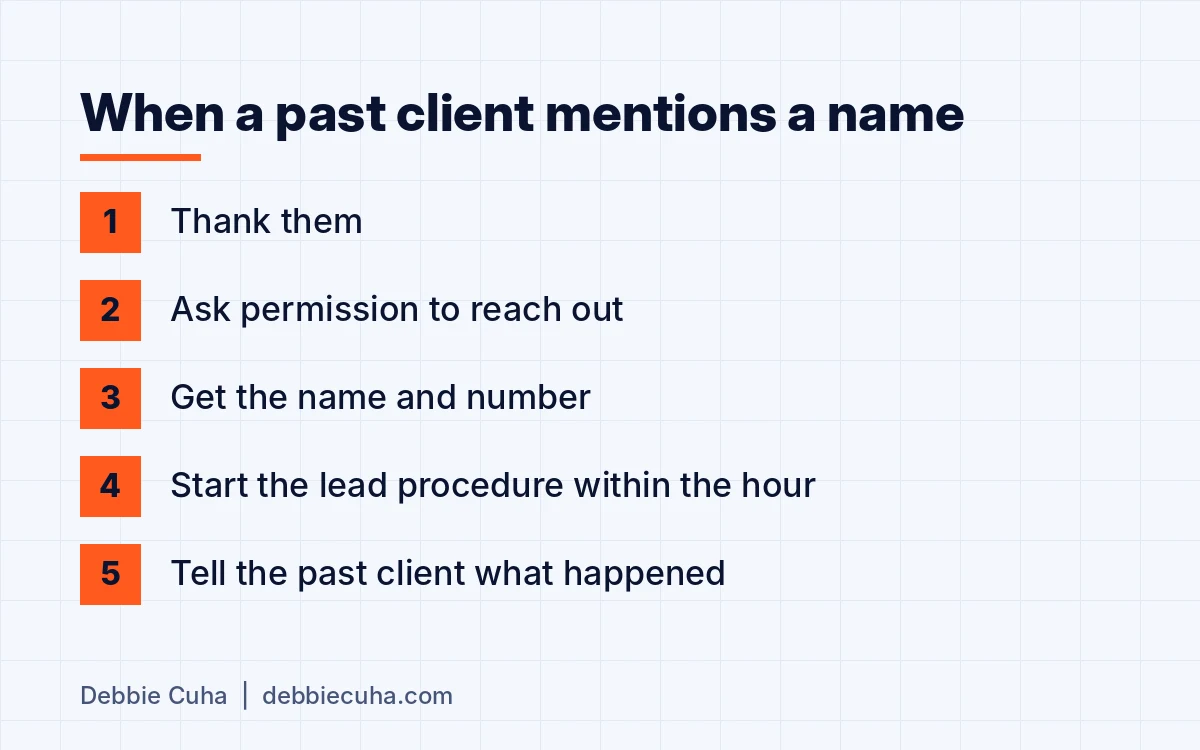
What do you do when a past client mentions someone who needs help?
Treat it as a new lead with a clock on it. Thank them, ask permission to reach out, get the name and number, and start your lead follow-up procedure within the hour.
Then tell the past client what happened. A referral nobody follows up on is the last one that client sends.
What happens to past clients when an agent leaves the team?
They are reassigned by name, in writing, and the new owner makes an introduction call. Decide the rule before anyone leaves: who inherits the list and how fast. Follow your broker's policy and your team agreement on who keeps the relationship.
Past clients left on a departed agent's list get no touches at all, and nobody sees it because nobody opens that list.
What number do you track?
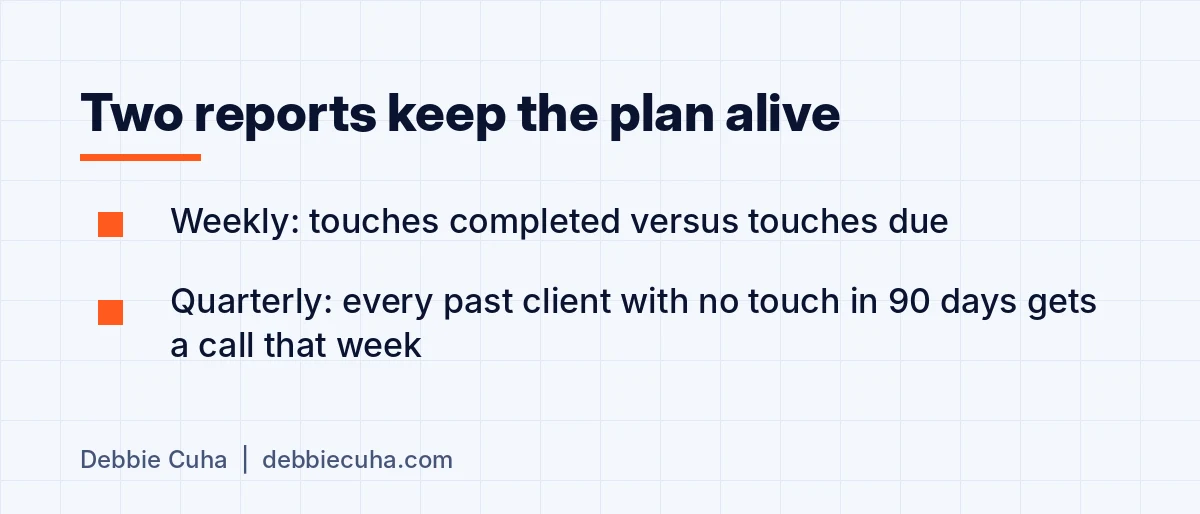
One number weekly and one report quarterly. Weekly: touches completed versus touches due. Quarterly: the admin lists every past client with no touch in 90 days, and each one gets a call that week.
What about closing gifts and vendor lists?
Keep both inside your broker's policy. On the vendor list, give more than one option in each category and let the client choose.
Never give or accept anything of value for referring settlement service business. Rules on gifts tied to referrals vary by state, so have your managing broker review the plan before you run it.
What does the setup checklist look like?
Seven lines. When all seven are true, the plan runs without you.
- Past client action plan built in the CRM
- Applying the plan is a line on the closing checklist
- Note cards and stamps stocked at every desk
- Vendor list updated twice a year, with more than one option per category
- Touches completed versus due on the weekly report
- Quarterly no-touch report on the admin's calendar
- Reassignment rule written for when an agent leaves
If your database is not in shape to run this yet, do the CRM cleanup first. This is the last of the twelve procedures in my guide to real estate SOPs.
Next steps
- Get the free 12-SOP kit and put your name on the first five.
- See how SOP consulting works if you want these built for your team.
- Or email me a question at dc@syngp.com. I read every one.