Clear to Close to Funding: The Closing Desk SOP for Mortgage Teams
By Debbie Cuha, November 24, 2026. 14 min read
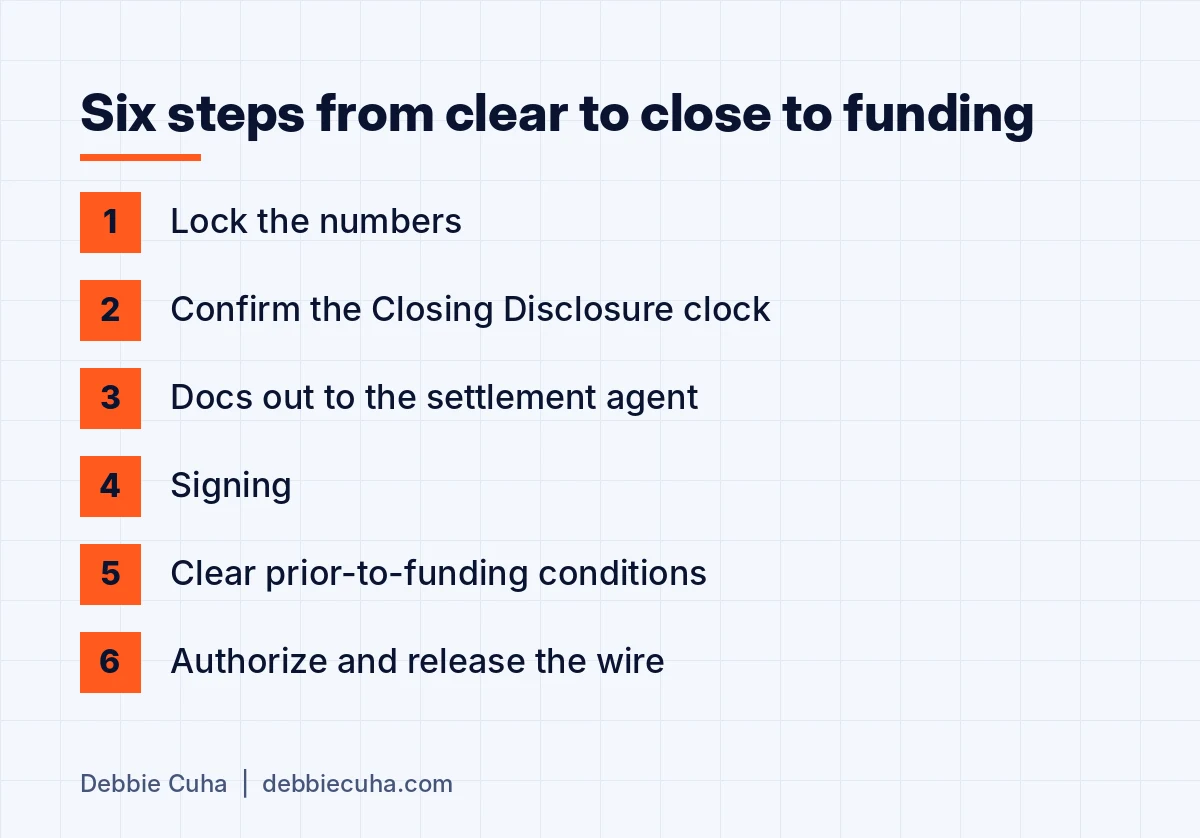
Between clear to close and funding, a mortgage team has six jobs: lock the numbers, confirm the Closing Disclosure clock, send docs, get them signed, clear the prior-to-funding conditions and release the wire. Clear to close means underwriting is finished. It does not mean the loan is. Give each of the six jobs one owner and one deadline.
Key takeaways
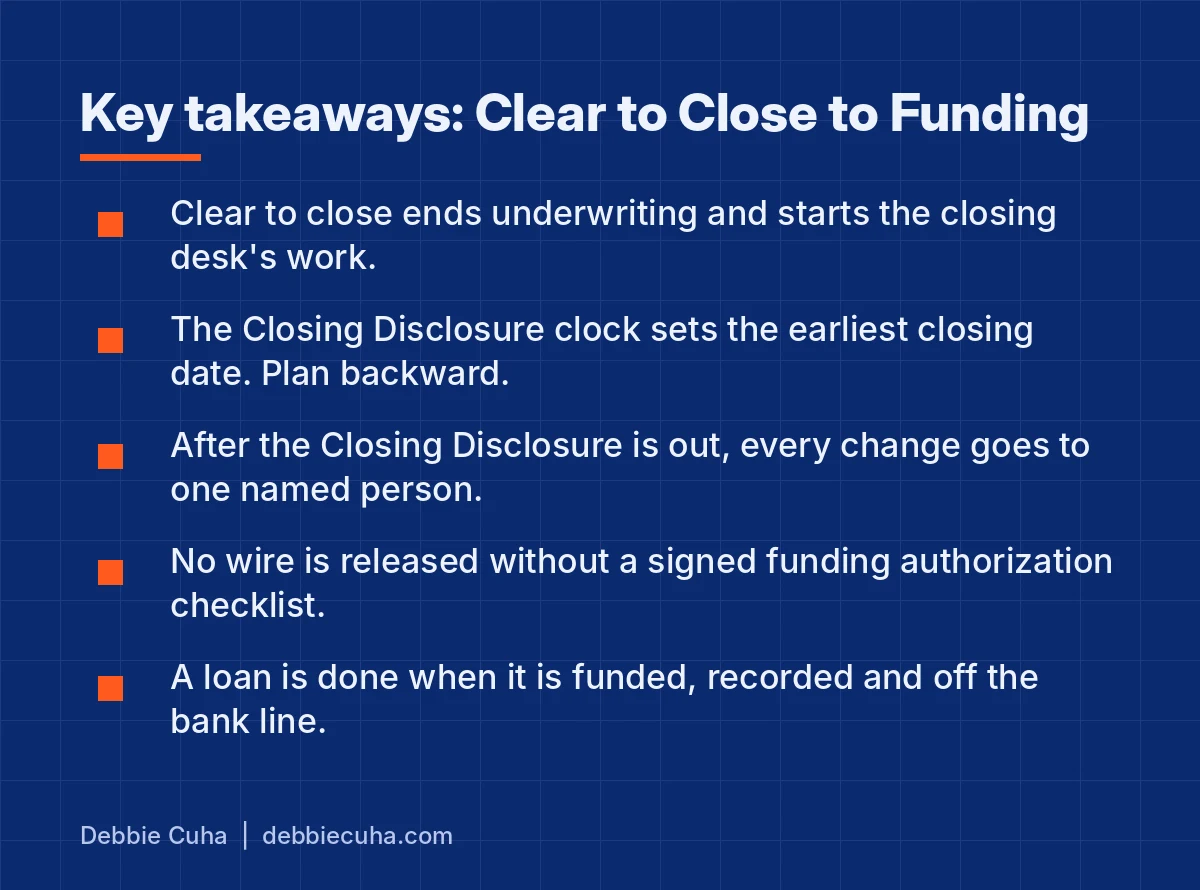
- Clear to close ends underwriting. It starts the closing desk's work, which has six steps and its own deadlines.
- The Closing Disclosure clock, not the clear to close, sets the earliest closing date. Plan backward from the closing date.
- After the Closing Disclosure is out, every change goes to one named person before anyone promises a date.
- Nobody releases a wire from memory. The funder signs a funding authorization checklist on every file.
- A loan is finished when it is funded, recorded and off the bank line with its trailing documents in.
At DirectLender.com, where I was co-founder and CFO, I ran everything from docs to funding: closing documents, rate locks and funding on the bank line, at more than 1,000 loans a month. This post covers internal operations only. It is not lending, legal or compliance advice, and your compliance officer reviews every procedure before it goes live.
What happens between clear to close and funding?
Six things, in order: the numbers are locked, the Closing Disclosure timing is confirmed, closing documents go to the settlement agent, the borrower signs, the last conditions are cleared, and the lender releases the wire. Recording and disbursement by the settlement agent follow.
The pages a borrower reads describe this from the borrower's chair: review the Closing Disclosure, do the walk-through, sign, get keys. All of that is true. None of it tells your closer, your funder or your loan officer who does what by when. That is what a closing desk SOP is for.
What does clear to close mean inside the lender?
It means the underwriter has signed off on every condition that had to be met before closing documents can be drawn. It is a handoff from underwriting and processing to the closing desk. It is not a promise that the loan will fund on a given day.
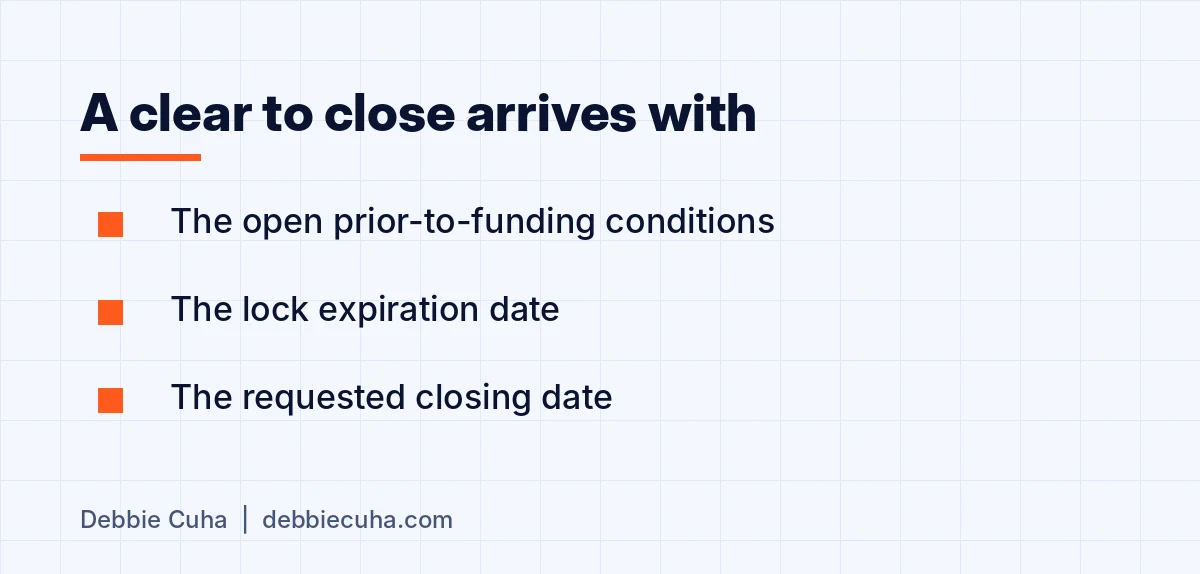
So write the handoff down. A clear to close arrives at the closing desk with three things attached: the list of prior-to-funding conditions still open, the lock expiration date, and the requested closing date. A clear to close with none of those attached is an announcement, and announcements do not fund loans. How the file gets clean before this point is in the mortgage processing SOP.
Who owns each step?
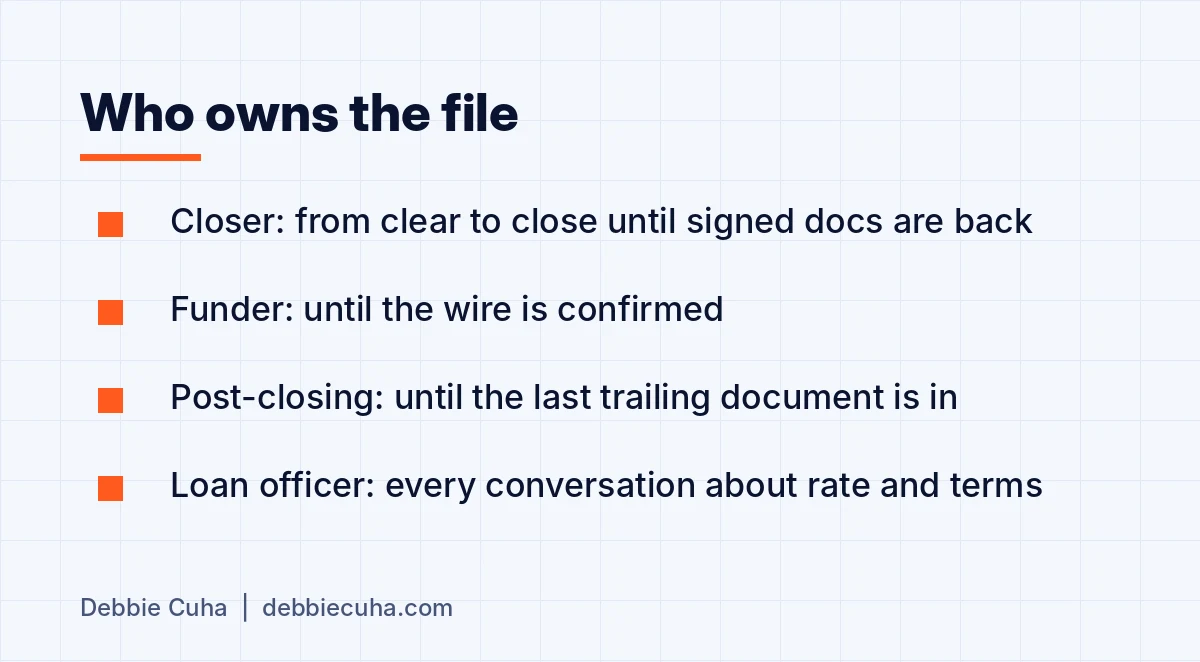
One named role per step. The closer owns the file from clear to close until the signed package is back. The funder owns it from there until the wire is confirmed. Post-closing owns it until the last trailing document is in.
| Step | Owner | Standard to write in |
|---|---|---|
| 1. Accept the clear to close and lock the numbers | Closer | Within ___ business hours of clear to close |
| 2. Confirm the Closing Disclosure clock | Closer, with compliance | Same day |
| 3. Docs out to the settlement agent | Closer | By your docs-out cutoff, ___ days before signing |
| 4. Signing | Settlement agent, tracked by the closer | Signed package back by ___ |
| 5. Clear prior-to-funding conditions | Funder | Before the funding cutoff |
| 6. Authorize and release the wire | Funder, second sign-off by ___ | Wire confirmed by ___ |
| 7. Post-closing and trailing documents | Post-closing | Within ___ days of funding |
On a small team one person may hold two of these roles. Write the role names anyway. The day you hire, the SOP already knows who does what.
How long does it take from clear to close to funding?
As long as the Closing Disclosure clock and your own cutoffs say. Federal rules put three business days between the borrower receiving the Closing Disclosure and closing. If it went out before clear to close, the gap can be short. If not, the clock starts now.
The Consumer Financial Protection Bureau's TILA-RESPA Integrated Disclosure FAQs (answer updated January 25, 2019) say the creditor must ensure the consumer receives the initial Closing Disclosure no later than three business days before consummation. Which days count, and when a disclosure that was not handed over in person counts as received, are questions for your compliance officer, not for a blog post.
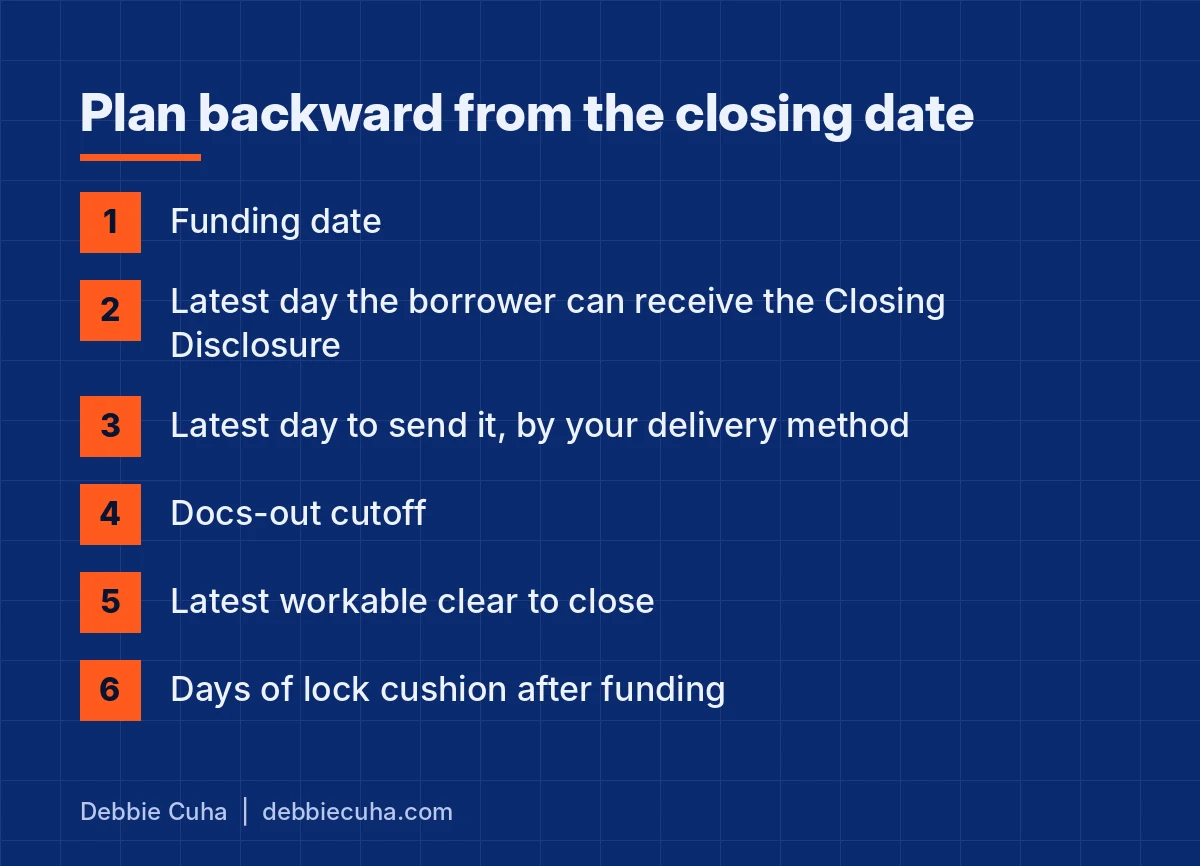
Plan backward from the closing date, not forward from clear to close.
| Count back from | To find | Your date |
|---|---|---|
| Requested closing date | Funding date (same day, or later for some loans, see below) | ___ |
| Closing date | Latest day the borrower can receive the Closing Disclosure, counted by compliance | ___ |
| That day | Latest day the Closing Disclosure can be sent, by your delivery method | ___ |
| Closing date | Docs-out cutoff | ___ |
| Docs-out cutoff | Latest workable clear to close | ___ |
| Lock expiration | Days of cushion after the planned funding date | ___ |
If the last line is zero or negative, the lock conversation happens today.
When should the Closing Disclosure go out?
As early as your policy allows and your numbers are reliable. The Closing Disclosure is the longest fixed wait in the last week, so the team that sends it only after clear to close has chosen the longest path every time.
That is my position, and it goes against the habit of treating clear to close as the starting gun. Whether your company sends the disclosure before final approval is a policy decision for compliance and management. Make the decision once, write it in the SOP, and stop making it file by file.
Which changes restart the three-day wait?
Three. The same CFPB FAQs list them: the annual percentage rate becomes inaccurate, the loan product changes, or a prepayment penalty is added. Each one needs a corrected Closing Disclosure and a new three-business-day wait. Other changes need a corrected disclosure at or before closing, with no new wait.
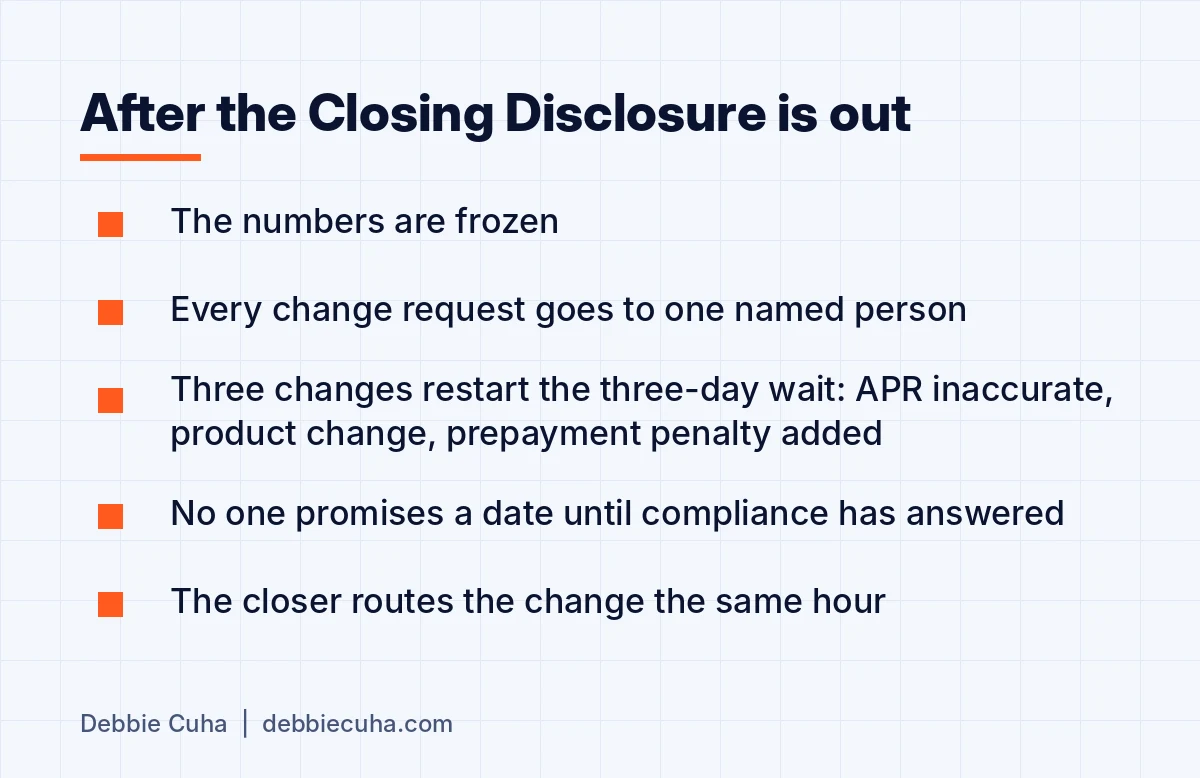
Turn that into an operating rule. Once the Closing Disclosure is out, the numbers are frozen. Any request to change rate, product, credits, fees or loan amount goes to one named person, and nobody tells the borrower or an agent a date until that person has answered.
| Change requested after the Closing Disclosure | New three-day wait? | Who decides |
|---|---|---|
| The APR becomes inaccurate | Yes | Compliance |
| The loan product changes | Yes | Compliance |
| A prepayment penalty is added | Yes | Compliance |
| Any other change to the numbers | Corrected disclosure at or before closing, no new wait | Compliance confirms, closer reissues |
The FAQs also explain when an APR that moved is still accurate under the rule's tolerances. That call belongs to compliance. The closer's job is to route the change the same hour, not to judge it.
What do you check before docs go out?
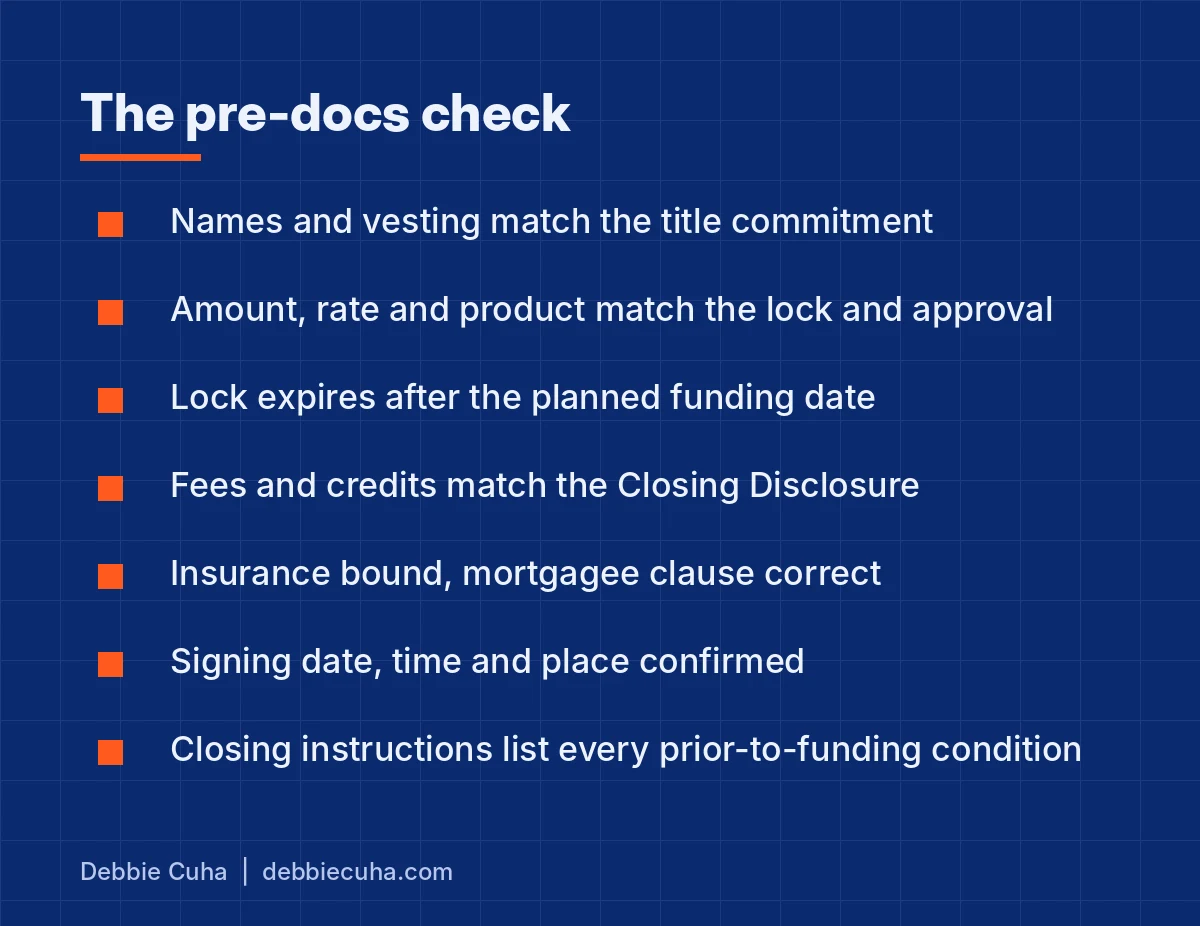
That the documents will match the approval, the lock and the Closing Disclosure. A package drawn from stale numbers comes back as a redraw, and a redraw on closing day is how a file misses its funding cutoff.
The closer's pre-docs check:
- Borrower names and vesting match the title commitment
- Loan amount, rate and product match the lock and the final approval
- Lock expires after the planned funding date
- Fees and credits match the Closing Disclosure and the settlement agent's figures
- Homeowners insurance is bound, with the right mortgagee clause
- The settlement agent has confirmed the signing date, time and place
- Closing instructions list every prior-to-funding condition
What are prior-to-funding conditions, and who clears them?
They are the items the lender needs after signing and before money moves. The funder clears them, and nobody else. Processing cleared conditions to get to closing. The funder clears these to release the wire.
The usual ones are the signed package reviewed for completeness, any final verifications your investor or company policy calls for, and anything the underwriter marked prior to funding. Your own list comes from your investor guidelines. The point of the SOP is that the list is on the file at clear to close, not discovered the afternoon of closing.
What goes on the funding authorization checklist?
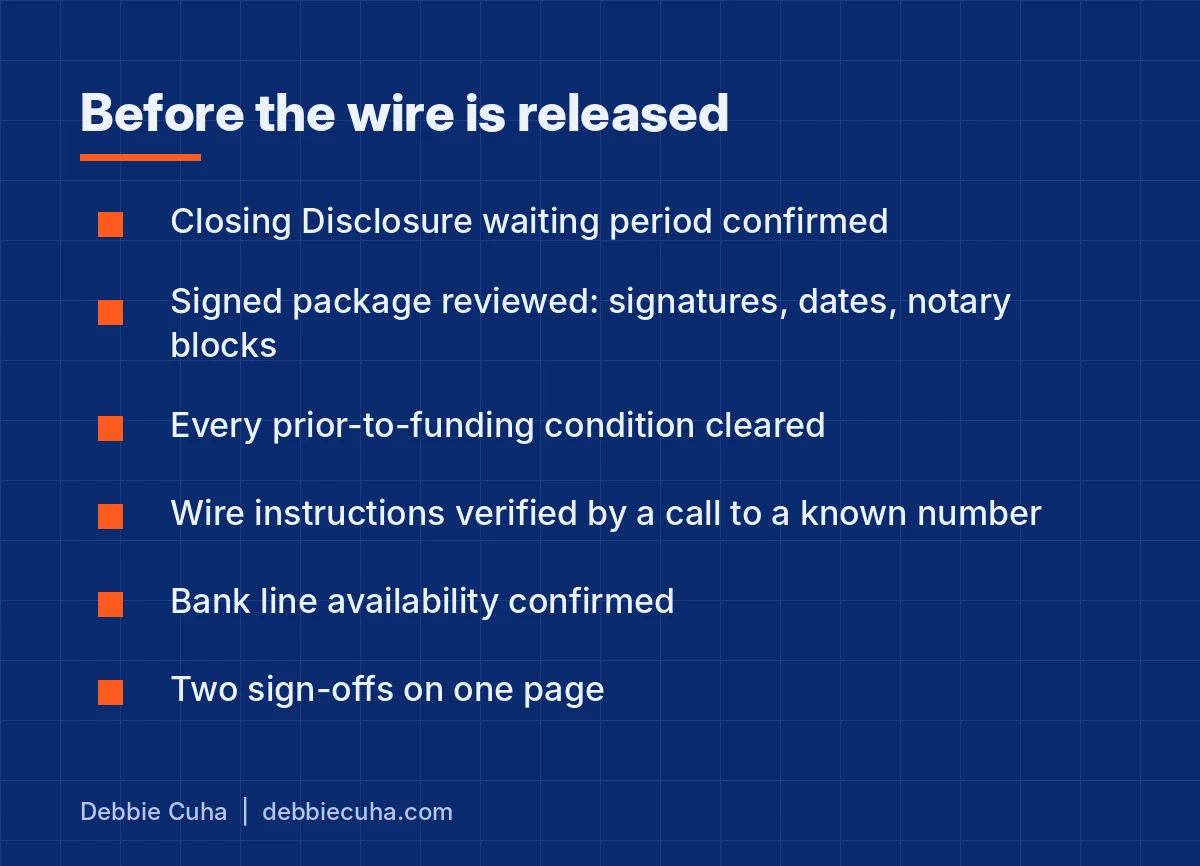
Everything the funder must see before the wire is released, on one page, signed. No wire leaves on memory or on a phone call saying the file is fine.
FUNDING AUTHORIZATION
Loan #: ______  Borrower: ______________  Funder: ______
Closing date: ______  Funding date: ______  Lock expires: ______

[ ] Clear to close in file, dated ______
[ ] Closing Disclosure received by borrower on ______
    Waiting period confirmed by compliance: ______ (initials)
[ ] Any change after the Closing Disclosure was routed and answered
[ ] Signed package received and reviewed: every signature,
    date and notary block complete, names match
[ ] Final Closing Disclosure matches the settlement statement
[ ] Every prior-to-funding condition cleared (list attached)
[ ] Rescission period, if it applies, ends on ______
[ ] Insurance bound, mortgagee clause correct
[ ] Wire instructions verified by a call to a known number,
    not a number from an email
[ ] Wire amount matches the funding figure
[ ] Bank line availability confirmed for today

Authorized by: ______  Second sign-off: ______  Time: ______
Wire confirmed received by settlement agent: ______ (time)
Your investor and compliance requirements win over this list. Add their lines, keep the signature, and keep it to one page.
Is funding the same day as signing?
Not always. On some loans the money moves the day the borrower signs. On others it moves after the signed package has been reviewed, or after a rescission period has ended. The SOP has to say which case each file is.
Three things decide it: the state the property is in, whether the loan is a purchase or a refinance of a primary residence, and your own funding cutoffs. Put the planned funding date on the file at clear to close, next to the closing date, as two separate dates. When they are different, the borrower and both agents hear that before closing day, not at the table.
What do you tell the borrower and the agents after clear to close?
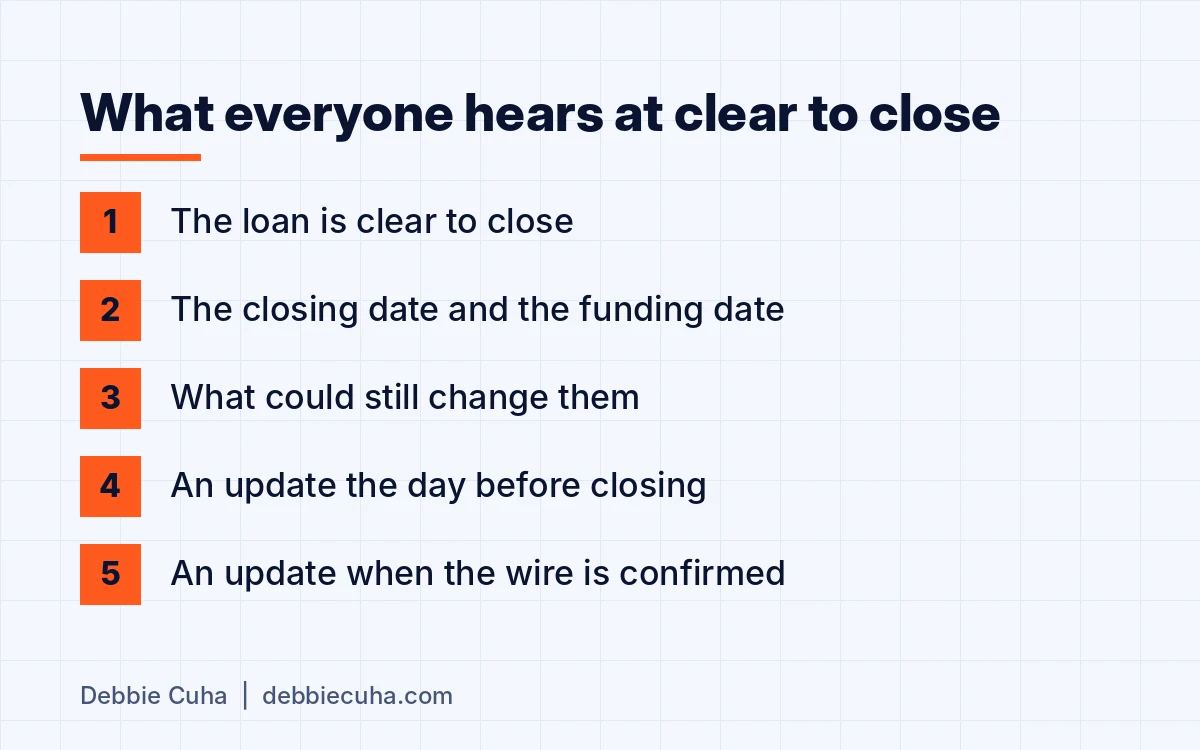
Three facts, the same day: the loan is clear to close, the closing date and the funding date, and what could still change them. Then one update the day before closing and one when the wire is confirmed.
The loan officer delivers these, because the loan officer owns every conversation about rate and terms. The closer supplies the dates. The wording I would use with an agent: "We are clear to close. Signing is set for [date]. Funding is planned for [date]. Two items remain before funding and both are ours." The rest of the agent update schedule is in the Tuesday update, and the agent's side of the same week is in the transaction coordinator SOP.
What do you do when closing is tomorrow and there is no clear to close?
Stop guessing and run the backward plan. If the Closing Disclosure has been received and the wait is satisfied, tomorrow may still be possible. If it has not, tomorrow is already gone, and everyone should hear that today.
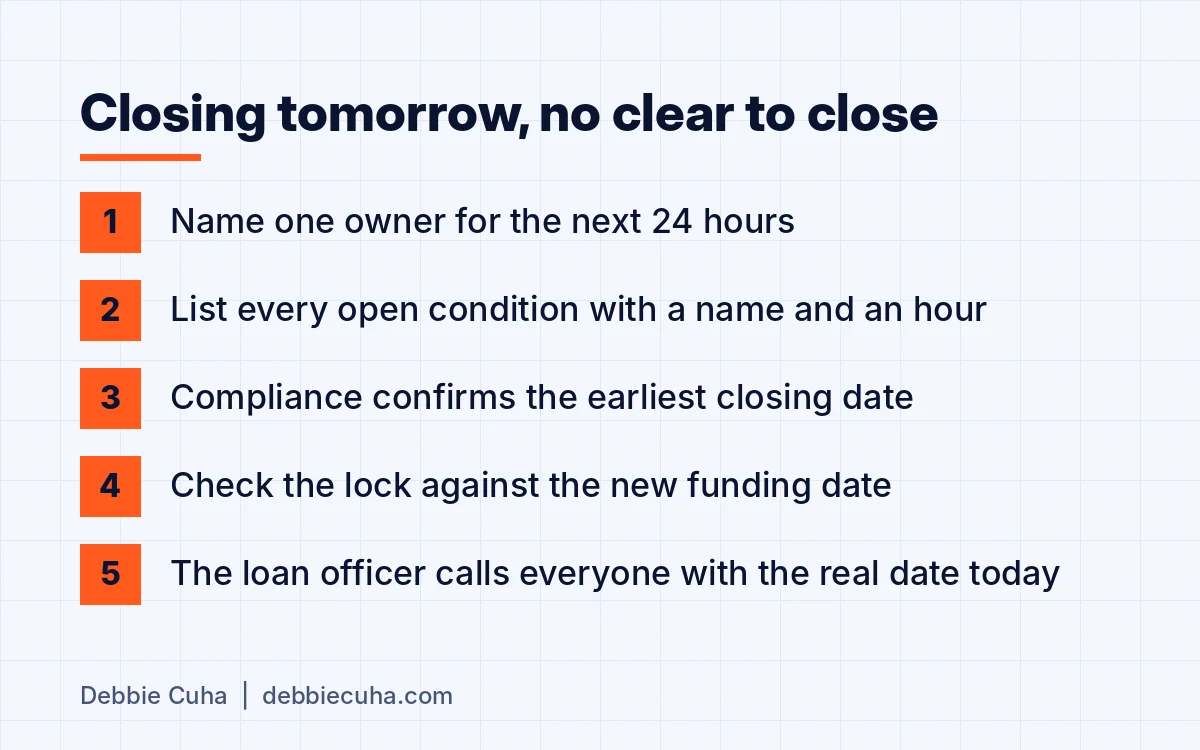
The order of work:
- The operations lead names one owner for the file for the next 24 hours.
- That owner lists every open condition with a name and an hour next to each.
- Compliance confirms the earliest closing date the disclosure timing allows.
- The closer checks the lock against the new funding date.
- The loan officer calls the borrower and both agents with the real date, the same day.
A file like this should have shown up days earlier in the daily exceptions meeting described in the mortgage processing SOP. When one gets through, write down why, and fix that step.
What goes wrong after clear to close?
Almost always one of six things. Each has a step in the SOP that catches it early.
| What goes wrong | The step that catches it |
|---|---|
| A change to the numbers after the Closing Disclosure | The frozen-numbers rule and one named decider |
| Documents drawn from stale figures | The pre-docs check |
| A signature, date or notary block missed at signing | Signed package review before funding |
| A prior-to-funding condition nobody listed | The list attached to the clear to close |
| A lock that expires before the real funding date | The backward plan |
| A wire sent late, or to the wrong instructions | The funding cutoff and the call-back verification |
None of these is a hard loan. They are ordinary loans with a step nobody owned, which is the same lesson as the loan officer to processor handoff.
What happens after funding?
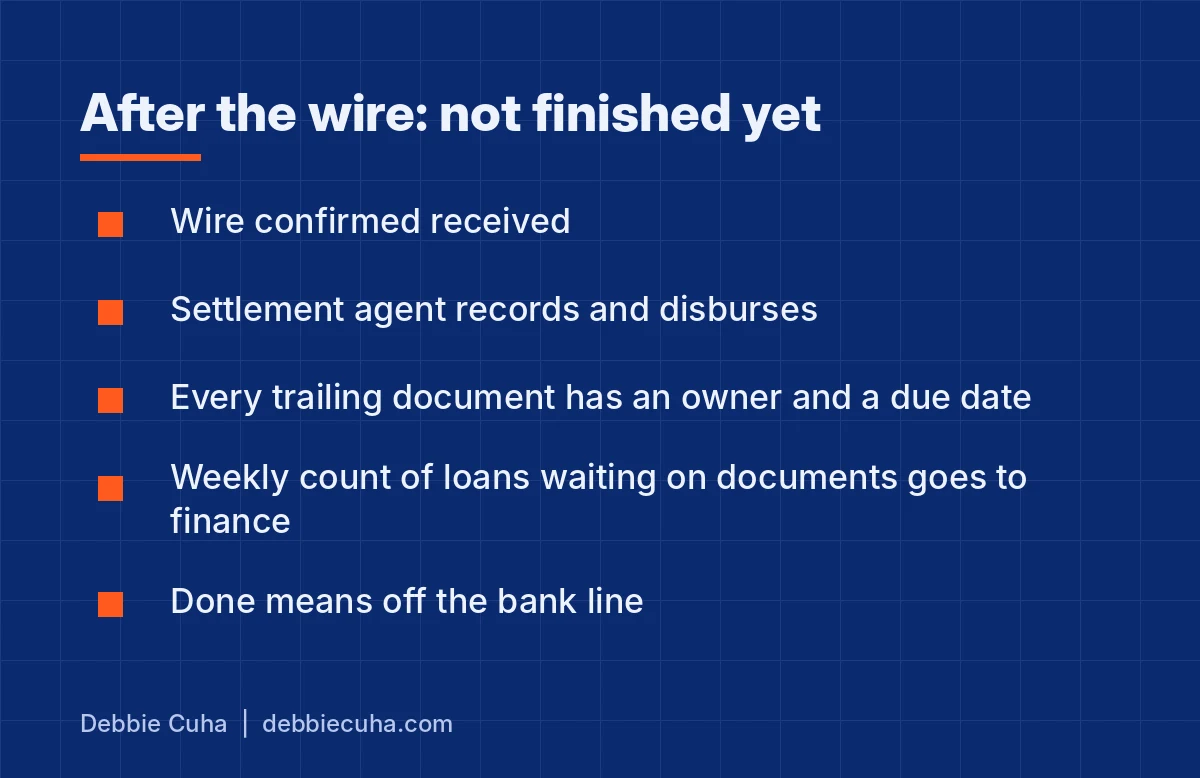
The file is not finished. The wire is confirmed, the settlement agent records and disburses, and post-closing starts collecting what trails in: the recorded security instrument, the final title policy and anything the investor requires.
When you fund on a bank line, a funded loan is still sitting on that line until it is delivered and paid for. So the post-closing checklist has a line for each trailing document with an owner and a due date, and the count of loans waiting on documents goes to finance every week. A loan is done when it is off the line.
What numbers tell you the closing desk is working?
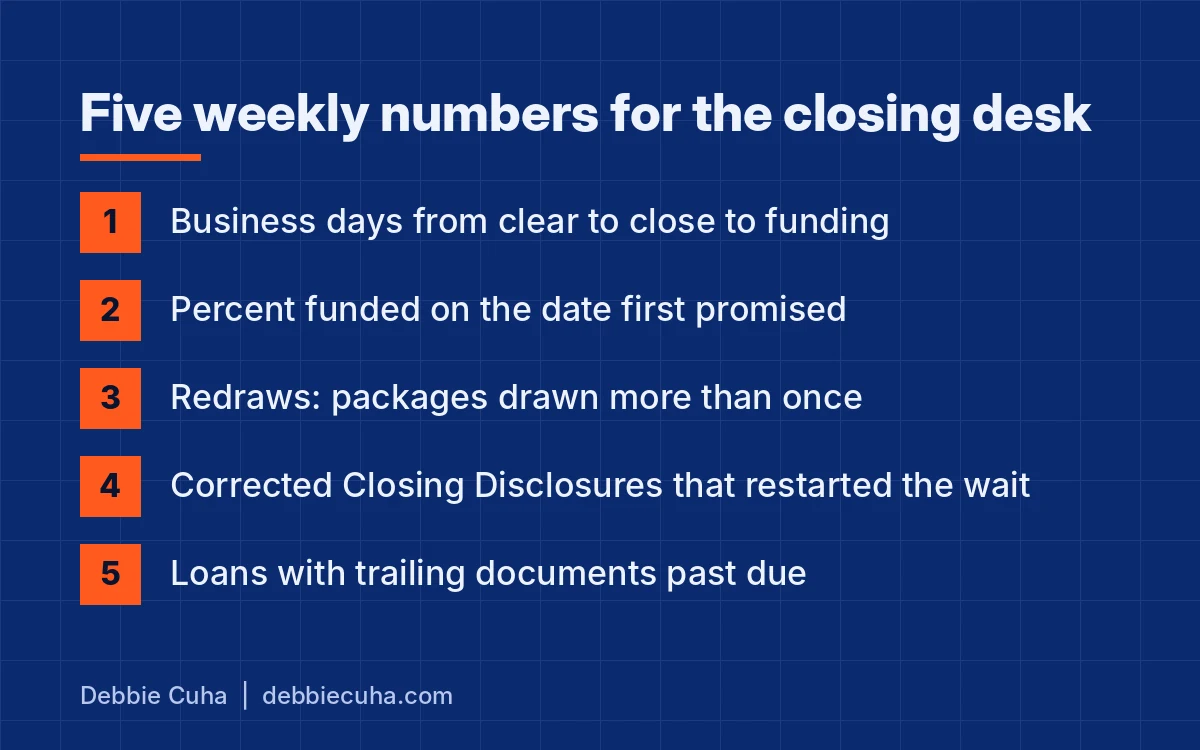
Five, reviewed weekly.
- Business days from clear to close to funding
- Percent of files funded on the date first promised
- Redraws: document packages drawn more than once
- Corrected Closing Disclosures that restarted the wait
- Loans funded with trailing documents past due
Add them to the mortgage branch version of the weekly numbers meeting. The second number is the one borrowers and agents feel, so it is the one I would put on the wall.
What does the one-page SOP look like?
Copy this and fill in the blanks with your compliance officer in the room.
CLOSING DESK SOP: CLEAR TO CLOSE TO FUNDING
Version date: ______  Owner: ______  Reviewed by compliance: ______

Trigger: underwriting issues clear to close with the open
prior-to-funding list, lock expiration and requested closing date.

1. Closer accepts the file within ___ business hours and runs
   the backward plan. Closing date and funding date go on the file.
2. Closer confirms Closing Disclosure receipt and the waiting
   period with compliance. Our policy on timing: ______
3. Numbers are frozen. Change requests go to ______ only.
4. Closer runs the pre-docs check. Docs out by ______ cutoff.
5. Loan officer tells the borrower and both agents: clear to
   close, closing date, funding date, what could change them.
6. Signed package back by ______. Funder reviews it.
7. Funder completes the funding authorization checklist.
   Second sign-off: ______. Wire released by ______ cutoff.
8. Funder confirms the wire was received. Loan officer tells
   the borrower and both agents.
9. Post-closing tracks every trailing document with an owner
   and a due date. Weekly count to finance.

Weekly numbers: days clear to close to funding, percent funded
on the promised date, redraws, restarted waits, trailing
documents past due.
Review it on the same schedule as every other procedure. That schedule is in the quarterly SOP audit, and where mortgage procedures sit beside the real estate ones is in the complete guide to real estate SOPs.
Next steps
- Get the free 12-SOP kit for the real estate side of the same closing.
- See how SOP consulting works if you want the closing desk procedures written for your branch.
- Or email me a question at dc@syngp.com. I read every one.