How Many Closings Do You Need? The Income Goal Math for Real Estate Agents
By Debbie Cuha, November 20, 2026. 11 min read

Take the pay you need to bring home in a year, divide it by one minus your tax set-aside rate, add your business expenses, then divide by what you keep from one closing after your split and fees. That is your closings number. Then turn it into conversations per week, because a week is the only part of the year you can still do something about.
Key takeaways
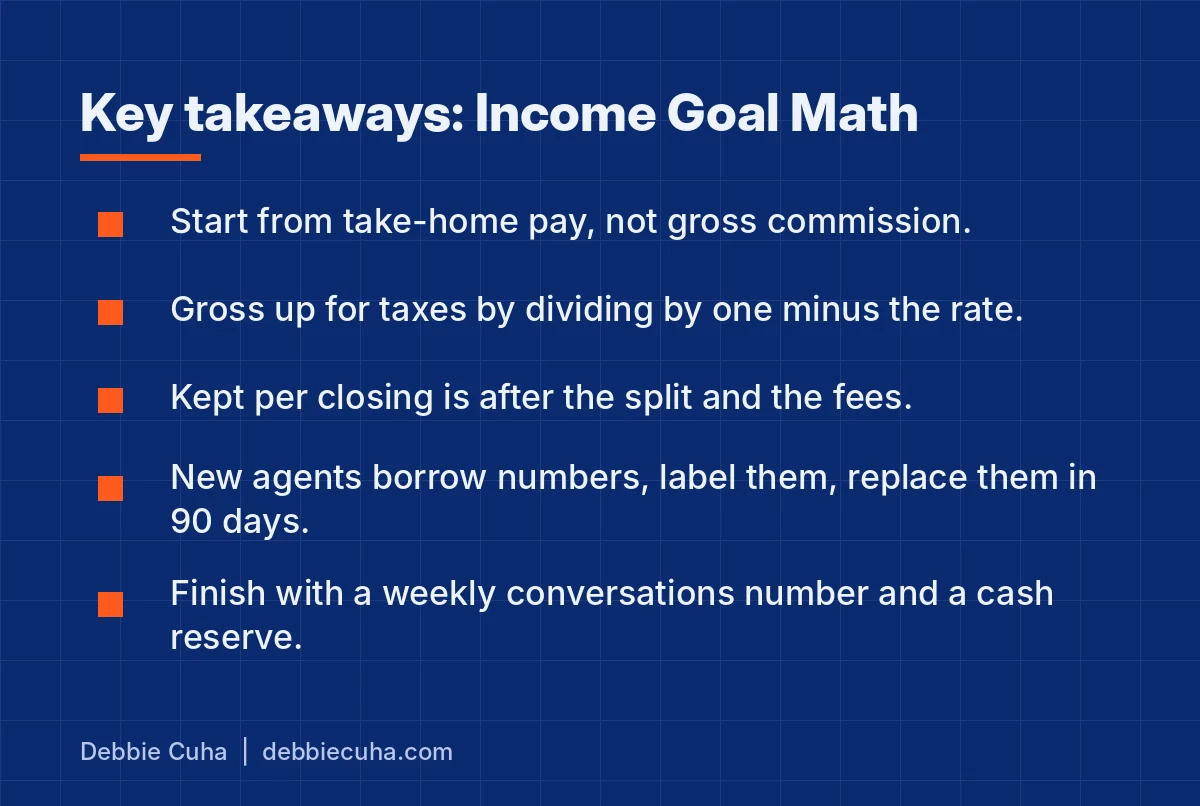
- Start from take-home pay, not gross commission. Gross commission is revenue. It is not your income.
- Gross up for taxes by dividing by one minus the rate. Adding the percentage on top leaves you short.
- What you keep per closing is the commission after the split and the per-file fees, not the number on the settlement statement.
- A new agent borrows conversion numbers from their own team or broker, labels them borrowed, and replaces them after 90 days.
- The plan is not finished until it is one weekly conversations number and a cash reserve that covers the wait for the first check.
I have been a CFO since 2000, including at DirectLender.com, where I was co-founder and CFO. So I do this math the way a finance person does it: from what has to be left at the bottom, back up to the top.
How many closings do you need to hit an income goal?
Closings needed equals the net commission you need for the year, divided by what you keep per closing. Net commission needed is your pre-tax profit plus your business expenses. Round up, never down.
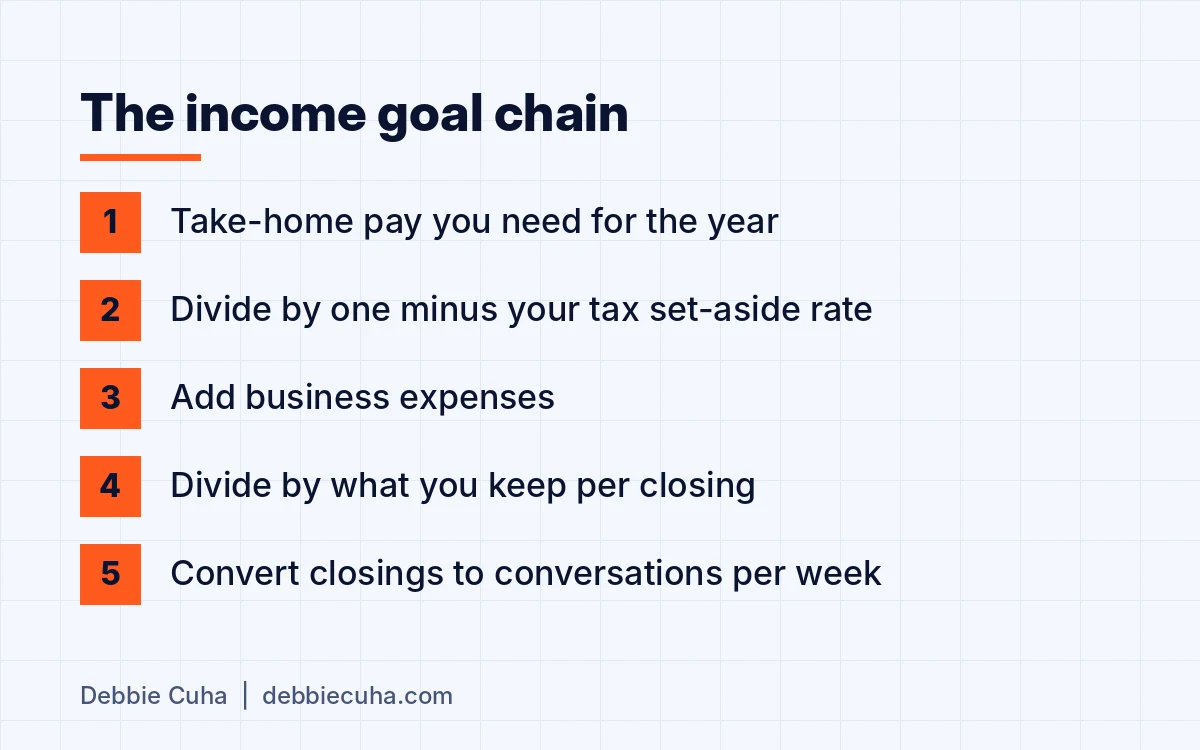
Here is the chain in order:
- Take-home pay you need for the year
- Divided by (1 minus your tax set-aside rate) equals pre-tax profit
- Plus business expenses equals net commission needed
- Divided by what you keep per closing equals closings
- Worked backward through your own conversion numbers equals conversations per week
Should you start from gross commission or from take-home pay?
Start from take-home pay. A gross commission goal tells you what came in the door. It says nothing about what is left after the brokerage, the expenses and the taxes, and what is left is the only number your household runs on.
The common worksheets start with last year's gross commission or a round income figure and never say whether it is before or after taxes. An agent can hit that number and still be short on the mortgage. I would rather you find that out in November on paper than next October in your bank account.
Tom Ferry's article on how to write a business plan for goals and marketing, published November 24, 2025, says to start with clear income and life goals and work backward, and to set quarterly targets for transactions closed, gross commission income and after-tax profits. I agree with all of it. This post is the arithmetic between the first number and the last.
How much do you add for taxes?
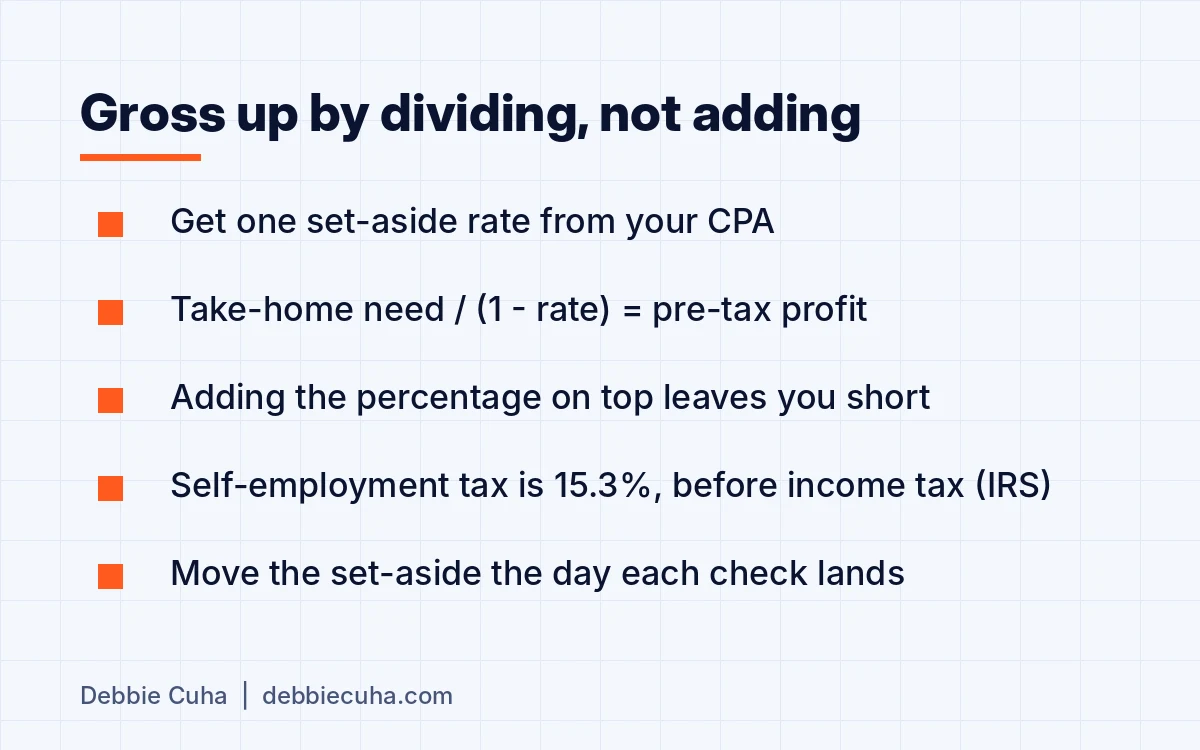
Ask your CPA for one number: the percent of profit to set aside for all taxes. Then divide your take-home need by one minus that rate. Do not add the percentage on top of your take-home need. That shortcut is wrong and it always comes up short.
Example numbers, to show the arithmetic only: you need $90,000 to live on and your CPA says to set aside 30 percent.
| Method | Math | Pre-tax profit needed |
|---|---|---|
| Add the rate on top (wrong) | $90,000 x 1.30 | $117,000 |
| Divide by one minus the rate (right) | $90,000 / 0.70 | $128,571 |
Check the wrong one: 30 percent of $117,000 is $35,100, which leaves $81,900. You are $8,100 short of the $90,000 you said you needed, and you will not see it until the tax bill.
The rate is higher than most new agents expect, because an independent contractor pays both halves of Social Security and Medicare. The IRS states the self-employment tax rate is 15.3 percent, made up of 12.4 percent for Social Security and 2.9 percent for Medicare (IRS, page last reviewed October 30, 2026). That is before income tax. The same page says a self-employed person may have to file estimated taxes quarterly. Move the set-aside into a separate account the day each commission check lands, so it is never counted as money you have. I am not giving tax advice. Your rate comes from your CPA, not from me and not from a blog.
Which business expenses go in the number?
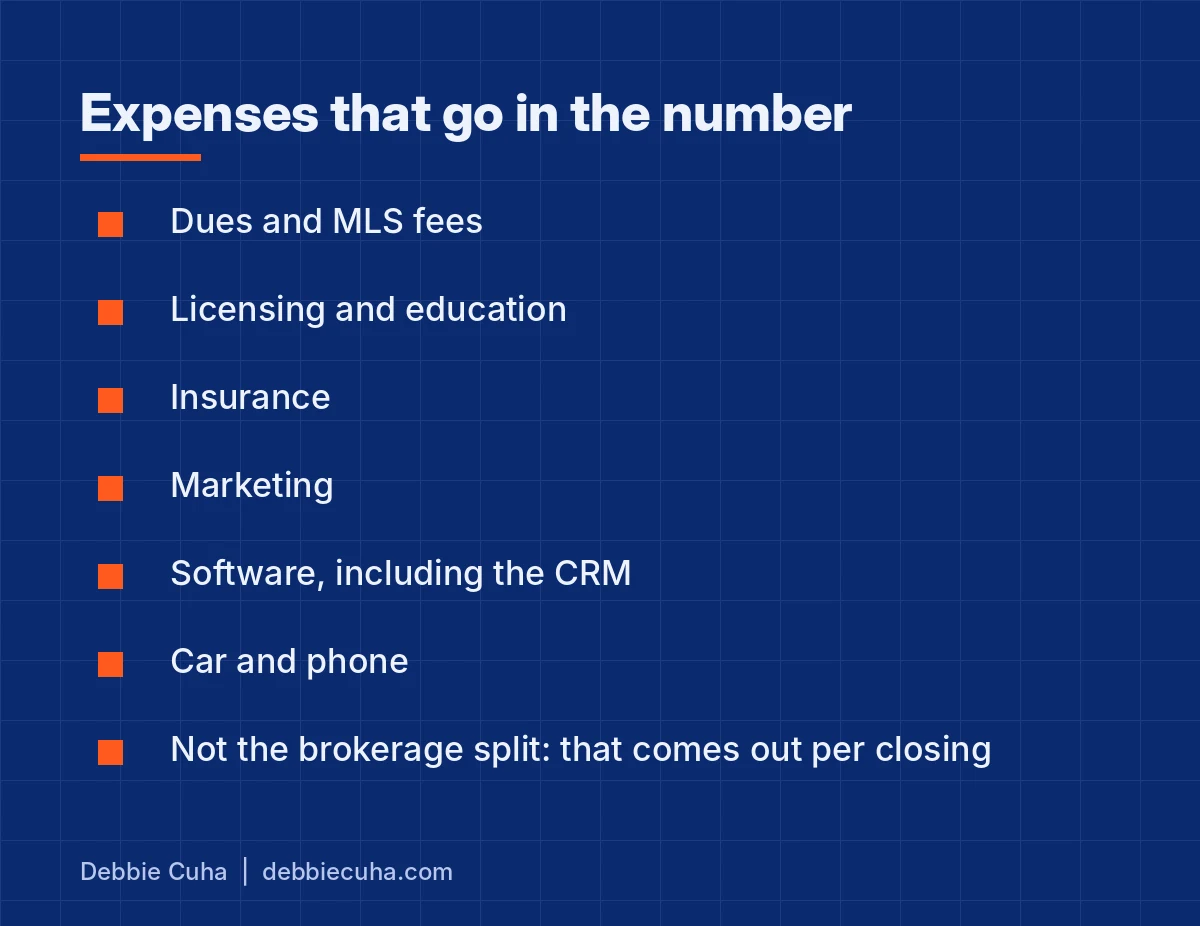
Every dollar the business spends that the brokerage does not take out of your check first: dues and MLS fees, licensing and education, insurance, marketing, software, your car and your phone. Use last year's actual total.
If you are new, ask your broker for the fixed costs in writing and add what you plan to spend on marketing. Do not put the brokerage split here. It comes out per closing in the next step. Count it in both places and you will scare yourself with a number that is too high.
What do you actually keep per closing?
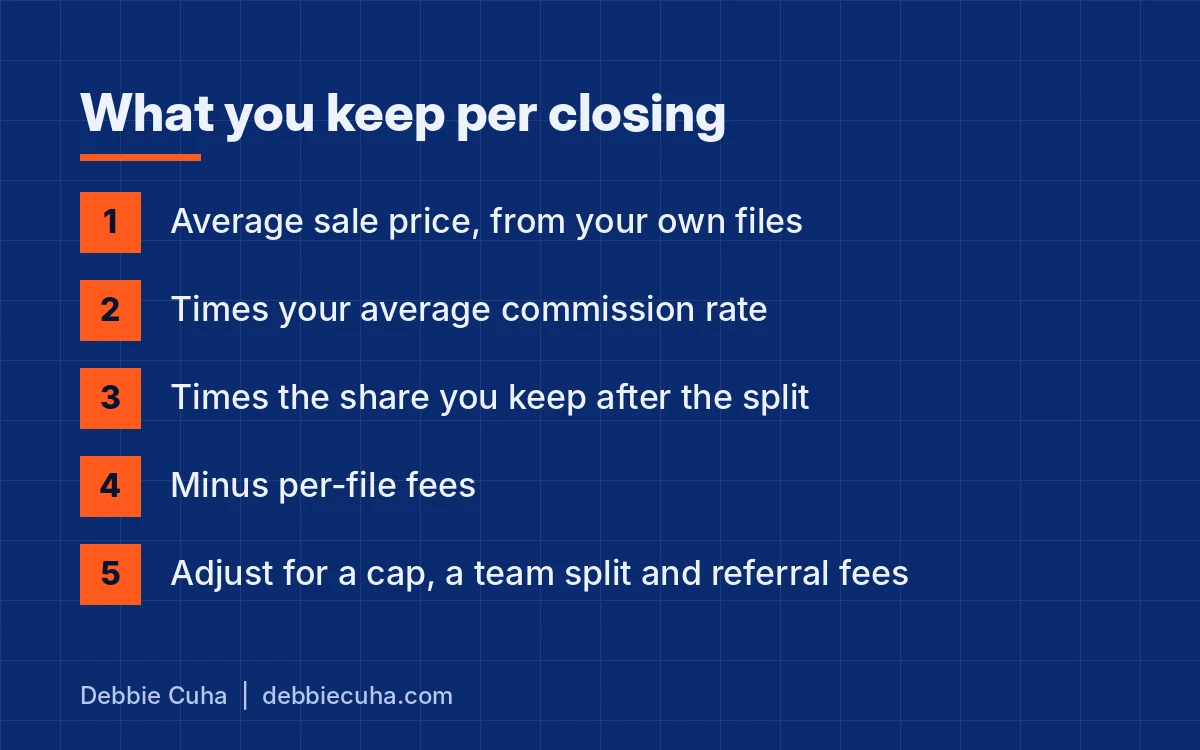
What you keep per closing is your average sale price, times your average commission rate, times the share you keep after the split, minus any per-file fees. Read all four off your own closed files and your own brokerage agreement.
Continuing the example: a $400,000 average price at 2.5 percent is $10,000. At an 80 percent split you keep $8,000. Take off a $300 transaction fee and you keep $7,700.
Three things move this number:
- A cap. If your split stops once you have paid the brokerage a set amount in a year, work out the year in two parts: closings before the cap and closings after it.
- A team split. If you are on a team, the team's share comes out before yours. Use the number that lands in your account.
- Referral fees. A lead that came with a referral fee pays less. If a real share of your business comes that way, use a blended average.
How do you turn closings into a weekly number?
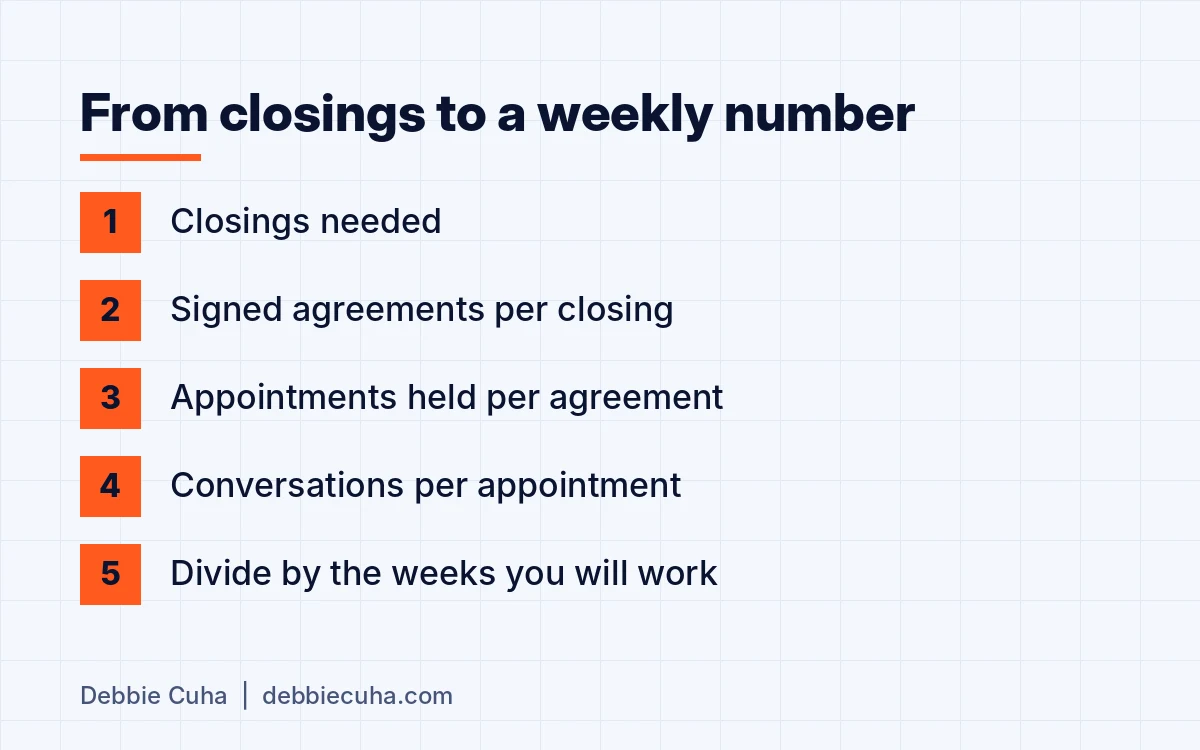
Work backward through your own conversion numbers, one step at a time, then divide by the weeks you will work. The chain is closings, signed agreements, appointments held, conversations. These are the same numbers that sit on the agent scorecard.
The example, with made-up ratios that are not benchmarks:
- $128,571 pre-tax profit plus $24,000 of expenses is $152,571 of net commission needed
- $152,571 divided by $7,700 is 19.8, so 20 closings
- If 8 of every 10 signed agreements close, 20 closings takes 25 signed agreements
- If 1 of every 2 appointments held becomes a signed agreement, that is 50 appointments
- If it takes 20 conversations to hold one appointment, that is 1,000 conversations
- Over 46 working weeks, that is 22 conversations and about one appointment a week
Twenty closings is a wish. Twenty-two conversations by Friday is a job. The new agent daily schedule is where that weekly number gets its hours.
What if you are new and have no numbers of your own?
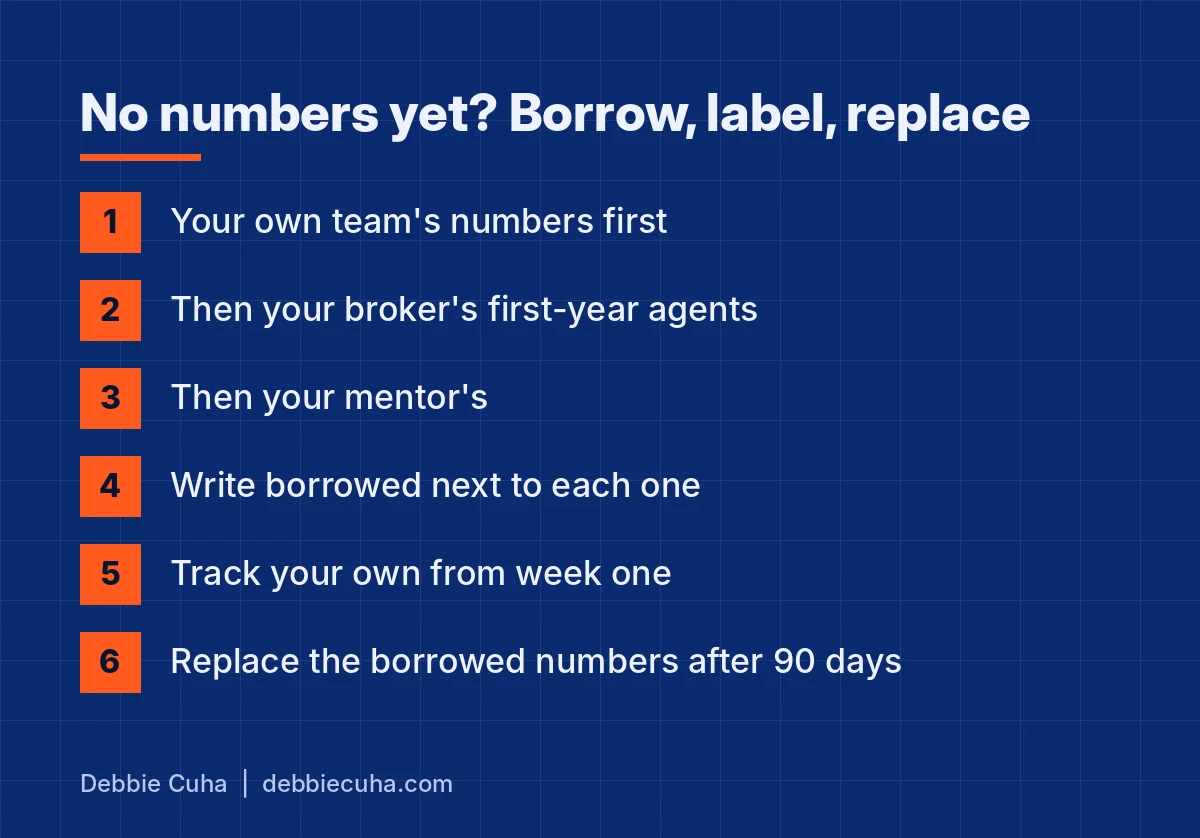
Borrow them from the closest real source, in this order: your own team's numbers, your broker's numbers for agents in their first year, then your mentor's. Write "borrowed" next to each one. Replace each with your own after 90 days of tracking.
Do not take conversion ratios from an article, including this one. The ratios in my example exist to show the arithmetic. A ratio depends on who you are talking to, how warm they are and how good you are at asking, and none of that travels from one agent to another.
Borrowed numbers will be wrong. That is fine. A wrong number you correct every quarter beats no number, and tracking from the first week is what the first 90 days plan is built around.
Should buyer and listing sides be counted separately?
Yes, as soon as you have both. The average price, the commission rate and every conversion ratio can differ between a buyer side and a listing side. Run the worksheet twice and add the two closings numbers together.
If you are new and nearly all buyers, run it once and add the listing column when you take your first listing. One honest column beats two guessed ones.
When does the money actually arrive?
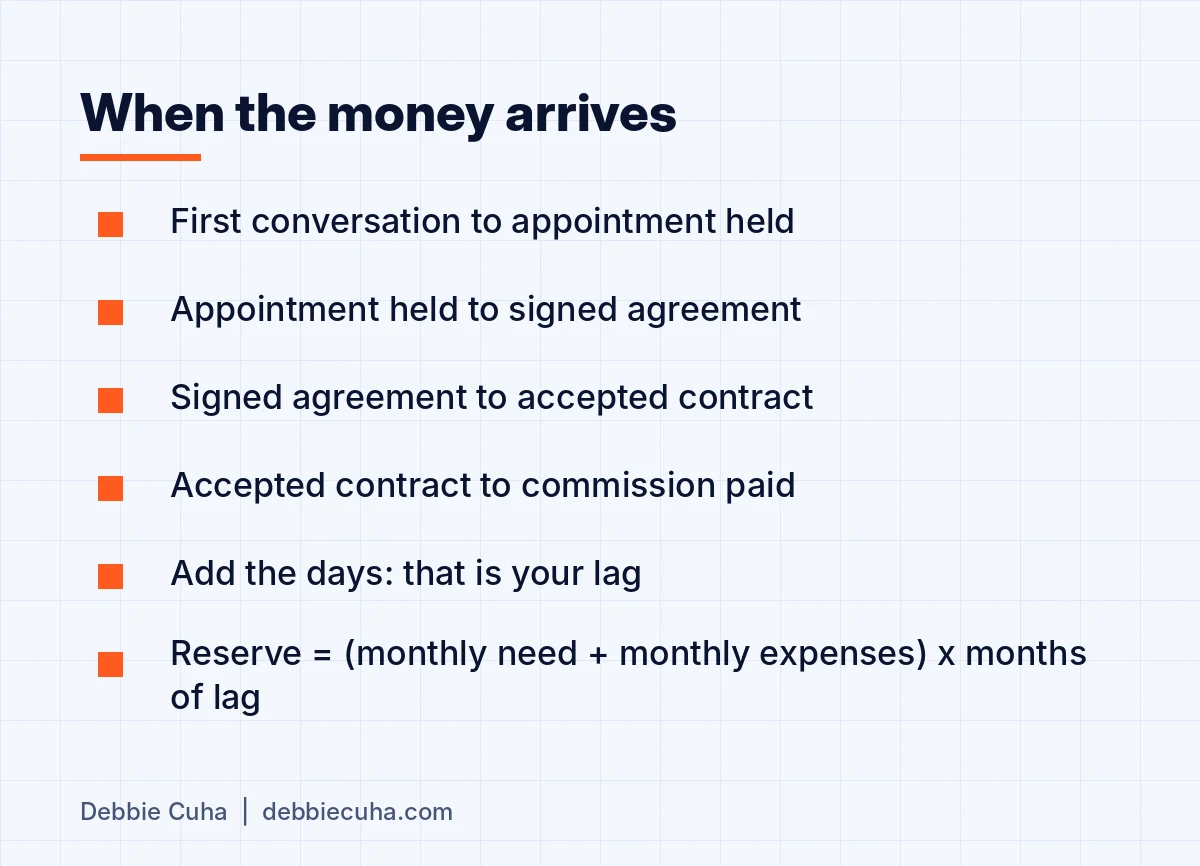
Later than the plan says. A closing pays on the closing date, and the work that produced it happened weeks or months before. Count the days in each stage from your own files, or your team's, and add them up. That total is your lag.
| Stage | Days (yours) |
|---|---|
| First conversation to appointment held | ___ |
| Appointment held to signed agreement | ___ |
| Signed agreement to accepted contract | ___ |
| Accepted contract to closing and commission paid | ___ |
| Total lag | ___ |
Then size the reserve from the lag, not from a rule of thumb:
Reserve = (monthly take-home need + monthly business expenses) x months of lag
This is the piece the usual income goal worksheet leaves out. The annual math can be right and the agent can still run out of cash in month three, because the plan assumed the checks arrive evenly from January. They do not. I wrote about what honest books look like when cash is tight in rebuilding after losing everything.
What does the full worksheet look like?
Fourteen lines. Copy the table, fill in the "Yours" column, and keep the example column only until you trust your own.
| Line | Item | How to get it | Example | Yours |
|---|---|---|---|---|
| A | Take-home pay needed for the year | Your household budget | $90,000 | |
| B | Tax set-aside rate | Your CPA | 30% | |
| C | Pre-tax profit needed | A / (1 - B) | $128,571 | |
| D | Business expenses for the year | Last year's actual, or your broker's list | $24,000 | |
| E | Net commission needed | C + D | $152,571 | |
| F | Average sale price | Your closed files, or your team's | $400,000 | |
| G | Average commission rate per side | Your closed files | 2.5% | |
| H | Share you keep after the split | Your brokerage agreement | 80% | |
| I | Per-file fees | Your brokerage agreement | $300 | |
| J | Kept per closing | (F x G x H) - I | $7,700 | |
| K | Closings needed | E / J, rounded up | 20 | |
| L | Signed agreements needed | K / share of agreements that close | 25 | |
| M | Appointments held needed | L x appointments per agreement | 50 | |
| N | Conversations per week | (M x conversations per appointment) / weeks worked | 22 |
Every example figure is there to show the arithmetic. None of them is a benchmark, and none of them is yours.
How often should you redo the math?
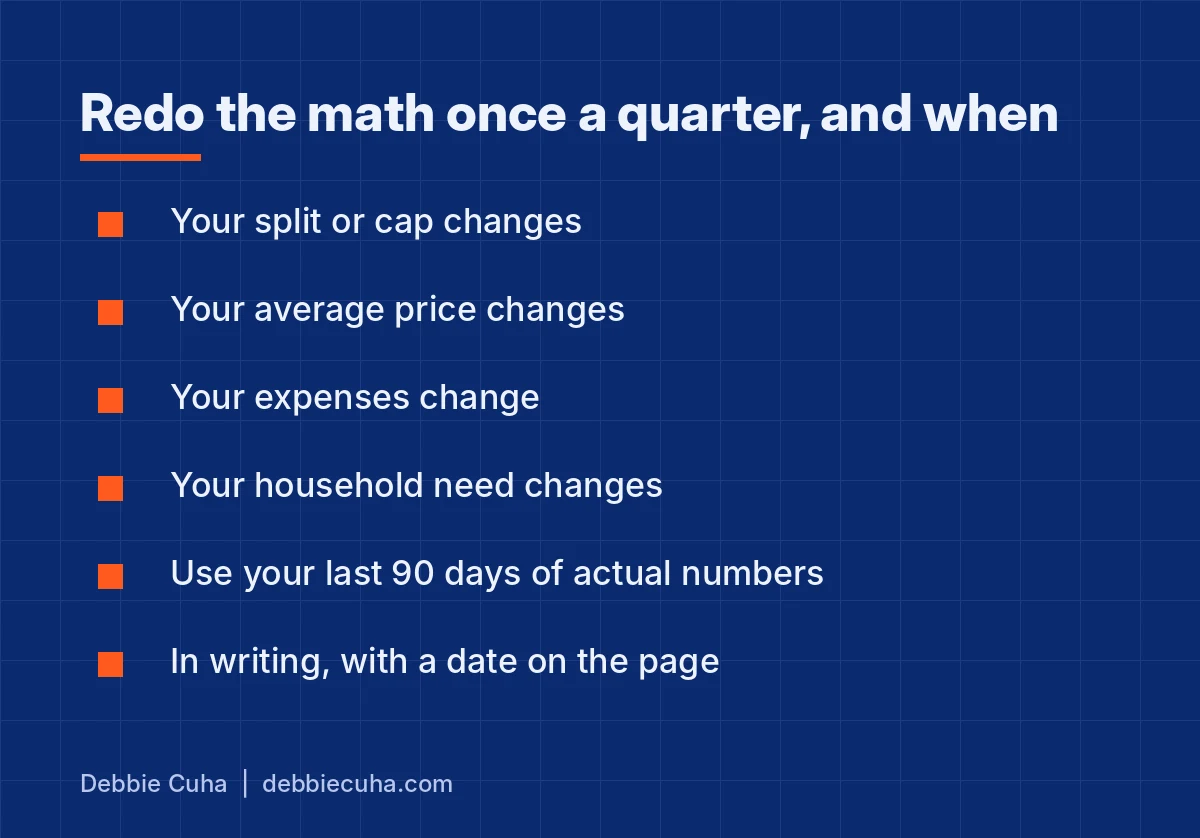
Once a quarter, and any time one of four things changes: your split or cap, your average price, your expenses, or your household's need. Redo lines F through N with your actual numbers from the last 90 days.
Tom Ferry's business plan articles give the same rhythm. Fundamentals of a workable real estate business plan, published August 3, 2026, says most agents should review and adjust the plan quarterly, and tells agents to treat commission income as business revenue and not as personal cash flow. That second point is this whole post in one line.
What I would add: do not move the goal in the middle of a quarter because of one good month or one bad one. Change the inputs on the review date, in writing, with the date on the page. It is the same discipline as the quarterly SOP audit.
What do you do with the weekly number?
Put it on the scorecard and report it every week. Line N is the conversations standard on your scorecard, and it is the first number in your weekly one-on-one if you are on a team.
If you lead a team, have every agent fill in this worksheet themselves and hand you line K and line N. A number an agent calculated from their own budget is harder to argue with than one you assigned. How those numbers roll up for the team is in the weekly numbers meeting, and where all of this sits among the other procedures is in the SOPs every real estate team needs.
Next steps
- Get the free 12-SOP kit. The weekly numbers review is in it, and it is where line N gets checked.
- See how SOP consulting works if you want the numbers, the scorecard and the procedures built for your team.
- Or email me your worksheet at dc@syngp.com. I read every one.