Lead Routing Rules: How to Distribute Leads on a Real Estate Team
By Debbie Cuha, November 17, 2026. 10 min read
Distribute team leads by a written rule, not by a daily decision. Start with round robin among the agents who are eligible that week, give each lead a short window to be accepted, reroute it when the window closes, and list the leads that never enter the rotation. The whole rule fits on one page.
Key takeaways
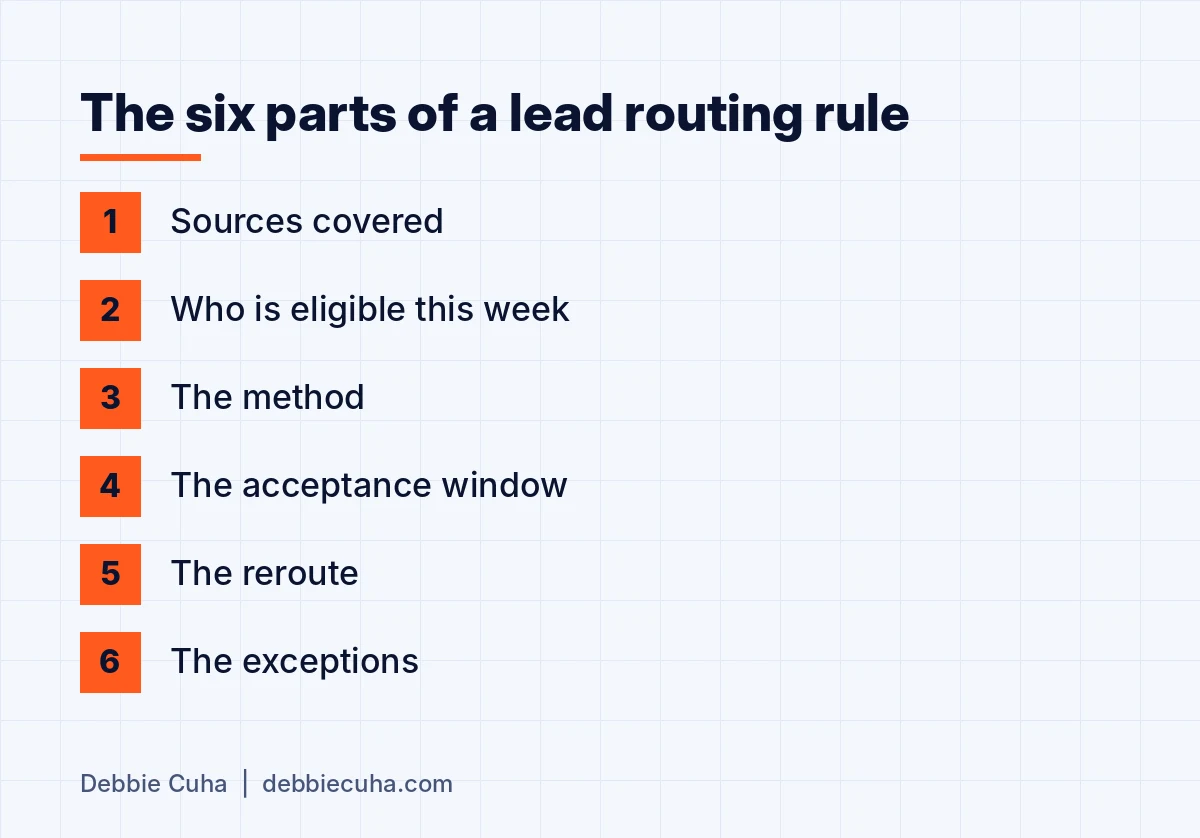
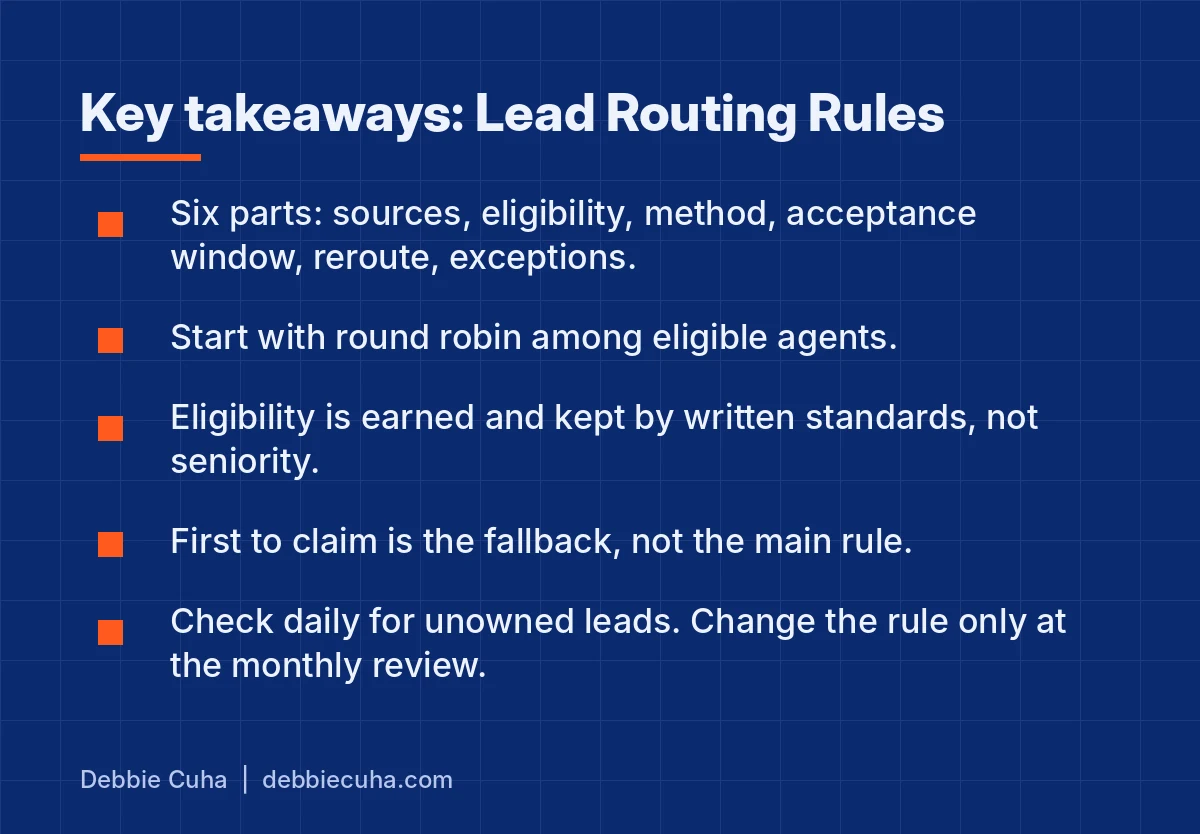
- A routing rule has six parts: sources, eligibility, method, acceptance window, reroute and exceptions.
- Start with round robin among eligible agents. Add weighting only after 90 days of conversion numbers.
- Eligibility is earned and kept by meeting written standards. It is not seniority.
- First to claim is the fallback for a lead nobody accepted. It is not the main rule.
- Check daily for unowned leads and monthly for fairness. Change the rule only at the monthly review.
At DirectLender.com I wrote the policies and SOPs for 280 offices and about 3,000 people. At that size a rule cannot live in one manager's head. It has to be on paper, and it has to read the same way to everyone it touches.
What is a lead routing rule?
A lead routing rule is the written answer to one question: when a new lead arrives, who owns it, and by when? It names the sources it covers, who is eligible, the method, the acceptance window, the reroute and the exceptions.
Tom Ferry's article on how to build a real estate team that scales, published October 1, 2026, says to systematize lead distribution before lead volume increases. It tells team leaders to document who receives each lead, the expected response time, where follow-up is recorded and when an unanswered lead is reassigned. This post is how I would put that on one page.
Routing is the second half of SOP 1, lead intake and routing, in my free 12-SOP kit. It ends where the speed-to-lead SOP begins.
What are the ways to distribute leads?
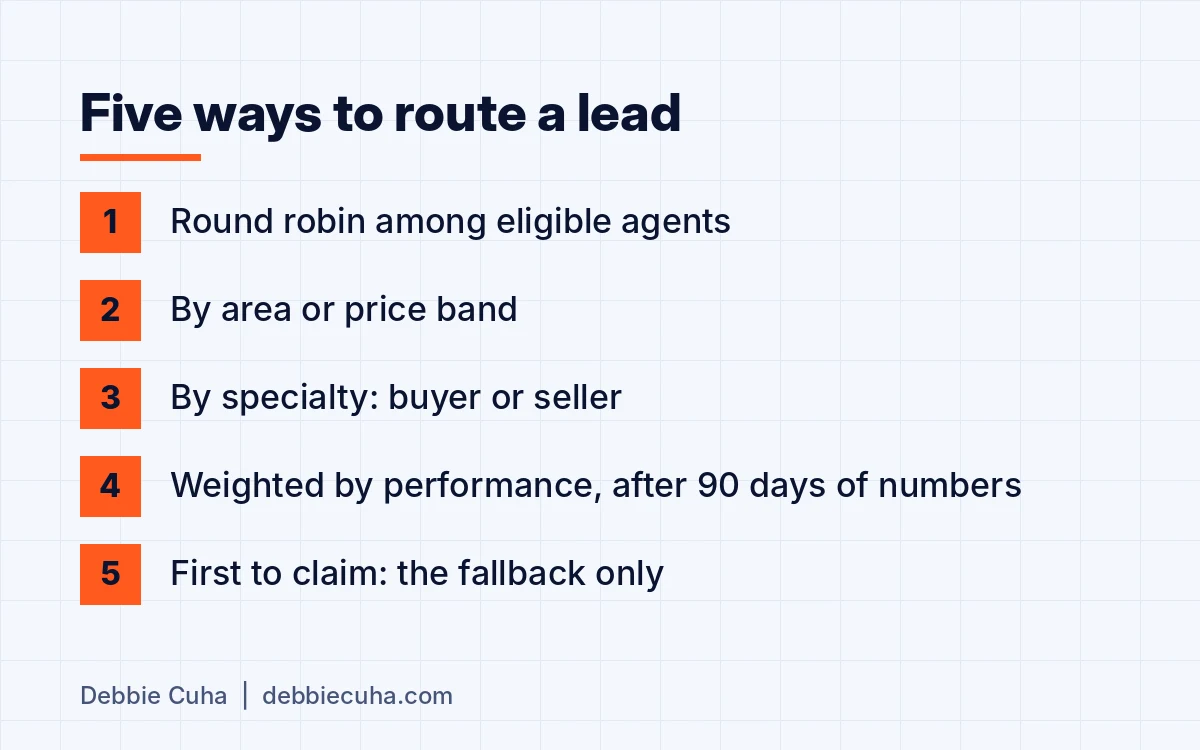
There are five common methods: round robin, by area or price, by specialty, weighted by performance, and first to claim. Each one is a setting in a CRM with lead routing. Choosing between them is a management decision, not a technical one.
| Method | How it works | Fits when | Watch for |
|---|---|---|---|
| Round robin | Each new lead goes to the next eligible agent in order | Agents have similar skills and availability | An agent who is out and not marked out |
| By area or price | The lead goes to the agent assigned to that area or price band | The team covers distinct markets | Uneven lead counts between territories |
| By specialty | Buyer leads to buyer's agents, seller leads to listing agents | The team has defined roles | One specialist holding too many leads |
| Weighted by performance | Agents who convert get a larger share | You have 90 days of numbers by agent | New agents starved of leads |
| First to claim, or a pond | The lead is offered to a group and the first to accept owns it | As the fallback for an unaccepted lead | It rewards whoever is watching a phone |
Which method should a team start with?
Start with round robin among eligible agents. It is the one method a team can check without an argument, because every eligible agent can count their own turns. Add area, specialty or weighting later, one change at a time, when a number tells you to.
A team of two or three still writes the rule. It may be one line: seller leads go to the team leader and buyer leads alternate. One written line beats a decision made fresh every morning.
Who should be eligible to receive leads?
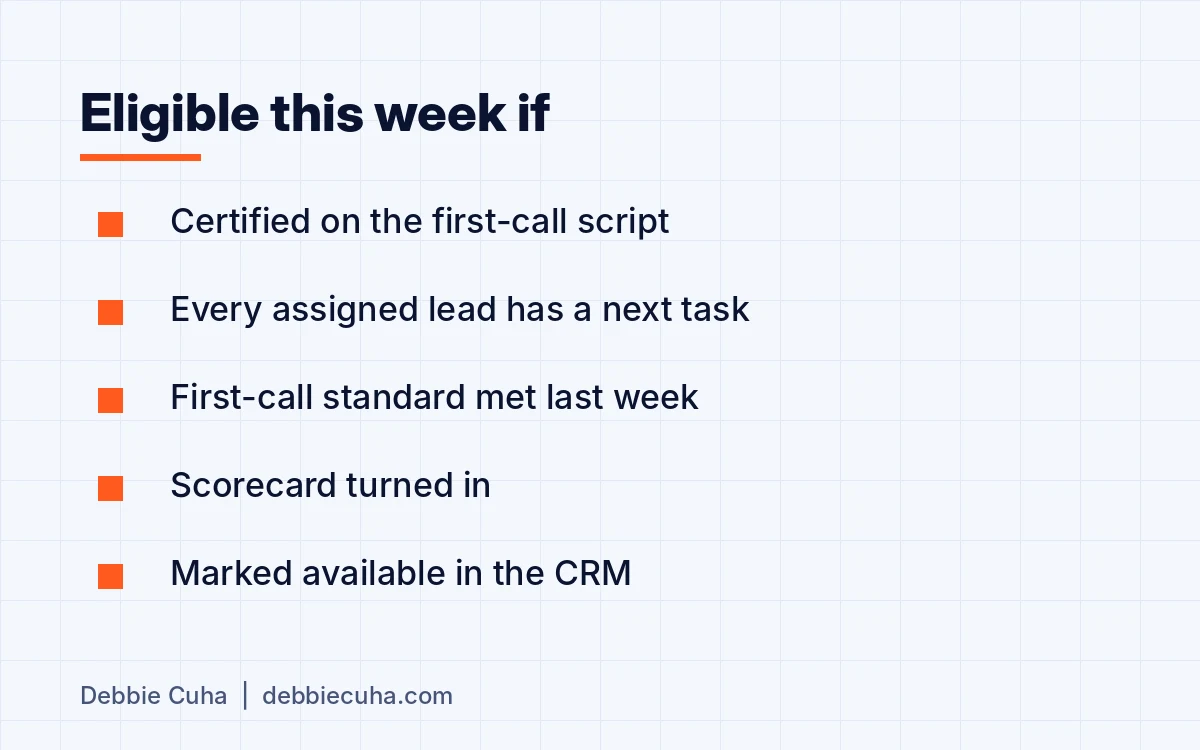
An agent is eligible when they have earned routing and kept it that week. Eligibility is a list of conditions anyone can check. It is not a judgment call and it is not seniority.
The conditions I would write:
- Passed role-play certification on the first-call script. That is the "certification before leads" step in the agent onboarding SOP.
- Every lead already assigned to them has a next task in the CRM.
- Met the first-call standard last week.
- Turned in last week's scorecard.
- Marked available in the CRM.
An agent who misses a condition comes out of the rotation for the week and goes back in when the condition is met. No meeting and no speech. The rule does the work, which is the point of accountability without micromanaging.
Should top producers get more leads?
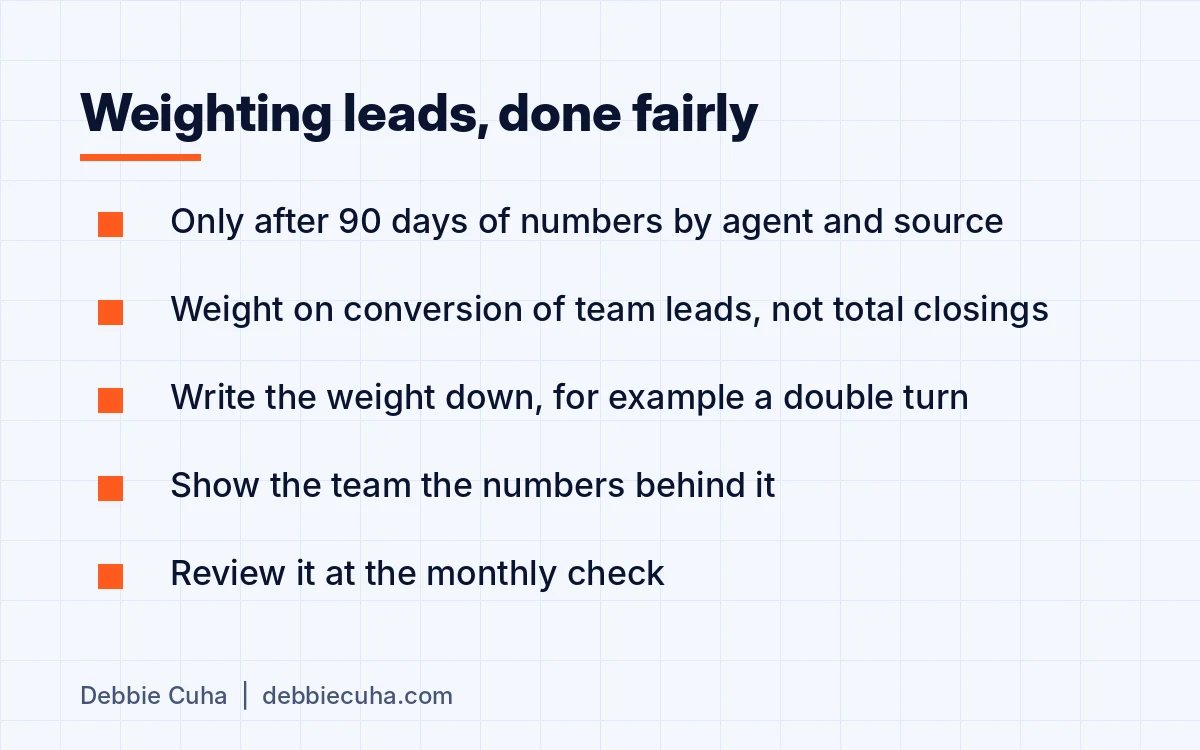
Not by default. Give a larger share to the agents who convert team leads, and only after you have at least 90 days of conversion numbers by agent and by source. Write the weight down, for example a double turn, and show the team the numbers behind it.
Weight on conversion of the leads the team hands out, not on total closings. An agent with a full pipeline of their own business can be the slowest person on the team to call a new lead.
Is first to claim fair?
No, not as the main rule. First to claim rewards the agent who is watching a phone and penalizes the agent who is in an appointment doing the job. Use it as the fallback when an assigned lead is not accepted.
The usual advice lists first to claim and lead ponds as equal choices beside round robin. I disagree for a second reason. Nobody is responsible for a lead nobody claimed. A routing rule has to end with a named person every time.
How long should an agent have to accept a lead?
Shorter than your first-call standard, or the two rules fight each other. If the team standard is a first call within five minutes during business hours, a long acceptance window cancels it before the agent has touched the lead.
Pick a number in minutes and write it down. I would use five minutes during business hours and a separate number for after hours. Accepting means one thing: the agent takes ownership in the CRM and the first call starts.
What happens when a lead is not accepted?
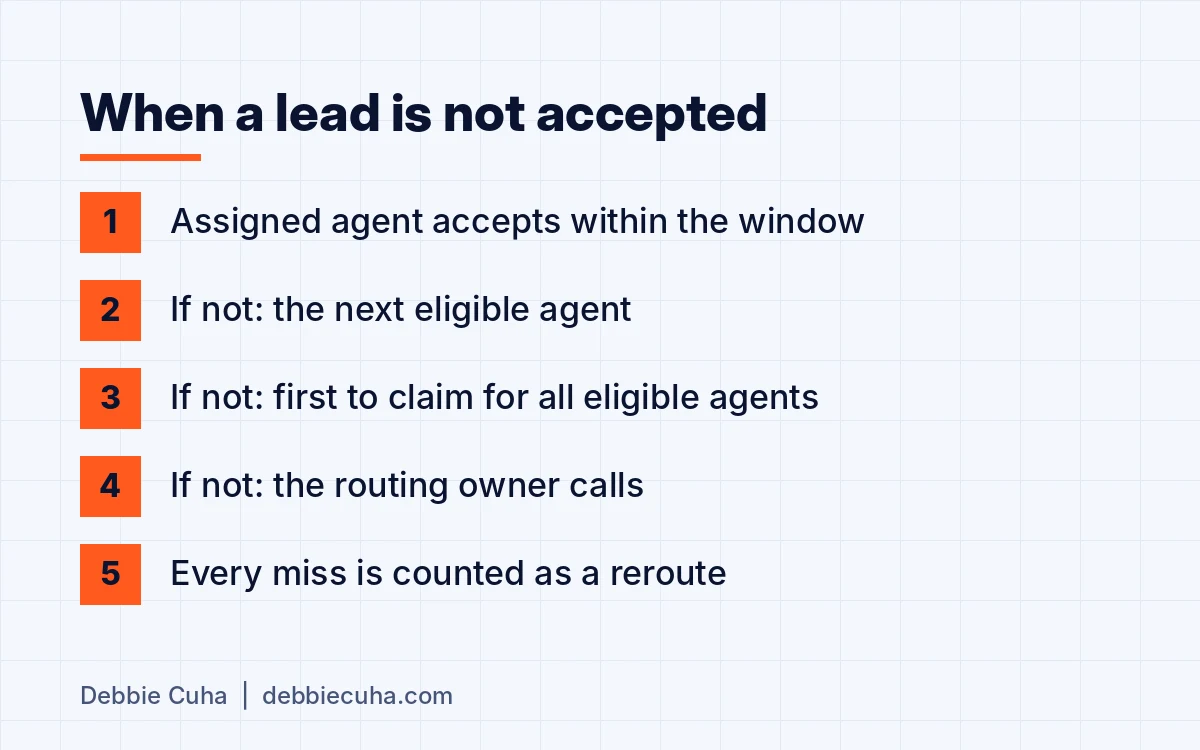
It moves on its own, and the move is counted. When the window closes, the lead goes to the next eligible agent. If that agent does not accept, it goes to first to claim for every eligible agent. If nobody claims it, the routing owner makes the call.
Each miss is a reroute on the first agent's record. Reroutes per agent is one of the numbers in the monthly check.
Which leads never go into the rotation?
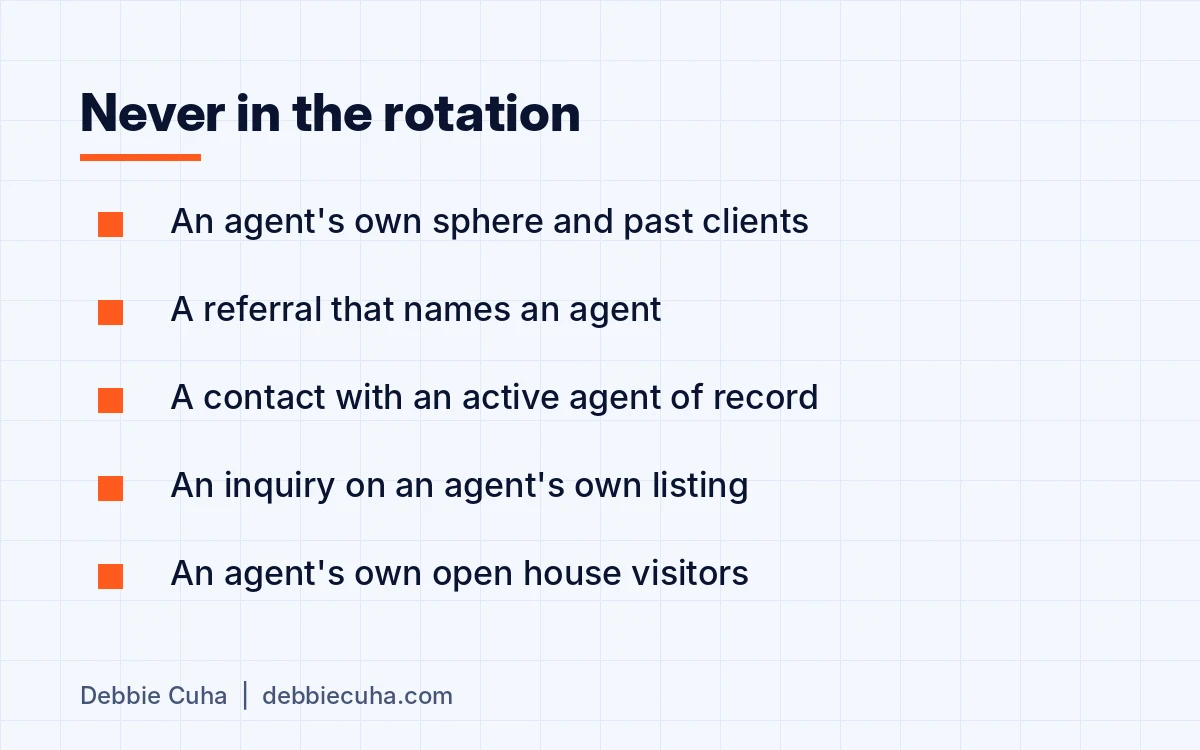
Leads that already belong to someone. Write the exceptions down so that no agent has to argue for their own client.
| Lead | Goes to |
|---|---|
| An agent's own sphere, past client or personal referral | That agent |
| A referral that names an agent | The named agent |
| A contact already in the CRM | The agent of record, unless that agent has logged no activity on the contact in your set number of days |
| An inquiry on an agent's own listing | The listing agent, unless your team agreement says otherwise |
| An open house visitor | The agent who held the open house |
| A hand assignment | Team leader only, logged with a one-line reason |
The duplicate check comes before routing, not after. If your database cannot tell you who the agent of record is, run the CRM cleanup SOP first.
What happens after hours or when an agent is out?
An agent who is out is marked out in the CRM and skipped, with no penalty. After hours, the rule names who is on duty, or says the first touch is an automated text with a call at a set time the next morning.
Planned time off is not a miss. Being marked available and not accepting is. The after-hours choices are laid out in the speed-to-lead SOP.
What should a routing rule never be based on?
Route on what the lead asked for and where it came from: source, area, price, property type, buyer or seller. Never route on who you think the person is.
Fair housing rules apply to how a team serves people. I am not giving legal advice. Have your broker review the routing rule before it goes live, and write the review date on the page.
Who owns the routing rule?
One person. The inside sales agent or the team admin owns it, and the team leader owns it until that role is hired.
The owner runs the unassigned and unaccepted report every day at a set time and clears every exception before the end of the day. A routing rule with no daily check is a setting somebody chose once and forgot.
How do you know routing is fair and working?
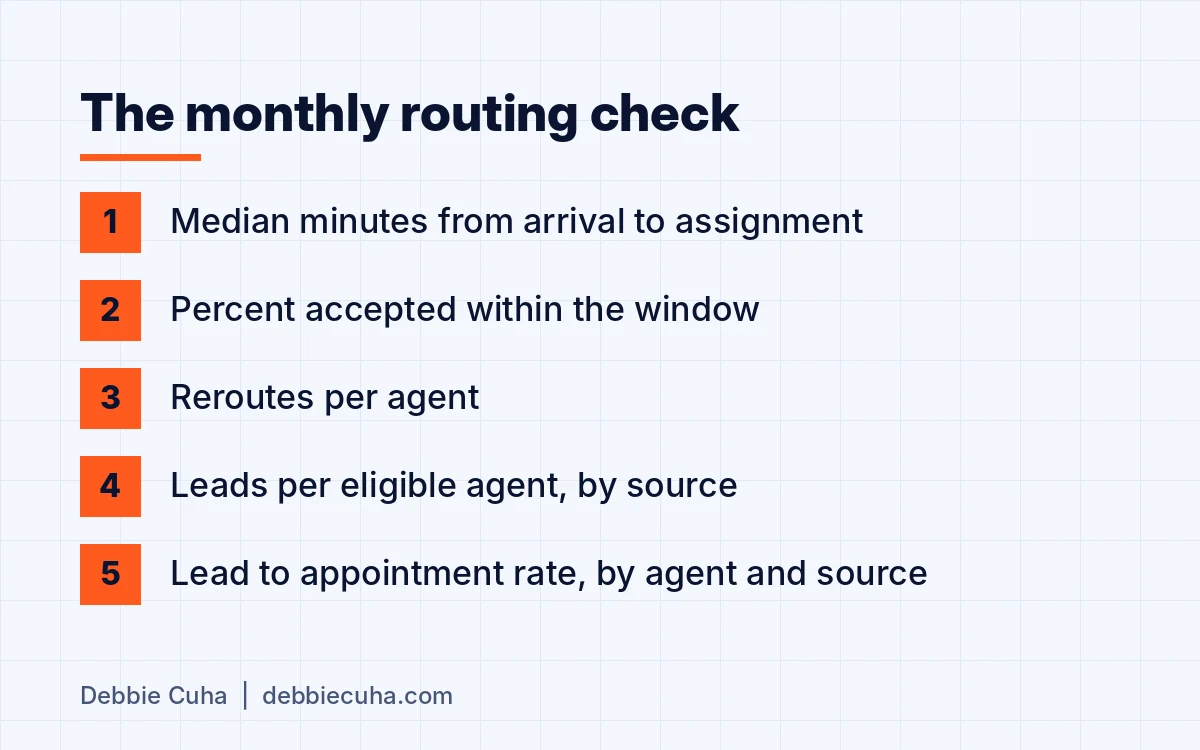
Review five numbers once a month and show them to the whole team.
- Median minutes from lead arrival to assignment
- Percent of leads accepted within the window
- Reroutes per agent
- Leads received per eligible agent, by source
- Lead to appointment rate per agent, by source
The first two measure speed. The last three measure fairness. Speed also belongs in the weekly numbers meeting. A team that cannot see the routing numbers will assume the routing is unfair.
When should you change the rule?
At the monthly review, in writing, with a version date. Never in the middle of the month. Changing who gets leads on the spot, because of one bad call or one good week, teaches the team that the rule is a mood.
A routing change follows the same version control as any other procedure. That process is in the quarterly SOP audit.
What does the one-page routing rule look like?
Nine lines and a broker review. Copy this and fill in the blanks.
LEAD ROUTING RULE, [team name]
Version date: [date]   Owner: [name]   Next review: [date]

1. Sources covered: [portal, website, sign calls, social, other]
2. Eligible this week if: certified on the first-call script,
   every assigned lead has a next task, first-call standard met
   last week, scorecard turned in, marked available
3. Method: round robin among eligible agents
   Routed differently: [seller leads to ___] [area ___ to ___]
4. Acceptance window: ___ minutes in business hours ([hours])
   After hours: ___
5. Not accepted: next eligible agent, then first to claim,
   then [owner] calls. Counted as a reroute.
6. Never in rotation: own sphere and past clients, named
   referrals, agent of record (active within ___ days), own
   listing inquiries, own open house visitors
7. Hand assignments: team leader only, logged with a reason
8. Daily: [owner] clears unassigned and unaccepted leads by [time]
9. Monthly: review the five numbers. Changes take effect on
   the first of the month.

Reviewed by broker: [name, date]
Put it next to your team standards, because eligibility is only as clear as the standards it points to. Where routing sits among the other procedures is in the SOPs every real estate team needs.
Next steps
- Get the free 12-SOP kit. Lead intake and routing is SOP 1.
- See how SOP consulting works if you want the routing rule and the rest built for your team.
- Or email me a question at dc@syngp.com. I read every one.