The Underperforming Agent: A 30-Day Plan for Real Estate Team Leaders
By Debbie Cuha, November 27, 2026. 17 min read

When an agent on your team is underperforming, check your own system first, then put one number, four weekly check-ins and the day-30 decision on a single page that you both sign. Thirty days later the page decides: the agent is back on standard, gets one short extension, or leaves the team with a clean handoff.
Key takeaways
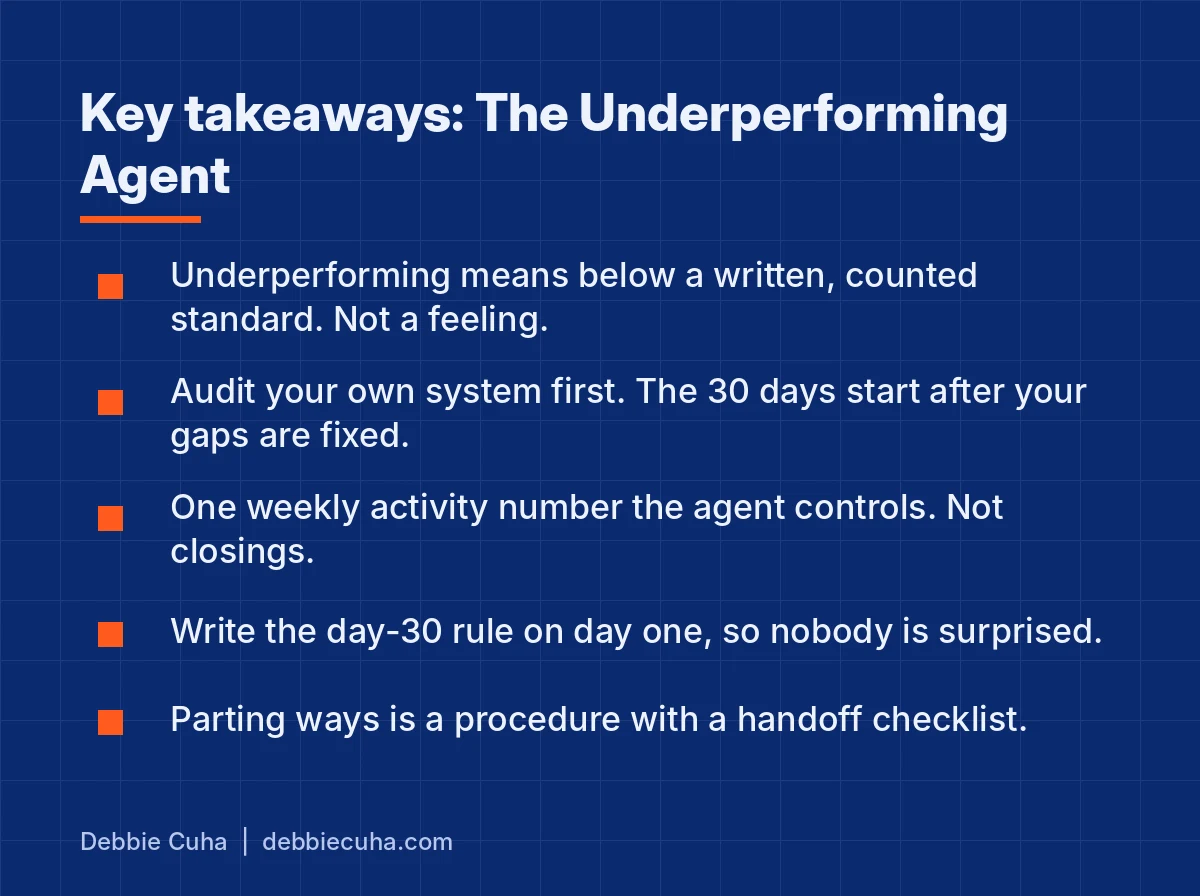
- An agent is underperforming only against a standard that was written down and counted. Without that, you have a feeling, and a feeling is not grounds for a plan.
- Audit your own system before you talk to the agent. Any gap you find is yours to fix, and the 30 days do not start until it is fixed.
- The plan holds one weekly activity number the agent controls. Closings are too slow to judge in 30 days.
- Write the day-30 decision rule on day one. Nobody should be surprised on day 30, least of all the agent.
- Parting ways is a procedure with a handoff checklist: leads, active clients, pending deals, logins and what the team is told.
At DirectLender.com, where I was co-founder and CFO, I wrote the policies and SOPs for 280 offices and about 3,000 people. This post is about operations: how to run the last step of an accountability system the same way every time. It is not legal or employment advice. Your broker reviews the plan, and your attorney answers anything about contracts and worker status.
What do you do with an underperforming agent?
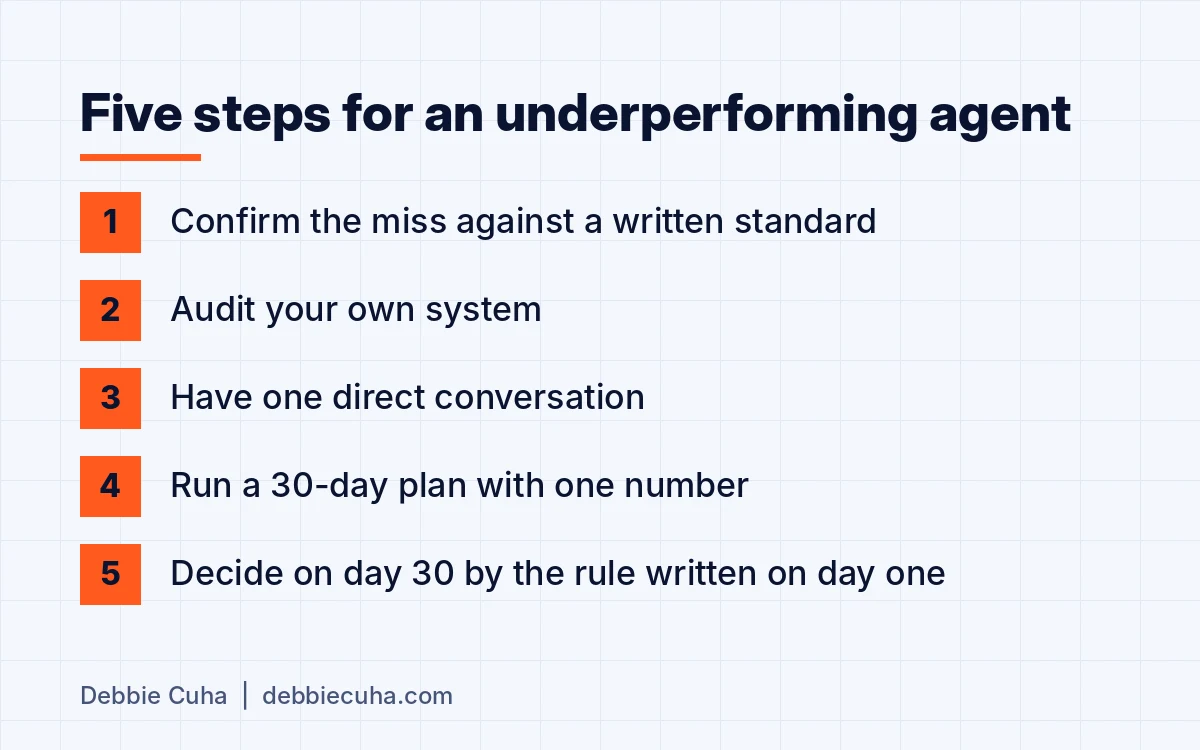
Five things, in order: confirm the miss against a written standard, audit your own system, have one direct conversation, run a 30-day plan with one number, and decide on day 30 by a rule you wrote on day one.
Most of the advice on this question falls into two camps. One says be patient, find the cause and keep helping. The other says cut the bottom of the roster and move on. Both leave the leader deciding by mood. A procedure takes the mood out. The agent knows exactly where they stand, and so do you.
How do you know an agent is underperforming?
An agent is underperforming when a number they agreed to has been below the written standard for three weeks in a row. Not when you are frustrated, not when another agent complains, and not when a quarter felt slow.
That takes two things to exist already: team standards on one page, and a weekly count on an agent scorecard. If you have neither, you do not have an underperforming agent yet. You have a team with no standard, and the fix starts with you.
It also means the 30-day plan is never the first step. One missed week is a question in the 20-minute one-on-one. Two is a smaller commitment and a midweek check. Three in a row is where this plan begins.
Is it the agent or the system?
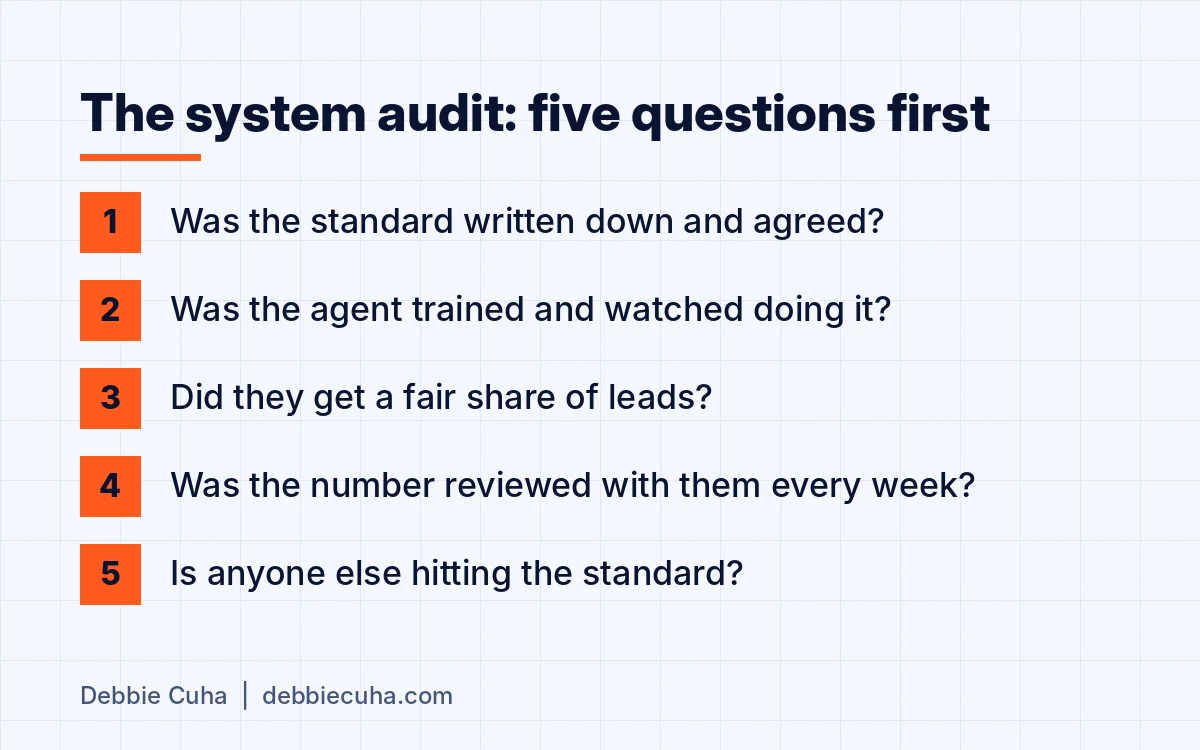
Assume it is the system until you have checked. Answer five questions before you say a word to the agent. Each "no" is a gap you own, and you fix it before any plan starts.
| Question | Where to look | If the answer is no |
|---|---|---|
| Was the standard written down, and did the agent agree to it? | The standards page and the signed agreement | Write it, review it together, and start counting from today |
| Was the agent trained on the task, and did someone watch them do it? | The onboarding checklist | Train it, watch it once, sign it off |
| Did the agent get their fair share of opportunity? | The lead routing log | Fix the routing, then give it a full cycle |
| Has the number been reviewed with them every week? | Your one-on-one notes | Hold four weekly one-on-ones before you judge anything |
| Is anyone else on the team hitting this standard under the same conditions? | The team scorecards | If nobody is, the standard or the system is wrong, not the agent |
Dustin Pritchard made a similar point in an Inman opinion piece, when to get rid of a struggling team member (October 10, 2019): he looks at expectations, accountability and access to training first, and puts performance last. I agree with the order. I would add that it has to be a written check with a place to look for each answer, because a leader who is already annoyed will answer all five from memory, and memory takes the leader's side.
What do you say in the first conversation?
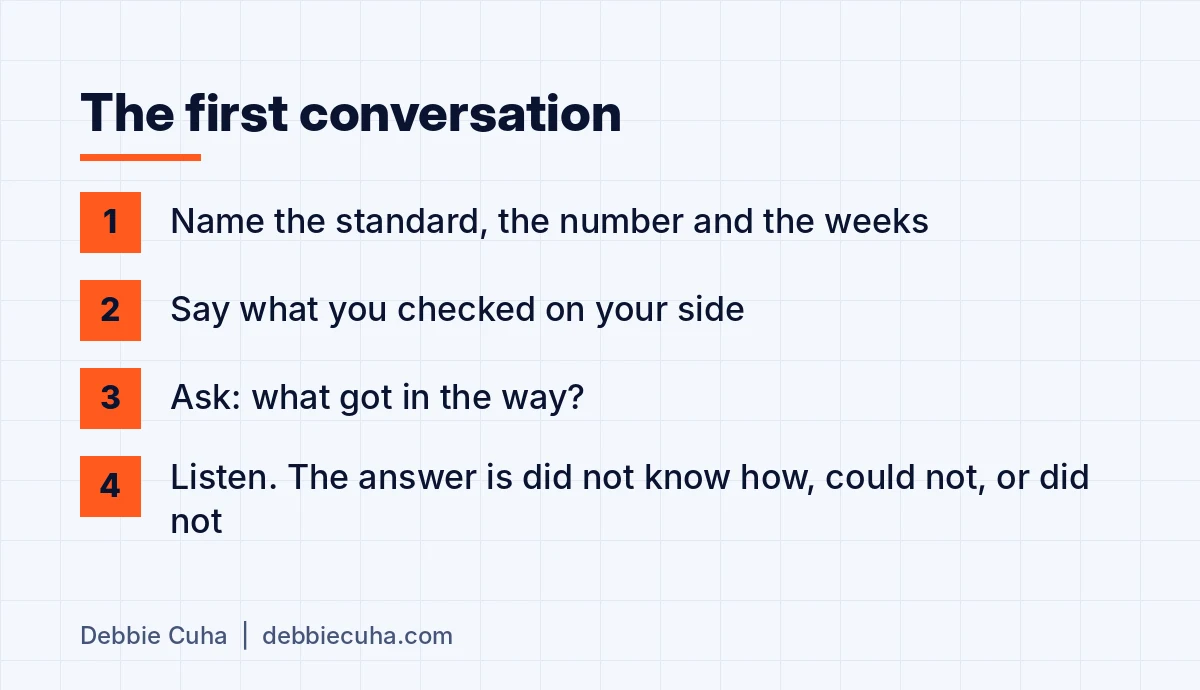
Say the standard, the number and the weeks, then ask one question: what got in the way? Keep it private, keep it short, and have the scorecard on the table so the conversation is about a page and not about a person.
A script you can adapt:
"Our standard is ___ a week. Your last three weeks were ___, ___
and ___. Before we talk about what happens next, I checked my
side: your training, your leads and our weekly meetings. Here is
what I found: ______. Now I want to hear your side. What got in
the way?"
Then stop talking. What you hear sorts into three answers. They did not know how, which is training and is on you. They could not, which is a circumstance you may be able to plan around. Or they did not, which is what the 30-day plan is for.
What goes in a 30-day plan?
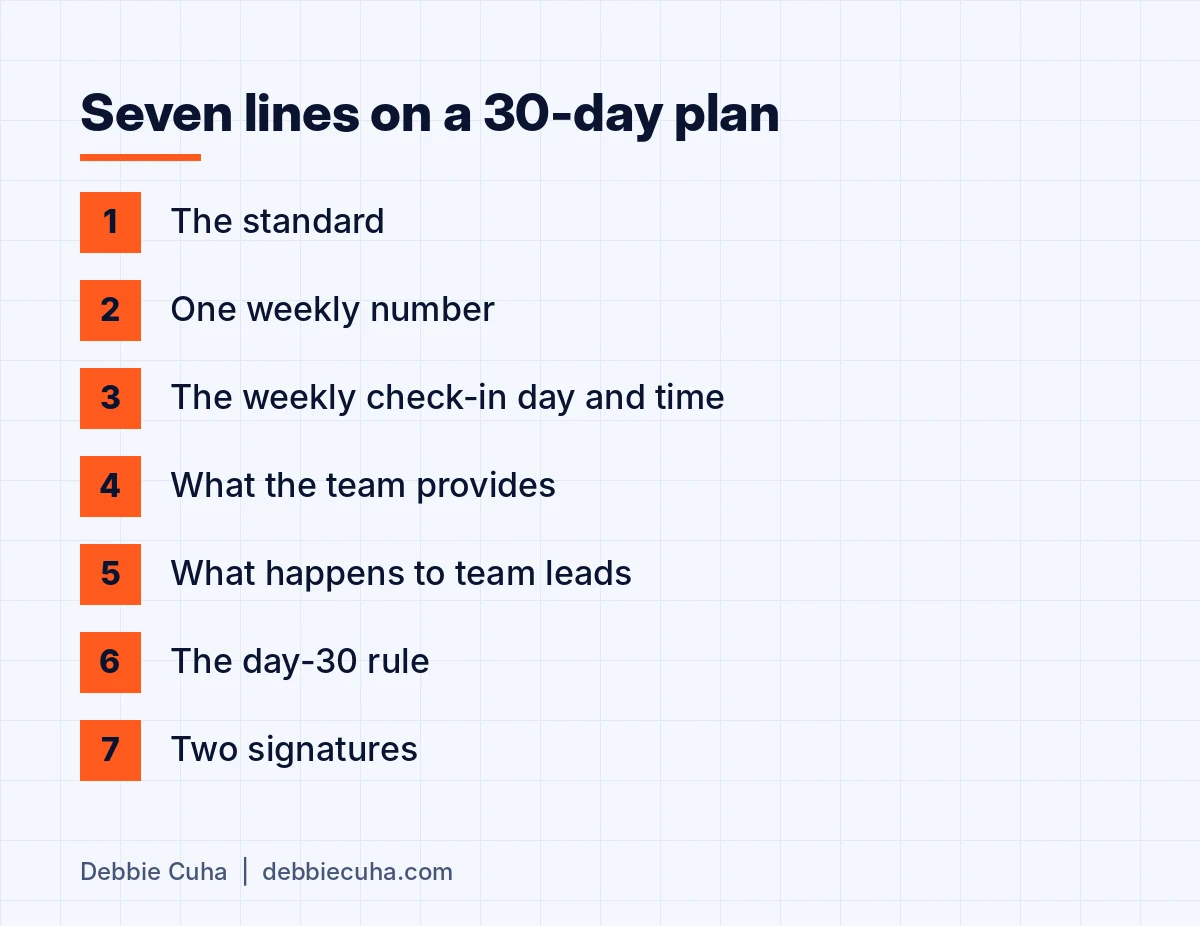
Seven lines on one page: the standard, the one number, the weekly check-in, what the team will provide, what happens to team leads during the plan, the day-30 rule, and two signatures.
That is all. The usual improvement plan lists six goals, three trainings and a paragraph about attitude. Nobody can tell on day 30 whether it was met, so the leader decides by feel, which is where you started. One number can be counted by both of you on a Friday afternoon without an argument.
The National Association of REALTORS described the same basic shape years ago. Its article how to fire an agent (November 7, 2016, now marked as archived content) offers a last-chance 30-day plan with measurable goals and weekly follow-up meetings. What that article does not print is the page itself, with the decision rule on it. That page is at the end of this post.
Should the plan measure activity or closings?
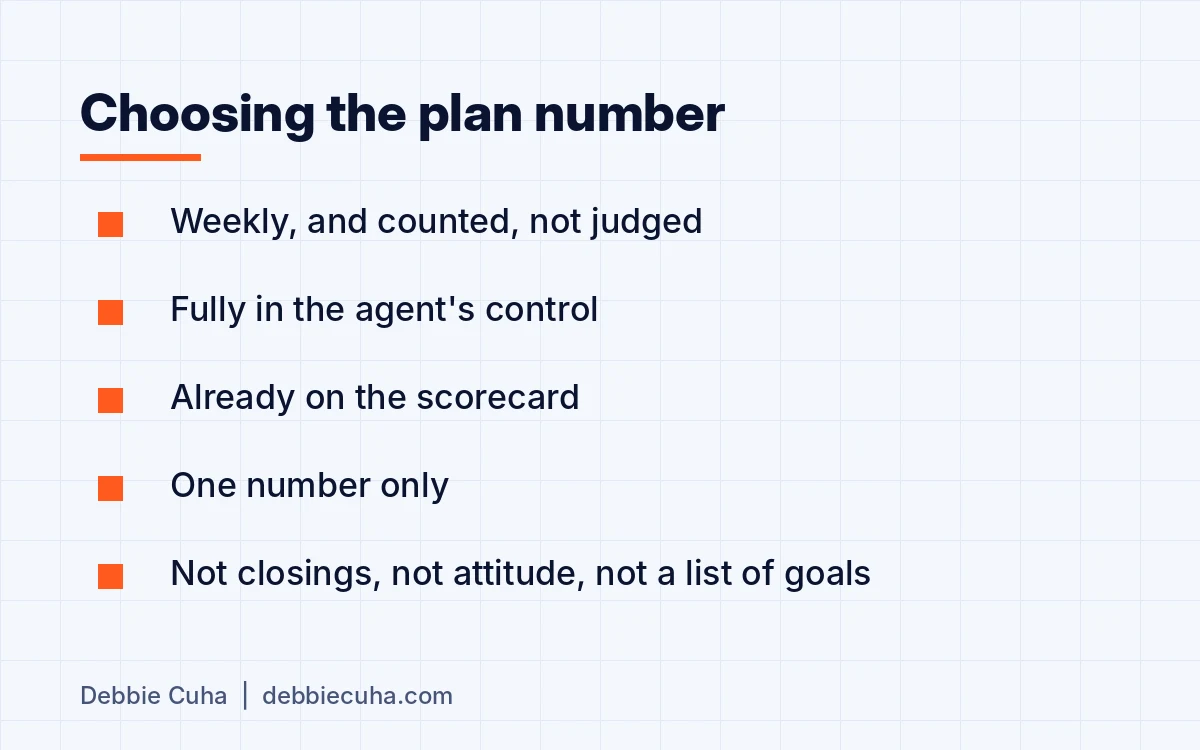
Activity. Pick one weekly number the agent fully controls, such as conversations started or appointments set. A closing depends on a buyer, a seller, a lender and a calendar, and most of that will not finish inside 30 days.
If you put closings on the plan, a good agent with bad timing fails it and a lucky one passes. Neither tells you what you need to know, which is whether this person will do the work when it is clearly asked for. Results still matter. They are judged over a quarter on the scorecard, not over four weeks on a plan.
Use the number that is already on the agent's scorecard. Do not invent a new one for the plan. A new number means a new standard, and they have had no chance to meet it yet.
Why 30 days and not 90?
Because four weekly counts are enough to see whether the work is happening, and 90 days of uncertainty is hard on the agent and on everyone watching. A plan with no end date is not kinder. It is a slow exit that nobody has named.
When team leaders talk about this in public, the mistake they name is waiting. In a Tom Ferry Team Spotlight interview, a proven 100-day plan to onboard new agents (September 10, 2020), team leader Jenny Turner told Debbie Holloway that her biggest onboarding mistake was giving people too many chances and keeping them too long when it was not working. She also said that at 100 days, an agent who is not showing up and in action probably means the team reconsiders the partnership.
Thirty days is my default for an agent who is past onboarding. A new agent still inside their first 90 days is on the onboarding plan, not on this one.
What do you owe the agent during the 30 days?
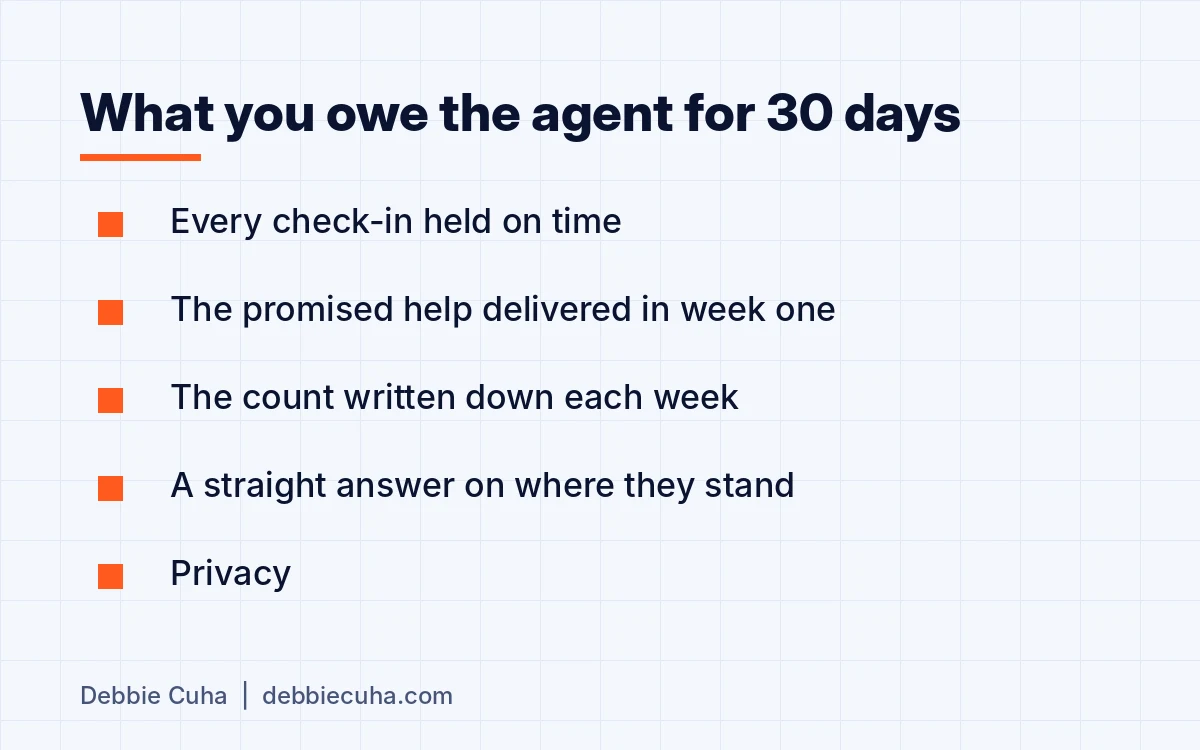
You owe them the same four weeks you are asking for: every check-in held on time, the help you promised delivered in week one, and the truth about the count each Friday. If you cancel a check-in, add a week to the plan.
| You provide | When |
|---|---|
| A 20-minute check-in, same day and time every week | Weeks 1 to 4 |
| The specific help named on the plan (a script session, a ride-along, a shadow day) | Week 1, not week 3 |
| The count, written on the plan in front of them | Every check-in |
| A straight answer on where they stand against the day-30 rule | Every check-in |
| No discussion of the plan with other agents | Always |
If team-provided leads were paused before the plan began, the plan says when they resume. My rule matches the one in my accountability system: two weeks back on standard and they come back, with no speech.
What happens on day 30?
You count the weeks on standard and read the rule you both signed. There is no new judgment to make on day 30. The judgment was made on day one, when you were both calm.
| Weeks on standard, out of four | What happens | What you write |
|---|---|---|
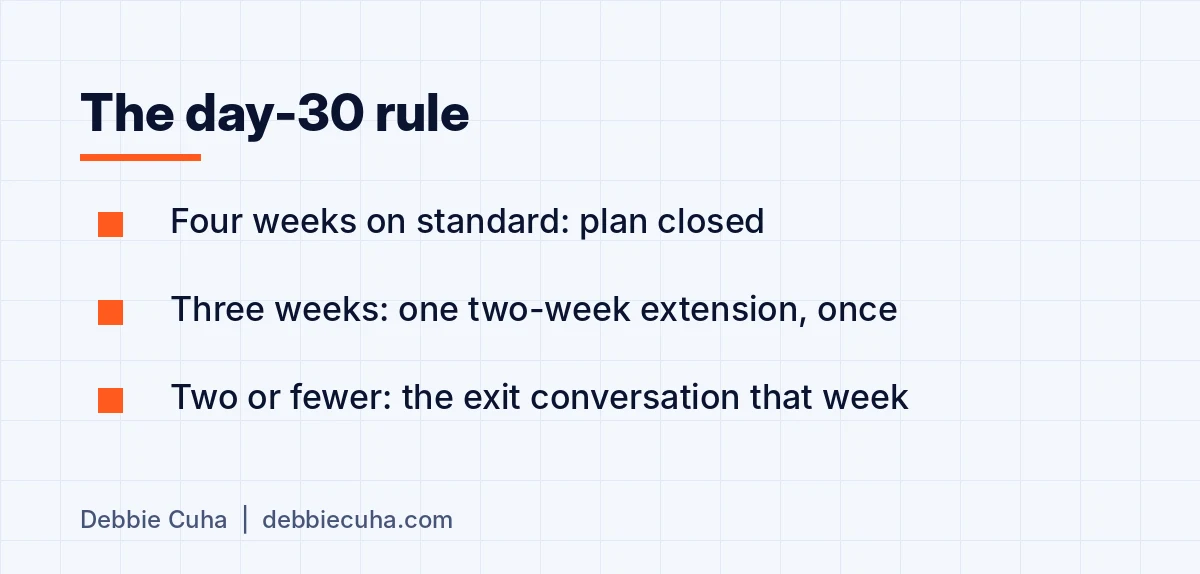
| Four | The plan is closed. Back to the normal weekly one-on-one. | "Plan met" and the date, on the plan |
| Three | One two-week extension, once. Both weeks on standard closes the plan. | The extension end date |
| Two or fewer | The exit conversation, that week | The date and the handoff checklist |
Set your own thresholds if these do not fit your team. What matters is that they are numbers, they are on the page before week one, and they are the same for every agent, including your top producer and your friend.
One more line belongs on the plan: an agent who closes the plan and falls below standard for three weeks again inside six months does not get a second plan. Otherwise the plan becomes a cycle, and the team learns that the standard only applies one month at a time.
Should you move the agent to a different role?
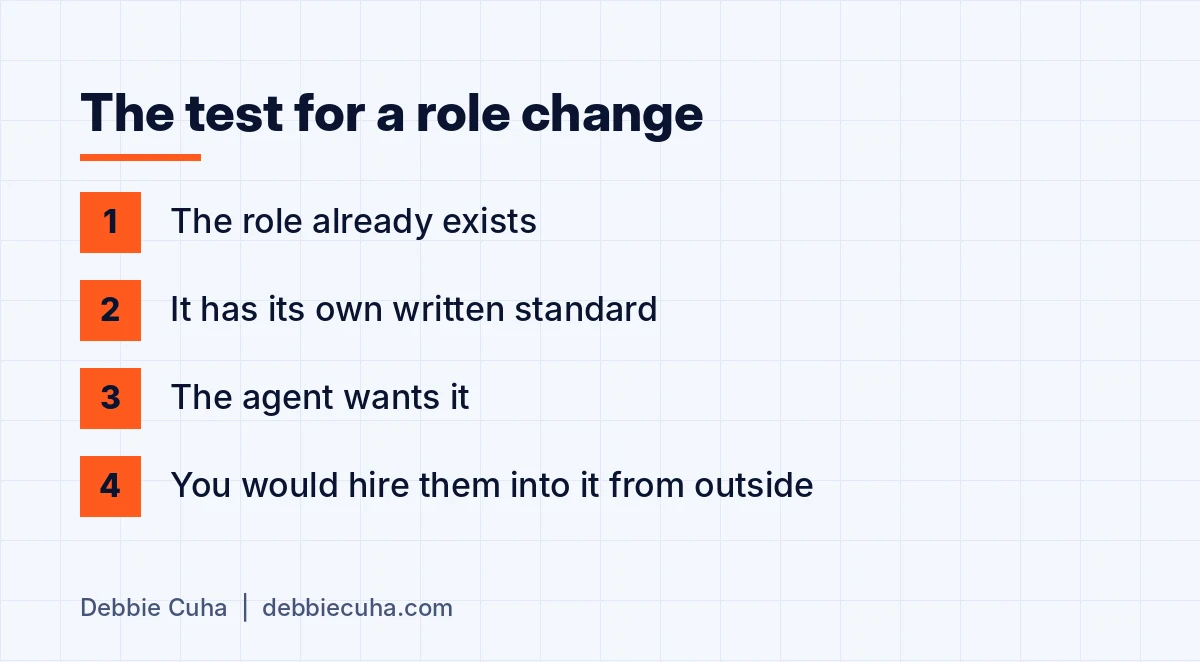
Only if the role already exists, has its own written standard, and the agent wants it. A role invented to avoid a hard conversation is a second underperformance problem with a new title.
A role change is a common suggestion, and sometimes it is right. An agent who is careful and reliable but does not prospect may be a strong fit for a showing or transaction support seat that is open. Test it honestly: would you hire this person into that seat if they applied from outside? If yes, offer it with its standard attached. If no, do not offer it.
What if something is going on at home?
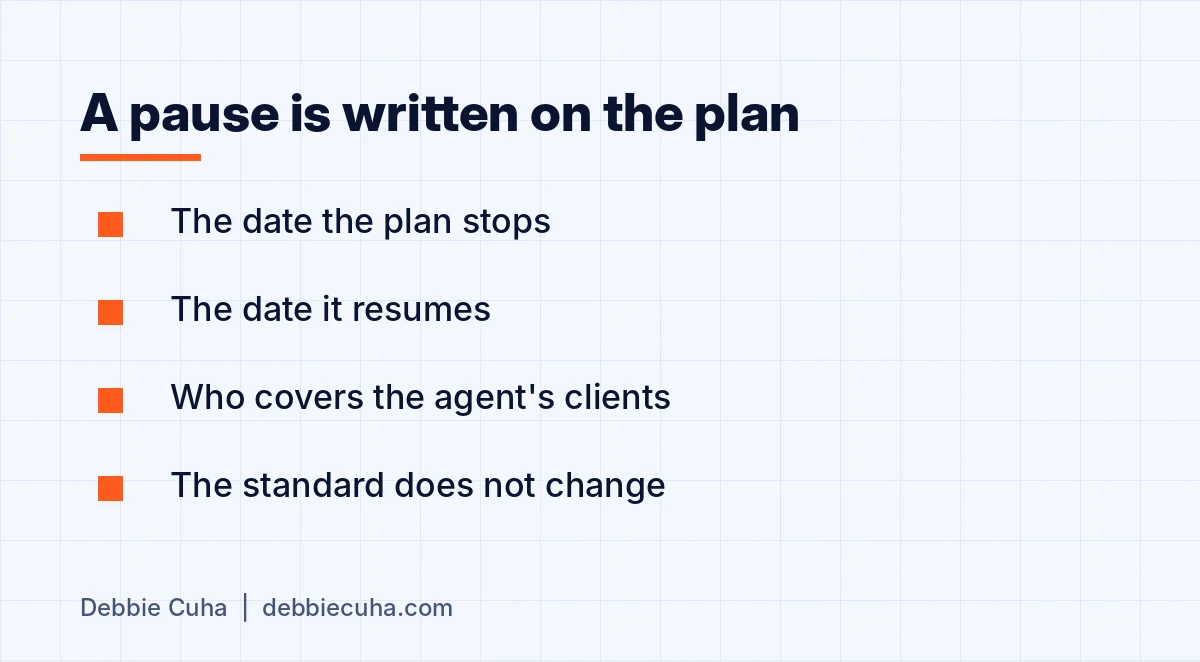
Pause the plan with a restart date. Do not lower the standard quietly, and do not pretend the plan is still running. A pause is written on the page: the date it stops, the date it resumes, and who covers the agent's clients in between.
A real crisis is the "could not" answer from the first conversation. People have deaths, illnesses and divorces, and a team that cannot absorb four weeks of one has no margin at all. What the pause protects is the standard. Everyone else on the team can see that the rule did not bend. It waited.
What skips the plan entirely?
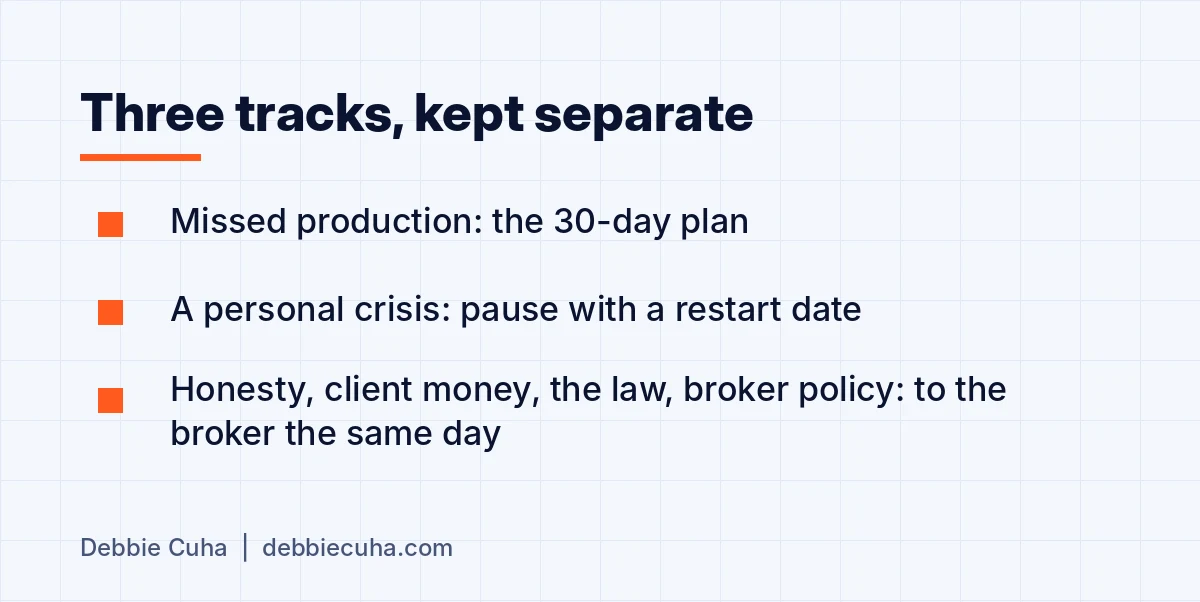
Anything that touches honesty, client money, the law or your broker's policies. Those go to your broker the same day. A 30-day plan is for missed production. It is not for misconduct, and it is not yours to offer in those cases.
Keep the tracks separate in your own head and on paper. Missing a call standard is a performance problem. Misleading a client is not, and treating it as one puts you and your broker at risk.
Can you put an independent contractor on a plan?
You can agree on a result and tie it to things the team provides. What you may require beyond that is a question for your broker and your attorney. Have both read the plan template before you use it once.
Agents on a real estate team are usually independent contractors, not employees. The Internal Revenue Service page on licensed real estate agents (last reviewed November 19, 2026) says they are statutory nonemployees, treated as self-employed for federal tax purposes, when substantially all their pay is tied to sales or other output and not to hours worked, and they work under a written contract saying they will not be treated as employees for federal tax purposes. That is the federal tax side only. State rules and your broker's supervision duties are separate, and I am not the person to interpret them.
As an operator, here is how I keep the plan on the right side of that line. It names an outcome the agent agreed to. It ties that outcome to access to what the team provides, such as team leads and a place on the roster. It does not set hours, a desk schedule or a method. If you have salaried staff, such as an assistant or a transaction coordinator, their plans fall under employment law, and that conversation starts with your attorney.
How do you part ways?
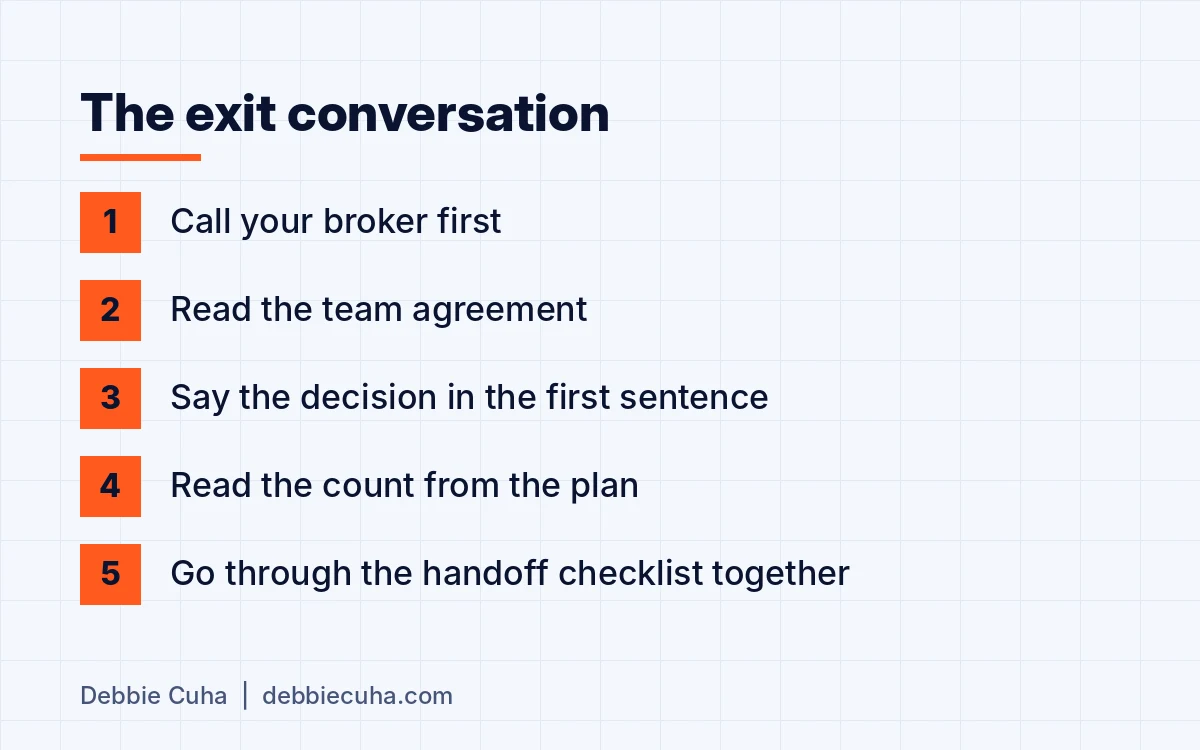
Call your broker first, read the team agreement second, and then have a short private conversation that surprises no one. Say the decision in the first sentence. Then go through the handoff checklist together.
The conversation is short because the plan already did the work:
"We agreed on ___ a week for four weeks. The count was ___, ___,
___ and ___. The plan says that means we part ways, and that is
what is happening. I want to go through the handoff with you now
so your clients are looked after and you are paid what the
agreement says you are owed."
Do not reopen the standard and do not list old frustrations. Thank them for specific work. If you can honestly point them toward a team or a model that fits them better, do it. An agent who was wrong for your structure can be right for someone else's.
What happens to their leads, clients and pending deals?
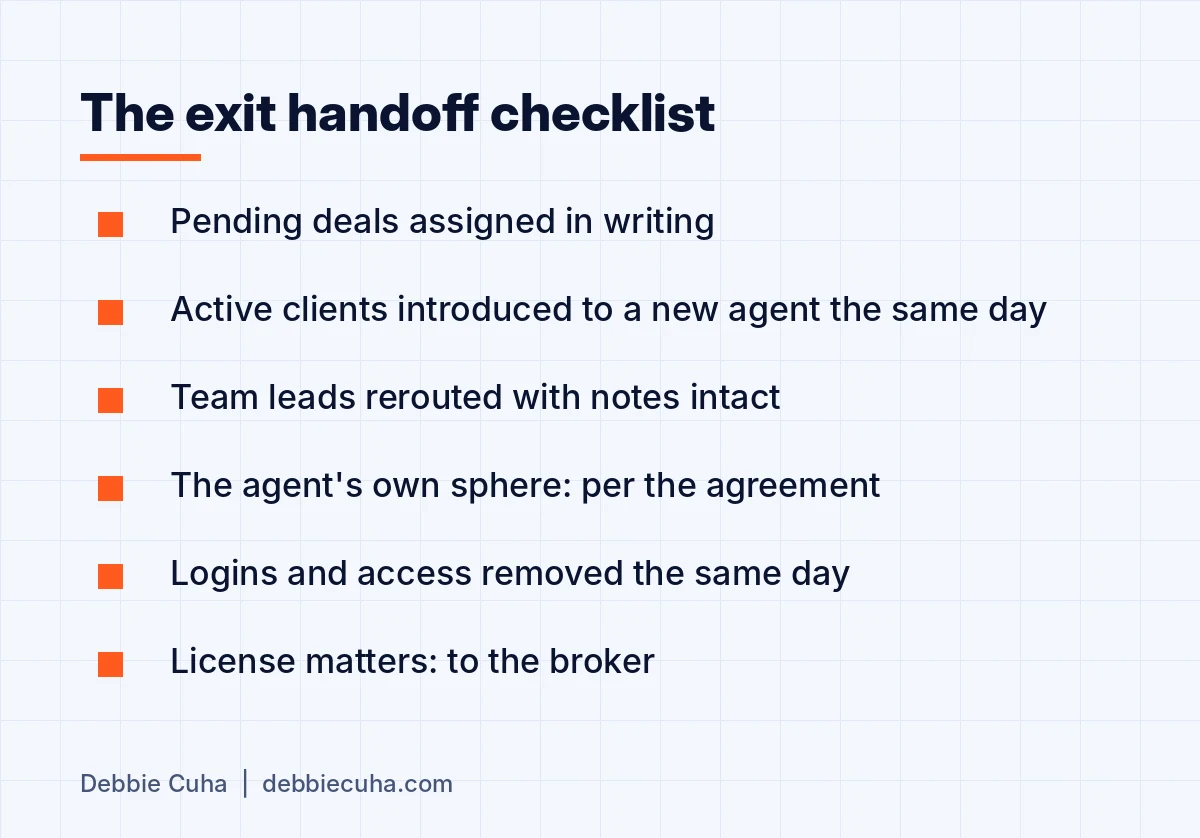
Your written team agreement and your broker decide who is owed what. Your job is to run the handoff so that no client feels the change. Use a checklist, on the day, with the agent in the room if possible.
| Item | Who decides | What you do |
|---|---|---|
| Pending deals | Team agreement and broker | Name who finishes each file and how the commission is handled, in writing, before the agent leaves the room |
| Active clients under agreement | Broker | Introduce the new agent by phone the same day. The client hears it from you first |
| Team-provided leads | Team agreement | Reassign through the normal routing rule, with the notes intact |
| The agent's own sphere | Team agreement | Follow the agreement exactly. If it is silent, ask your broker, and then fix the agreement |
| Logins, signs, lockbox access, team email | You, with broker policy | Remove or collect the same day, using a list |
| License transfer and listings in their name | Broker | Hand it to the broker. Do not improvise |
If your agreement is silent on most of these, you have found the next document to write. It is far easier to agree on who keeps what when everyone is still happy.
What do you tell the rest of the team?
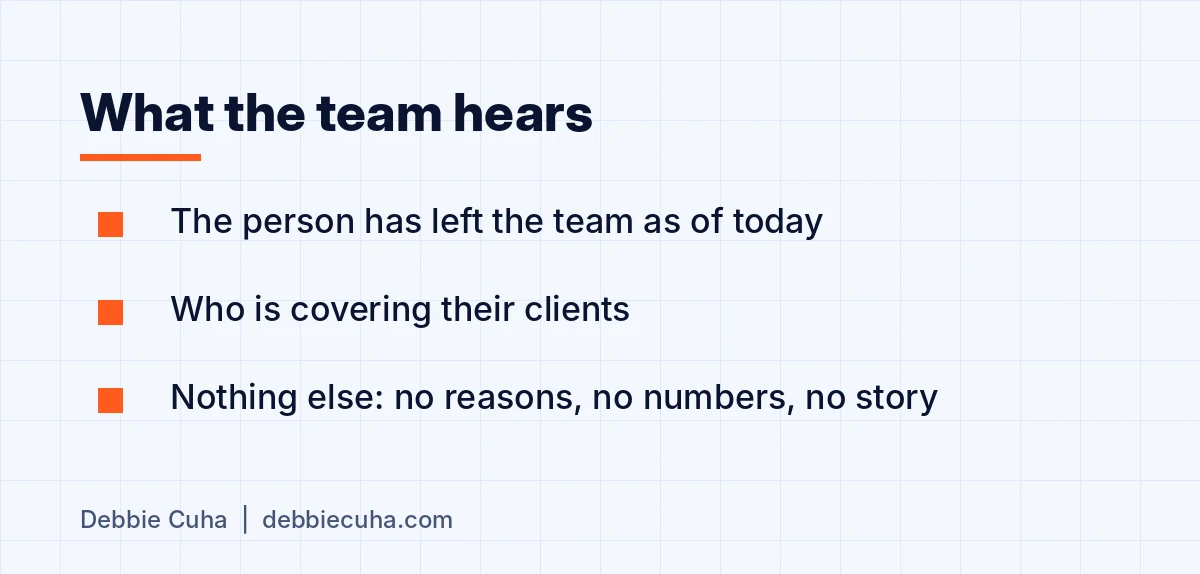
Two sentences, the same day, from you: the person has left the team, and here is who is covering their clients. No reasons, no numbers and no story. Then go back to the agenda.
"___ is no longer on the team as of today. ___ is taking over
their active clients, and I have spoken with each of them. If a
client or another agent asks you, that is the whole answer."
The team does not need the details, and they already know more than you think. What they are watching for is whether the standard on the wall is real and whether you handled a person with respect. A quiet, clean exit answers both. That is what I mean when I say structure creates culture.
How do you keep from getting here again?
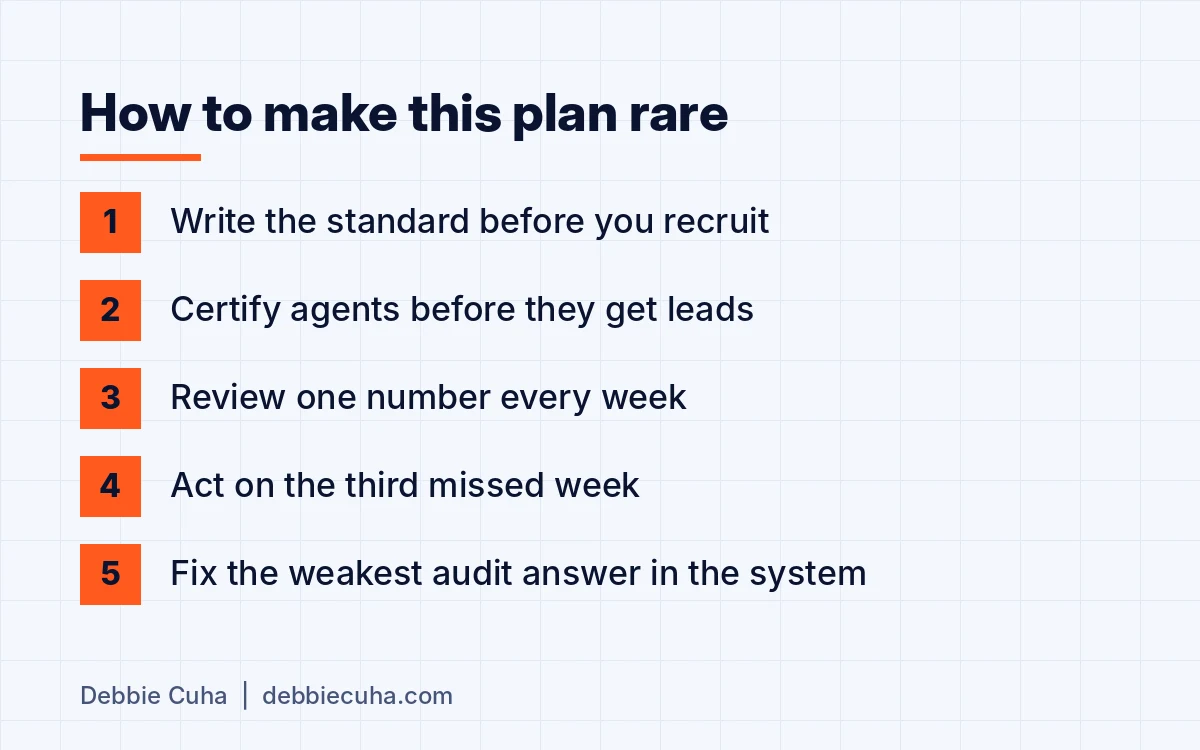
Make it rare by doing the early steps well: write the standard before you recruit, certify agents before they get leads, and review one number every week. A 30-day plan that surprises the agent means something upstream was skipped.
Each plan you run should end with one question for yourself: which of the five audit questions was weakest this time? Fix that one in the system, not only for this agent. Add it to your quarterly SOP audit. If the same audit question fails on every plan, your problem is hiring or onboarding, and no number of 30-day plans will solve it.
What does the one-page 30-day plan look like?
It fits on one page, it has more blanks than sentences, and both people sign it on day one. Copy this, have your broker review it, and change the thresholds to fit your team.
30-DAY PLAN
Agent: ______________   Team leader: ______________
Start date: ________    Day 30: ________
Reviewed by broker on: ________

1. The standard (copied from the team standards page):
   ______________________________________________

2. The one number: ______ per week, counted every ______ by ______.
   Last three weeks: ____ / ____ / ____

3. System audit completed on ________. Gaps found and fixed:
   ______________________________________________

4. Weekly check-in: every ______ at ______, 20 minutes.
   A cancelled check-in adds one week to the plan.

5. The team provides (by the end of week 1):
   ______________________________________________

6. Team-provided leads during the plan: ______________
   They resume after two weeks in a row on standard.

7. The count:
   Week 1: ____  on standard? Y / N   initials ____ / ____
   Week 2: ____  on standard? Y / N   initials ____ / ____
   Week 3: ____  on standard? Y / N   initials ____ / ____
   Week 4: ____  on standard? Y / N   initials ____ / ____

8. The day-30 rule:
   4 weeks on standard: plan closed.
   3 weeks: one two-week extension, ending ________.
   2 or fewer: we part ways and run the handoff checklist.
   Below standard three weeks in a row within six months
   of closing this plan: no second plan.

9. Pause: if the plan is paused, stop date ________,
   restart date ________, clients covered by ________.

This plan covers production only. Conduct matters go to the
broker. Nothing here changes the agent's written agreement
with the team or the brokerage.

Agent: ______________  date ________
Team leader: ______________  date ________
Where this page sits among the other procedures a team needs is in the complete guide to real estate SOPs.
Next steps
- Get the free 12-SOP kit so the standards and the onboarding steps exist before you ever need this plan.
- See how SOP consulting works if you want your standards, scorecard and 30-day plan written for your team.
- Or email me a question at dc@syngp.com. I read every one.